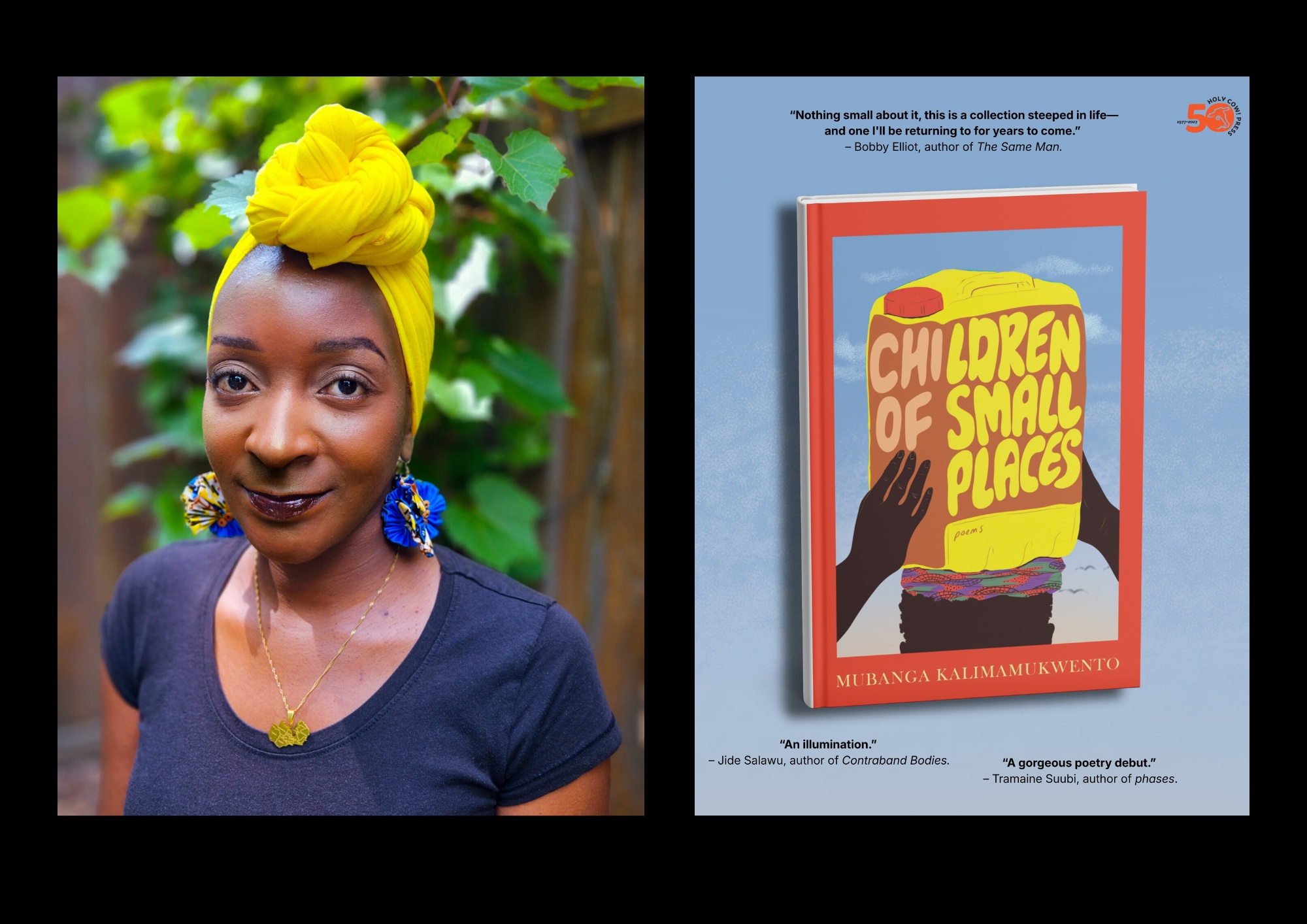
American independent publishing house Holy Cow! Press has acquired children of small places, a forthcoming poetry collection by Zambian writer Mubanga Kalimamukwento. The book was acquired by Holy Cow! Press’s founding editor, publisher, and award-winning editor Jim Perlman.
Set in Zambia and the United States, children of small places is as ambitious as it is relentlessly focused, moving from Zambia’s national awakening and disillusionment to personal reckonings with grief, domestic trauma, immigration, and the diasporic experience, where “we learn that the things that are ours are items of shame,” ultimately finding a tumultuous, yet resilient sense of sanctuary and belonging. Kalimamukwento journeys unapologetically between form and language, anchored in a style now identifiable across her oeuvre, children of small places grounds each poem in the linguistic landscape of Zambia to create an intimate yet accessible collection. Kalimamukwento employs a sharp, lyrical voice that weaves the political into the mundanity of the domestic, using enjambment and fluid shifts in time to mirror “this making & unspooling of self conjoined with heartbreak,” echoed by the haunting line, “the mouth is an intercessor, it can redeem you.”
Before securing the publishing deal, Kalimamukwento’s children of small places was named a finalist for both the Ottoline Book Prize and the Fence Modern Poets Series Book Prize. It is expected to appeal to readers of poets Yrsa Daley-Ward, Carmen Giménez Smith and Warsan Shire.
The collection also features advance praise from several award-winning writers, including:
“There is both passion and beauty in these robust poems situated in Zambia and attentive to its legacies of colonialism and cultural displacement. Mubanga Kalimamukwento writes about the difficult work of remembering. children of small places is an astounding reworking of the past, with branches calling on the present not to forget the beginning. With fresh narrative language and interior strength, voices are given to mothers, daughters, ancestors, rivers; perfectly deployed with wonder and complete astonishment to do the ethical uncovering of things. This is a gorgeous book.” – Chinua Ezenwa-Ohaeto, author of The Naming.
“In the beginning, our poet writes, we insist on an origin story. And so we readers begin in Zambia in 1964 and travel through a dense, beautifully written history of the country. We conclude this part of the collection in 2024, a traumatized birth of a nation working to free itself from colonization, to be free of those who used their prayer books to bury our gods, to discard the name they gave a country, aiming for clean redemption as the years went by. And then, in a way, our poet asks us to begin again, inside a family, inside deep familial trauma and abuse, inside love, and deep loss, takes us through generational trauma made vivid through fragments of language, and we feel the trauma of big history measured against this family, political torment, family torment. The poet keeps us caught as she was caught. She does escape, but learns that not all dreams are butterflies/some are a foot on the neck/a shaking waking/meaning your father’s voice finds wings inside the night. In the final pages of this dense and compelling collection, we read the truth-telling abecedarian, a brilliant use of a received form which takes us through the complicated alphabet narrative our author has lived, from A of alien/African through Z for Z Visa, Zambezi, Zambia where we began. Her American life begins, beloved children let go of their original language, and though homesickness swamps her, she stays, while her city in Zambia stands witness. Read this exceptional book. ” – Deborah Keenan, author of from tiger to prayer.
“An astonishing collection, and unabashedly enchanting. children of small places is a cascade where juvenescence wounds are unsettled and tended, a terrain where the daughter of the postcolony negotiates with the country with all deserved vituperations. Mubanga painfully reminds us of a country grappling with vicissitudes of identity and sovereignty. Even so, Mubanga’s work is a filial threshold, brewed with bildungsroman poetics of a daughter in rhythmic harmony with the father, yet without hesitation of a lash against patriarchal hegemony. At once, the virago also comes to terms with the reality of motherhood, mothering, and variables of maternal pedagogy. Mubanga is adept and meticulous, commanding metaphor at will in sublime language and an assured tone. This is an illumination.” – Jide Salawu, author of Contraband Bodies.
“Traveling from Lusaka to Minnesota and back again, children of small places is a reckoning and a reminiscence—a chronicling of “this making & unspooling of self / conjoined with heartbreak,” and a vertiginous song of the choices made for us and the choices we make for ourselves. Nothing small about it, it is a collection steeped in life—and one I’ll be returning to for years to come.” – Bobby Elliot, author of The Same Man.
“Grief is continually transformative for Mubanga Kalimamukwento. Through extended metaphor and other vessels, she explores the realities and fantasies of girlhood to womanhood, of colony to nation. Nouns find unlikely pairings and perpetually expand our empathies here. Verbs shapeshift and find exponential lives in the capable hands of this poet. She carefully attends to the details of broken promises and frail hopes in the belly of the youngest continent in the world. She implicates readers and listeners with her relentless use of the second person point-of-view. She guides us through the spectrum of owning and being owned. The chitenge of specificity is a major throughline in this gorgeous poetry debut. What a gift!” – Tramaine Suubi, author of phases.
“Kalimamukwento has written a much-needed book that requires us to revisit our history and its lessons. The poems are songs that move across different landscapes and human relationships, delivering difficult truths.” – Ajibola Tolase, author of 2,000 Blacks.
children of small places is scheduled for publication in September 2027, coinciding with the press’s 50th anniversary.
About The Poet
Mubanga Kalimamukwento is a multi-award-winning editor and writer. She is the author of The Mourning Bird (Jacana), unmarked graves (Tusculum University Press), Obligations to the Wounded (University of Pittsburgh Press), and The Shipikisha Club (Dzanc Books). Her other work appears or is forthcoming in The Hopkins Review, adda, Aster(ix), Nimrod International, Contemporary Verse 2, Kweli, Overland, The Ex-Puritan, Menelique, on Netflix, and elsewhere. Her editorial work can be found in Shenandoah, the Water~Stone Review, Doek! Literary Magazine and Safundi. She is the founding editor of Ubwali Literary Magazine.
Her work has been awarded the Minnesota Book Award, the Dzanc Books Prize for Fiction, and the Dinaane Debut Fiction Award. Mubanga was the first African winner of the Drue Heinz Literature Prize. She has also received support from the Hubert H. Humphrey (Fulbright) Fellowship, Young African Leadership Initiative, the Center for Race, Indigeneity, Disability, Gender & Sexuality Studies, the Africa Institute, the Hawkinson Scholarship for Peace and Justice, the Miles Morland Scholarship for African writers, and the Mercatus Center at George Mason University.
Congratulations, Mubanga Kalimamukwento!