![You are currently viewing [Featured Post] Leaving Lagos: A Rongo Residency Travelogue](https://jaylit.com/wp-content/uploads/2026/09/PHOTO-2026-09-23-14-35-05.jpg)
For what seemed like the umpteenth time in the seven years since I started leaving Lagos, I left Lagos again. It was a cool Friday in late August 2026, and this time I was headed to Benin, where five other writers and I would spend the following week at a residency organized by the Rongo Art Foundation.
Lest I get ahead of myself, this is meant to be a travelogue; my first, because I have never thought much of journeys beyond how much I dislike them. Packing, especially, feels like writing an abstract; how do I compress my clothes and shoes, books and gadgets (my life, essentially) into one small bag? Trips excite me, perhaps, but they also provoke me, in the most literal sense.
The journey began at 4 a.m., when I woke for no reason other than to be awake. For someone who claims to hate travelling, I am always restless on the eve of a trip. I was ready so early that the main estate gate was still locked, and Ugo and I had to trek to the other one, wheeling my noisy bag behind us. Somewhere along the way, a buka was just opening. Cats darted around it, and I paused to ruffle an orange one before we continued to Berger.
On the bus there, the conductor spotted a BRT bus and said, “Na the bus wey kill Monsuru be that.” Apparently, Monsuru, their colleague, had been helping an old woman cross the expressway when the BRT bus struck him. The driver and conductor mourned him briefly, honoured him with a silence, then started sharing crude jokes about him. Just before we alighted, the driver said, “Na why I no dey help people be that.”
Valid, I thought. But invalid all the same.
At Efex Park, I learned that I had missed the first bus and would have to take the second. Fair enough, except that the “second” bus arrived four hours later. We finally left Lagos at about 10 a.m. If only I had slept longer.

Before we departed, a man approached the bus and asked us to close our eyes in prayer. He was the second preacher to approach us that morning. The first had prayed at length for safety, an accident-free journey, and our arrival in one piece, stretching the same prayer across many different words. Afterward, he asked us to help him “recharge his battery,” the battery being the voice in his body. Ugo gave him a thousand-naira note.
So, when the second man appeared, I sighed. The driver slammed the door while he was still hanging onto it, catching the edge of his shirt. Once freed, he moved to the passenger window and continued preaching until the passenger wound up the glass and we pulled away.
We did not get far. At Mowe, we stopped to have the brake pads worked on. But about an hour later, we were back on the road; properly this time.
Somewhere between Mowe and Sagamu, a voice began competing with my earbuds. It belonged to a woman in an ankara palazzo, speaking in a heavy Benin accent about everything. She started with a wealthy family she had worked for, and the day their twelve-year-old daughter picked out a $100 purse at Zahra Stores.
“You know how much $100 is in naira? My two months’ salary isn’t even up to that!”
Gun to my head, I thought, and you still would not catch me telling strangers this.
Between stories about work and degeneracy, Madam Palazzo sprinkled in evidence that she had, in fact, made it in life.
“Me that has several Birkin bags in my wardrobe? You know how much they cost?”
Then came the climax: “When I travelled to Germany, there was a welcome party at the airport. They were singing and dancing for me.”
From the depths of half-sleep, I wondered how many of her stories were truths, lies or half-truths, and whether anyone else was doing the arithmetic, because I actually was.
At Ore, I bought a large doughnut and a bottle of Maltina, a combination I later blamed for my motion sickness. Sleep eluded me, partly because of the nausea and partly because another passenger was making his way from a Ghanaian prison to Port Harcourt. He had served time for fraud and, since returning to Nigeria, had been taking menial jobs in Lagos to fund his journey back home.
“So what will you do when you get to Benin now?” Madam Palazzo asked.
“I’ll wait there again for some days, maybe do some work, because I don’t have any money on me right now.”
The bus immediately divided into two factions. One pitied him and applauded his willingness to rebuild his life; the other (specifically, a man in his late 50s or early 60s, who sat in front of me and frequently had to turn his head and shout over mine) berated him for chasing money so recklessly that he had brought misery upon himself and his father. Everybody wanted to drop their two cents and measure shoulders with the next person. It was the first time people’s voices had managed to drown out my earbuds, even at full volume.
Eventually, the motion sickness took pity on me, and I slept. When I woke up, we had arrived in Benin, and it was about five in the evening.
At the residency, I climbed a frankly astonishing number of stairs before reaching the vast studio where we would live and work. I met Testimony, one of the programme managers, Francis, and my roommate, Sarah.
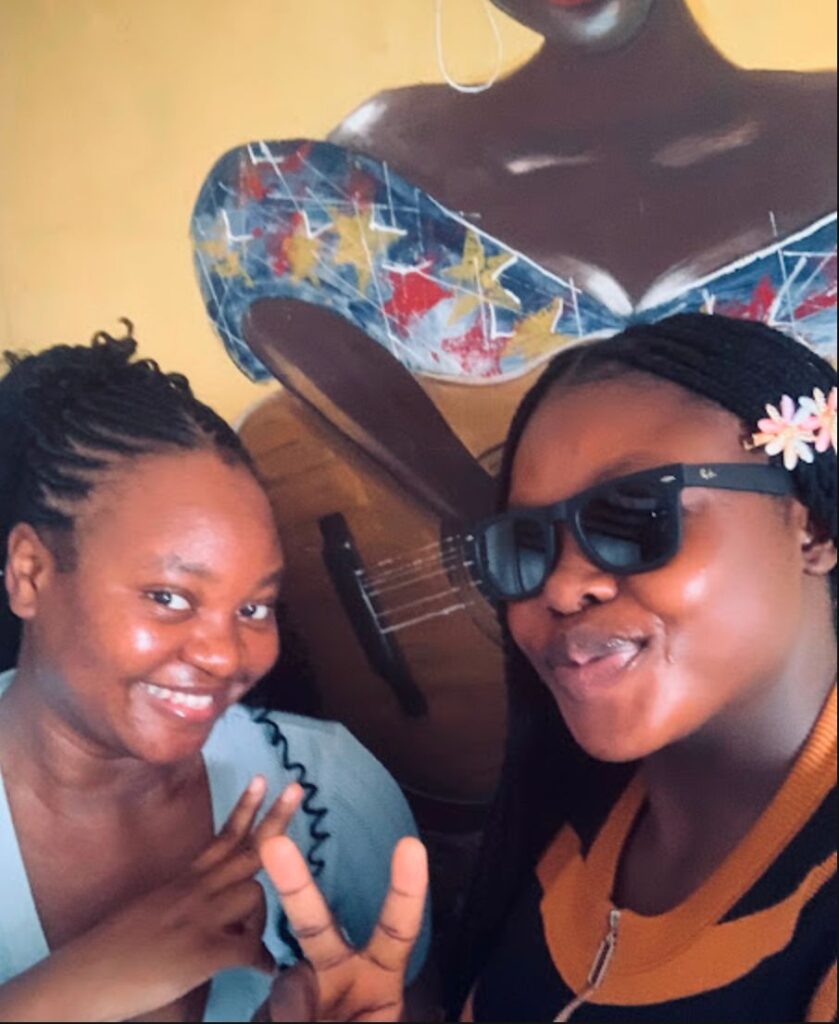
By seven p.m., we gathered with Isaiah and Sunmi in the common room. Testimony had us play a game of story-building: one person starts, the next adds a sentence, and so on. It was chaotic, but funny enough to break the ice.
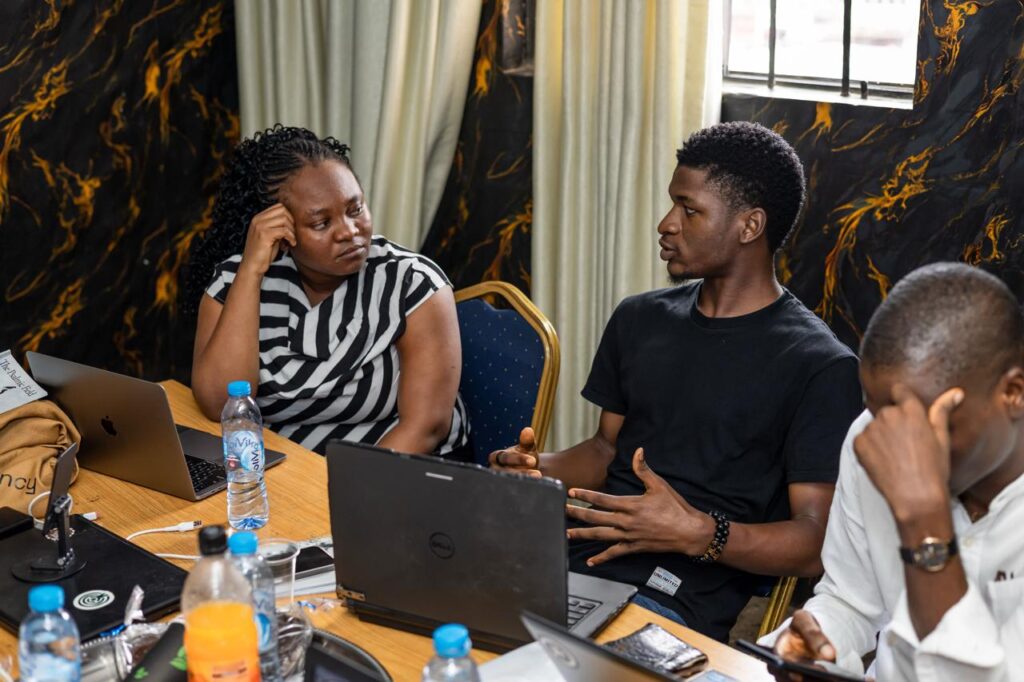
The next morning, we sat around a large table in the gallery with Ntui, who had arrived earlier that day. Everyone bent over their projects. I tried to work but could not; I was unused to writing in the presence of other people.
Then someone began a conversation, and the room came alive. There I was, among these brilliant minds, listening to vastly different opinions on writing, reading, religion, sexuality, gender roles, racism, history, artificial intelligence and technology. The conversation wandered, doubled back, and left my mind buzzing.
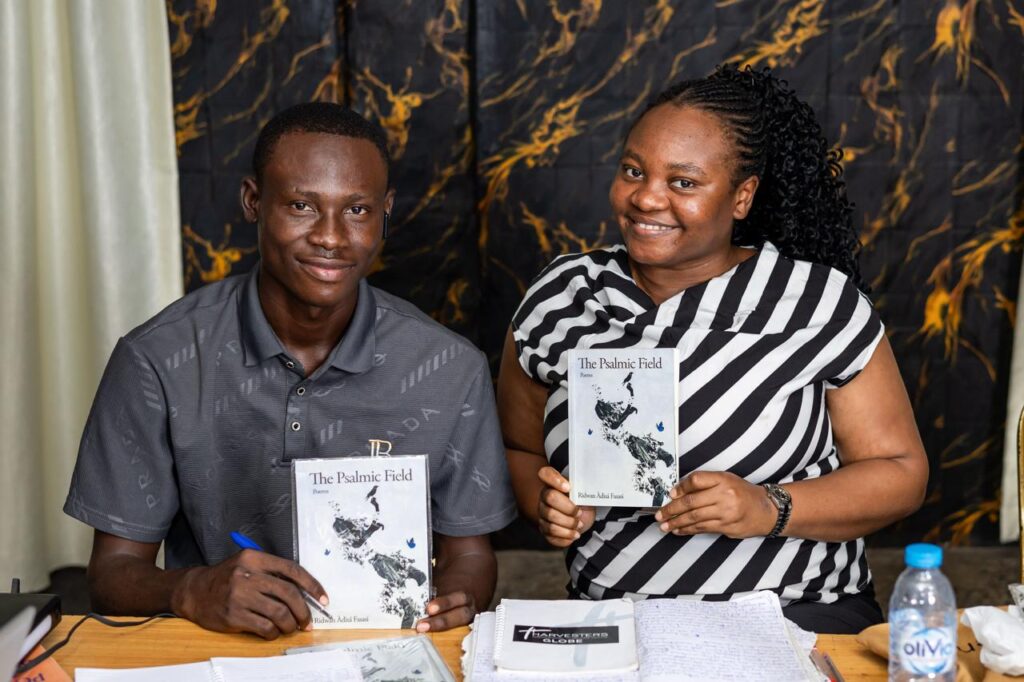
Ridwan arrived on Tuesday after the most stressful journey of us all, all the way from Sokoto. I told him repeatedly that I looked forward to reading his travelogue because I know he has plenty to say. He also brought his chapbook, The Psalmic Field, along and signed copies for us.
Our days soon fell into a rhythm: writing, workshopping, discussing, watching films, and playing games. In one game, we wrote anonymous notes, shuffled them, and guessed who had written what. It amused me how quickly we had learned (but not learned) one another’s peculiar ways of thinking and writing.
And we ate. Toast bread, jollof rice, jollof spaghetti, spaghetti with stew, rice with stew and dodo, boiled/fried yam with stew, yamarita, eba with egusi, eba with vegetable soup and, I think, fufu. My favourite was yam with garden egg sauce. Lunch was chocolate cake, orange juice, tea or coffee, and one milky snack (bread? biscuit? cookie?). It felt relieving to not have to worry about cooking for a week.
At midnight, sometimes closer to dawn, I would return to my project. Before the residency, I had not even settled on what to write (thank you, writer’s block), but now I was overflowing with ideas, as though my brain had only been waiting for Rongo.
On Wednesday, Testimony, Ruona and JK took us on a tour. MOWAA was closed to tourists because of the elections and the tension surrounding them, so we went to the National Museum instead. We moved through fragments of Benin’s artistic history: commemorative heads of obas and queen mothers, ceremonial swords, bronze and brass depictions of court life, symbolic mudfish and crocodiles, and photographs by Chief S. O. Alonge, who documented the Benin royal court for decades.
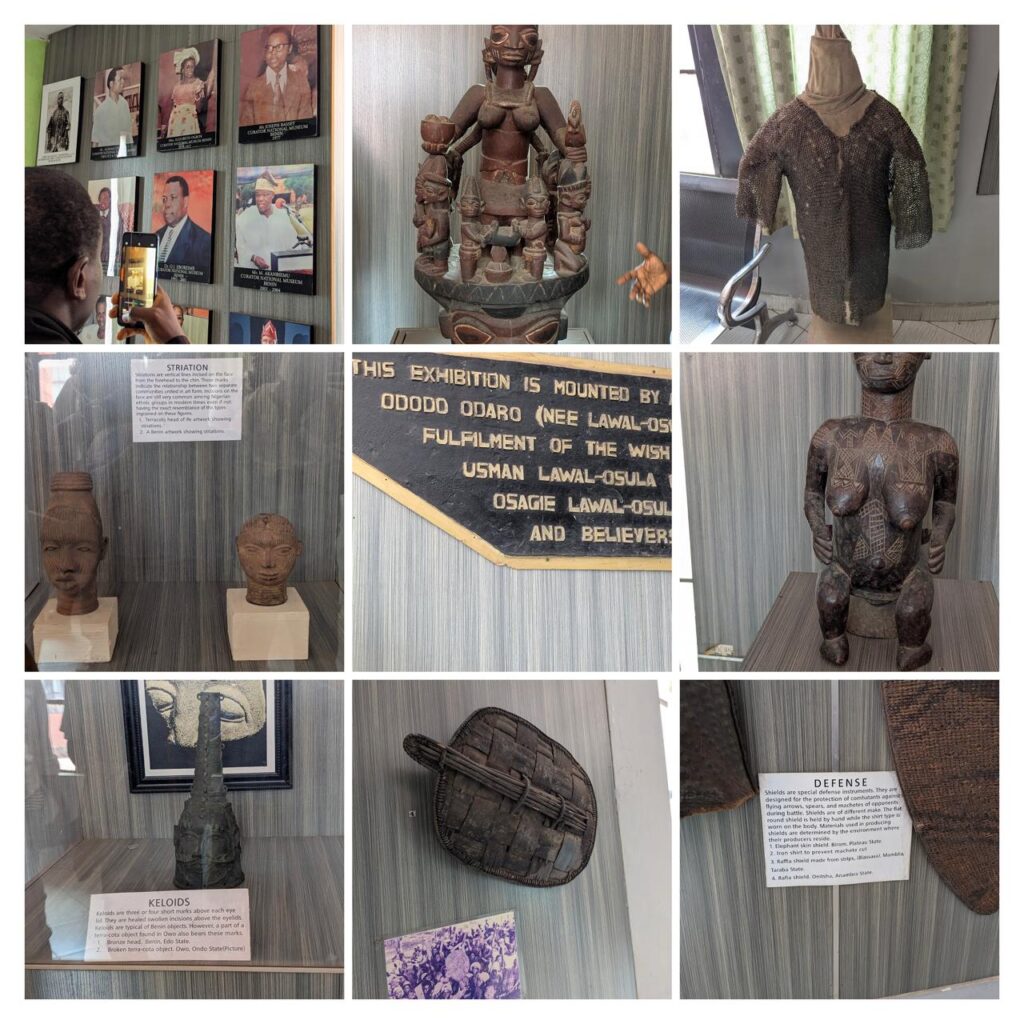
Some older gentlemen touring with us had personal connections to these histories. Listening to them made the objects feel less like distant artefacts behind glass.
At the Institute for Benin Studies, Mabel Oviahon and her team spoke to us about Benin history and their preservation work, including Digital Benin, which reconnects thousands of stolen Benin objects scattered across institutions around the world. I was astonished by their brilliance and passion. You could tell this was not simply work to them, but devotion.
Although evening had begun to settle and exhaustion had caught up with us, we stopped at a surviving section of the Benin Iya, the ancient system of ditches and earthen ramparts that once marked boundaries and defended the kingdom. The sides were too steep for me to see properly.
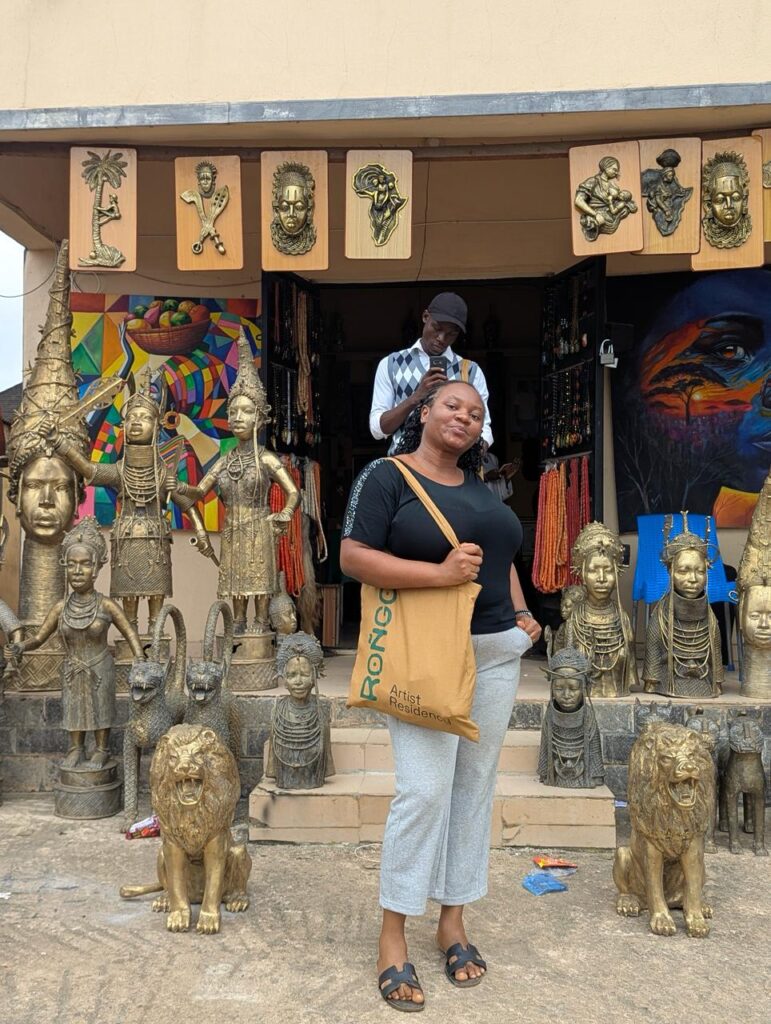
Our final stop was Igun Street, the historic home of the guild of bronze and brass casters. We admired the sculptures in its shops and did some ambitious window-shopping. A few people bought souvenirs.
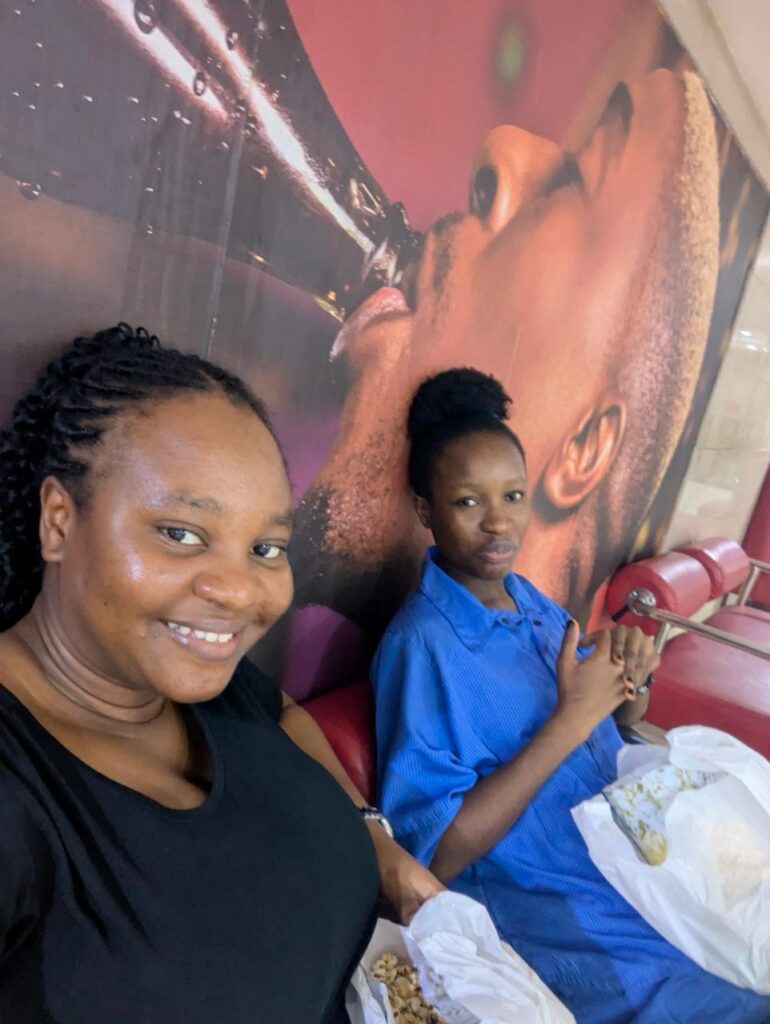
Thursday was free, so I met Uyi, a pen pal I had known for seven years but had never met in person. At Kada Cinemas, over popcorn, we talked about life, university, writing, and what we wanted for ourselves. She is a writer too, a fine one at that. It felt wonderful to sit across from someone who had existed for years as words and pictures on a screen and find that conversation came just as easily in person.
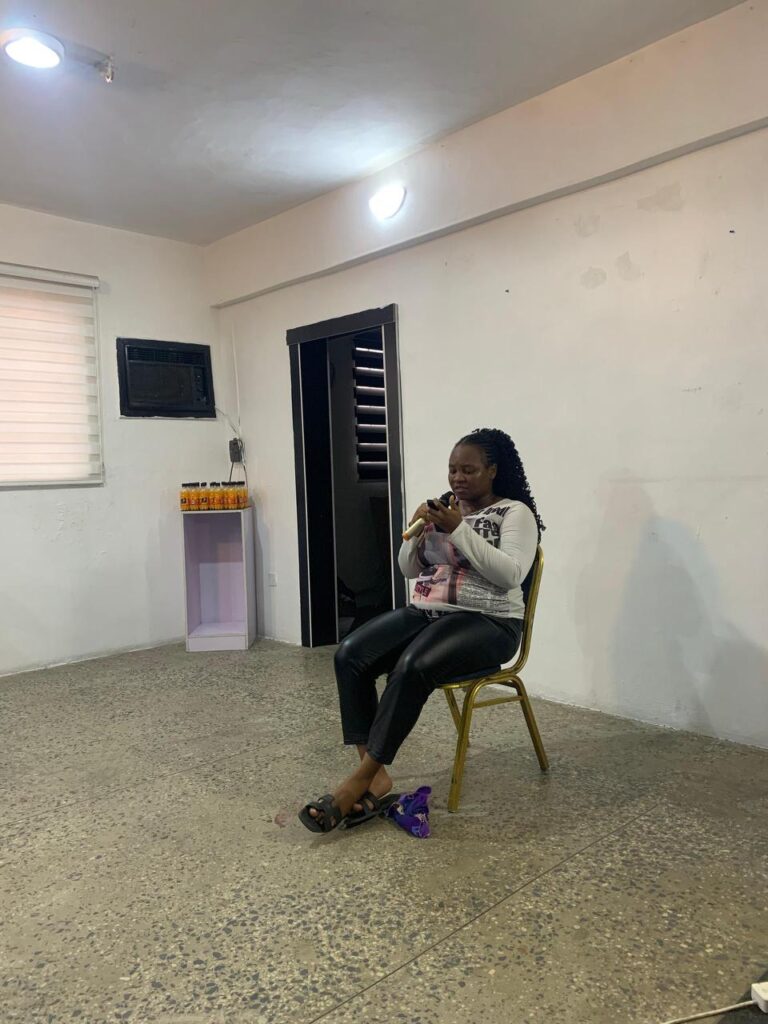
On Friday, the Coral Literary Circle joined us for readings from our works in progress, a short film, games, and conversations. One discussion spiralled into a very aggressive debate about AI and the death of creativity.
That night, I had to pack. I disliked it even more than usual because I had somehow grown attached to everyone and the space PeterFleming Art Gallery provided, and folding my clothes into my bag felt like admitting that our little world was finally ending.
Before we left, I read a send-off piece titled “A Light Roast and Toast,” my attempt to tease everyone affectionately and fit what they had come to mean to me into a few paragraphs.
On Saturday morning, we said our goodbyes, and Sunmi and I boarded a Libra Motors bus to Lagos. Unlike the journey to Benin, the return to Lagos was quiet and motion-sickness-free. No unsolicited sermons or people turning the bus into a podcast. But our driver, dressed dramatically in a checked senator outfit, took wrong turns, got us stuck in potholes, and, to the irritation of some other passengers, drove too slowly.
Still, we reached Lagos at about two p.m., the earliest I had ever arrived by road.
During one of our few conversations, Sunmi echoed my thoughts about leaving Lagos. We spoke about our desire to leave while so many others were desperate to enter it, and about a certain permanence to leaving; the kind that means beginning again in a smaller, calmer city, where trees line clean roads, and no stranger grabs at your clothes and luggage the moment your bus drops you off at Berger.
Perhaps I was not simply travelling out of Lagos, but rehearsing how to leave it for good.

Blessing Obiahu
Blessing Obiahu is a Nigerian writer, content specialist, and lawyer. She was a writer-in-residence at the Rongo Artist Residency and a top-ten finalist in the Brittle Paper Flash Fiction Competition. Her work has appeared in the Nigerian Students’ Poetry Prize anthology, Kaassa, Loana Press, Akpata Magazine, Challenging the Writers, the Umuofia Books and Arts Festival Anthology, and the Anarchist Fictions Journal. She is the Editor-in-Chief of D’LitReview.