![You are currently viewing [Featured Post] KAPFEST Lifetime Achievement Award Goes to Another Family Head of Writers](https://jaylit.com/wp-content/uploads/2026/09/Prof-Malumfashi.png)
The Kano International Poetry Festival is set to honour Professor Ibrahim Malumfashi with a lifetime achievement award. He is arguably the most famous expert in Hausa literature. As the pioneer lead judge of the BBC Hausa Hikayata £10,000 prize for women’s short stories, his name is familiar to almost every radio listener. I was one of those listeners, from the comfort of our home in Gboko.
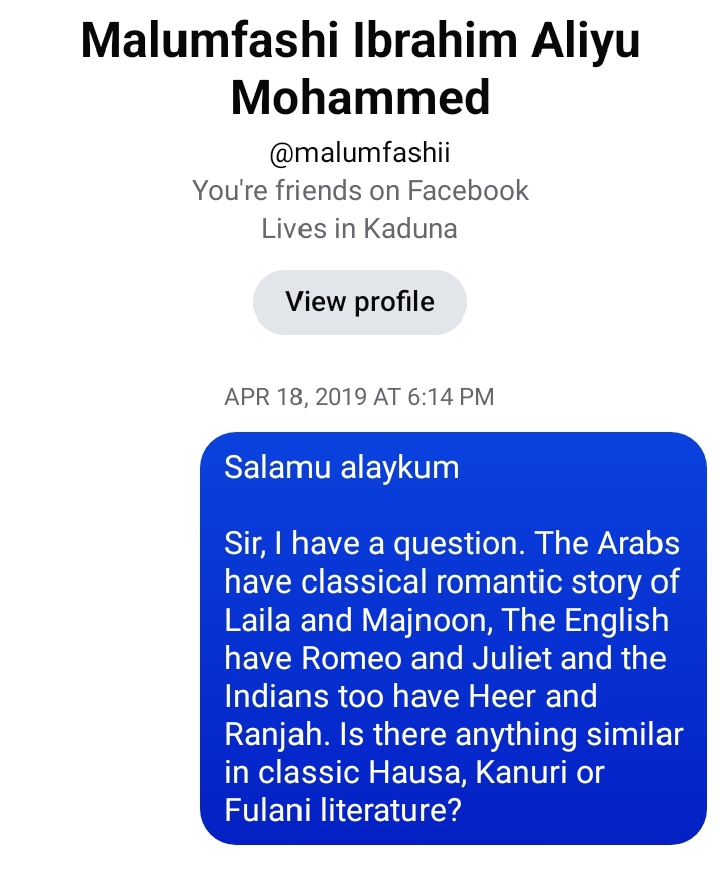
Around 2018, when I noticed he was active on Facebook, I sent him a friend request. Like most famous people overwhelmed with friend requests on the blue app, he did not accept it. The following year, I sent a question to his inbox, but it went unanswered. Let me share the question here verbatim:
“Salamu alaykum.
Sir, I have a question. The Arabs have classical romantic story of Laila and Majnoon, The English have Romeo and Juliet, and the Indians too have Heer and Ranjah. Is there anything similar in classic Hausa, Kanuri or Fulani literature?”
I soon gave up on my quest to connect virtually with this celebrity scholar, but I kept following his activities closely, especially the regular duet he had with Nasiba Babale. Despite his simplicity, I was star-struck when I first saw him in person in 2024 at the Kaduna Books and Arts Festival, where two of his children, Sada Malumfashi and Sumayya Ja’eh (his daughter-in-law’s sister), featured as guests. Both have gone on to have different global art fellowships, including literary studies in the United States.
The access I had long desired to this scholar finally came in 2025, when I joined the organizing team of the ill-fated Jos Arts and Culture Festival. But I hate to recall our first in-person encounter as acquaintances, which took place during the last edition of the Kano International Poetry Festival. When I arrived at Residence Sixteen on Magaji Rumfa Road, where the festival’s poetry clinic was held, I was there to cover the event as a reporter, but they were almost finished. Shortly afterward, they took a group photograph, and Prof. Malumfashi briefly left the room.
When he came back, he stood close to me, going through his phone. I was busy discussing something with a friend. When I stood up, Prof. immediately sat down. It was only then that it dawned on me that I had been sitting on his seat! Such an immodest child I was. I immediately wanted the earth to swallow me and hide me from my rashin kunya. I considered apologizing, but my shame far outweighed my courage. If Professor Malumfashi was offended, he never showed it in our subsequent interactions. A true Bakatsine, always known for kara—restraint.
Last year, BM Dzukogi received the award, founder of the Hilltop Creative Arts Foundation and biological father of the award-winning poet with global stage acclaim, Sadiq Dzukogi, whose siblings are also writers. This year’s too goes to another father of writers—most notably Sada Malumfashi and Habiba Malumfashi—as well as mentor and father-in-law to Salma Ja’eh and her sister Sumayya Ja’eh, the brains behind Open Arts, the game changers of art administration in Northern Nigeria. Professor Malumfashi embodies the idea that charity begins at home.
“Some people do not merely participate in a literary tradition; they help build, preserve, document and advance it,” writes Salim Yunusa, co-curator of the Kano International Poetry Festival, on Facebook. “For decades, Prof. Malumfashi has contributed immensely to the study, documentation, criticism and promotion of Nigerian literature, particularly the rich literary traditions of Northern Nigeria.” He continues, “Through his scholarship, teaching, criticism and unwavering commitment to literature, he has helped generations of writers, readers, researchers and literary practitioners better understand the depth and diversity of our literary heritage.”
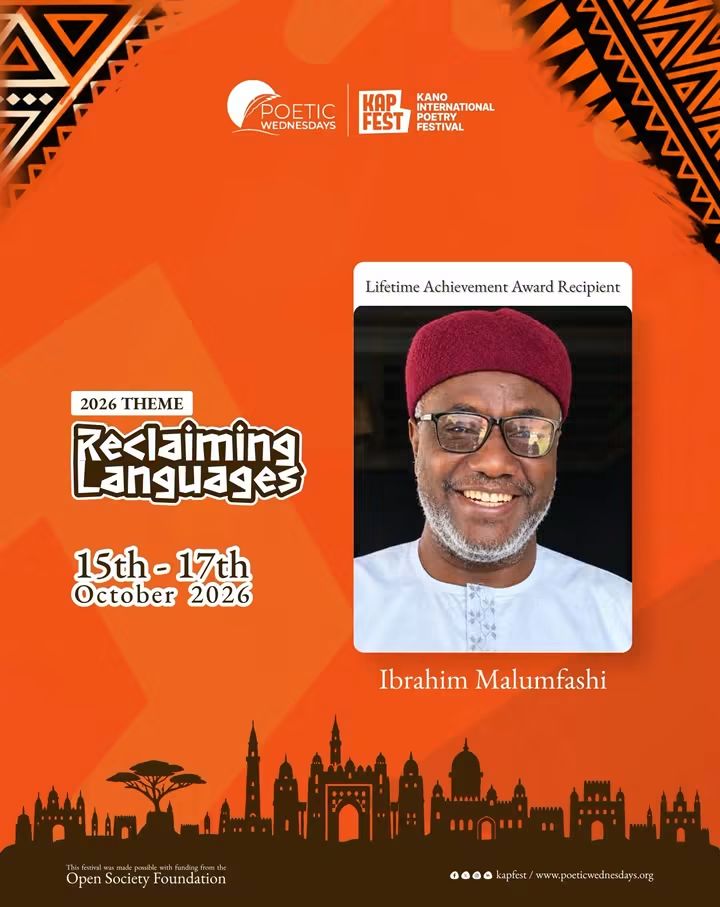
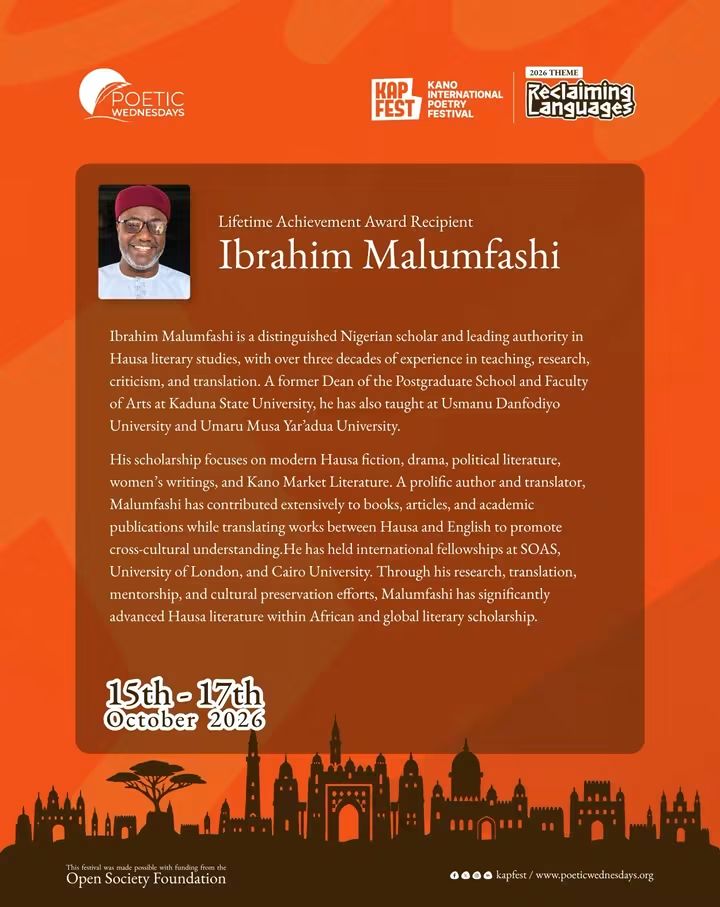
Explaining the festival’s decision to choose Professor Malumfashi as this year’s award recipient, the post adds: “At KAPFEST, whose 2026 edition explores languages, honouring Prof. Malumfashi carries particular significance. His work reminds us that languages are not merely vessels for words. They are archives of memory, identity, history and imagination.”
With a global footprint spanning fellowships at the Centre of African Studies at SOAS, University of London, where he remains a member, and Cairo University, Professor Malumfashi is also a cross-cultural translator. He has translated foundational global works into the Hausa language to enrich local reading cultures. His notable literary translations include Jarusalem, a Hausa translation of Gonçalo M. Tavares’s Jerusalem; Mista Wasler, also translated from Tavares’s Mister Walser; and Yarima Ɗan Sarki, a celebrated Hausa rendering of Antoine de Saint-Exupéry’s classic, The Little Prince.
After over three decades of practice, largely dedicated to advancing the visibility of northern Nigerian women’s voices and serving as a leading expert on Hausa women writers and their contributions to the African literary canon, Professor Malumfashi now receives his gong from the Kano International Poetry Festival, another platform built by his literary children.

Ahmad Mubarak Tanimu
Ahmad Mubarak Tanimu is a freelance book reviewer and fiction writer based in Kano. In June 2024 he was selected for the Flame Tree Project that aimed at bringing new voices in Northern Nigerian literature, facilitated by two past winners of the NLNG Nigeria Prize for Literature, Abubakar Adam Ibrahim and Chika Unigwe. He was a finalist in the book review contest of the festival books of the 26th edition of Lagos Books and Arts Festival (LABAF)