![You are currently viewing [Featured Post] Christ(s) in Conversation off Mission Road: A Rongo Residency Travelogue](https://jaylit.com/wp-content/uploads/2026/10/Sunmi.jpg)
It is a feeling of déjà vu. Leaving home before the first light of the morning breaks the sky, hurrying to the park from where I am to take off to another part of the country. This was my life for most of last year, so it is all familiar: the walk along the already busy road toward the bus terminal, the stray hands from park men pulling at me and my bag, the voices from loudspeakers announcing different Nigerian cities and towns I’ll probably never see. The only difference this time is where I’m headed. The city—Benin. The purpose—to join a cohort of talented writers at the Rongo Artist Residency.
At the terminal, I am told that the bus I booked has only two passengers on it, so I am to join an earlier bus to Asaba, which will make a detour at Benin. The other fellow in my shoes and I are assigned new seats on the bus that ordinarily should have left. A woman in the waiting area with multicoloured plastic chairs complains about the delay, her voice loud when she says, “Is Asaba not going again?”
When we eventually board, I meet her bright face as my seat partner. She says she is displeased with the backseat. I say my seat was changed too. “I am heading to Benin and not Asaba.” She talks a lot, and I listen. She says she is heading for her sister’s wedding, and that she is a tailor who spent the whole night sewing. I am not a big talker, but I try to engage her. She tells me her other sisters and her children travelled the previous day in a Sienna vehicle. It was cheaper but much more stressful, and they arrived in Asaba late into the night despite leaving Lagos early. “The Benin road to the East is very bad,” she says. I know that the Benin-Agbor Road to the South-East is quite terrible. She points my attention to every Sienna vehicle stopped at the police checkpoints that start to pop up past Ore. “Aside from the road sef, these stops also cause problems.” Her voice routinely competes with the music playing in my ears.
The journey from Lagos is relatively quick. Uneventful, as one would like an interstate journey on Nigerian roads to be. We reach Benin City by mid-afternoon. The woman says she will spend some extra days in Asaba to rest after the wedding. “And what about you? What will you be doing in Benin?” I do not say I’m going into a residency with five other exceptional writers. I only say, “I am a writer.” I know it doesn’t explain anything to her, but she nods as if it does. I wish her good luck with the wedding. We exchange goodbyes. I alight and watch the bus drive away, hauling this woman towards that wedding in Asaba.
I call Abby, one of the program managers, who furnishes me with final directions. When I arrive at the building just off Mission Road that hosts the residency, it is a towering block that rises four floors high. Atop the gate stands a striking statue of Christ, his arms stretched wide to the sky. On its body is a small plaque that reads “The Great Statue”. I follow the narrow staircase till I reach the second floor. The Peterfleming Art Studio and Academy sit on this floor. Above it is the art gallery, and finally, at the very top, is the residency accommodation.
I met Testimony Odey, the on-site program manager. She is delightful in her welcome. Throughout my stay, I will see her not only as the brilliant writer she is, but also as careful and thoughtful in her duty at the residency. By evening, only four residents are around. Myself, Isaiah Adepoju from Ife, Blessing Obiahu from Lagos, and Sarah Adeyemo from Ekiti. Ntui Mbey will arrive the next morning from Calabar, after facing a serious standstill on the already infamous Benin-Agbor Road. Ridwan Àdísá Fasasi’s trip from Sokoto will take a couple of days more than necessary.
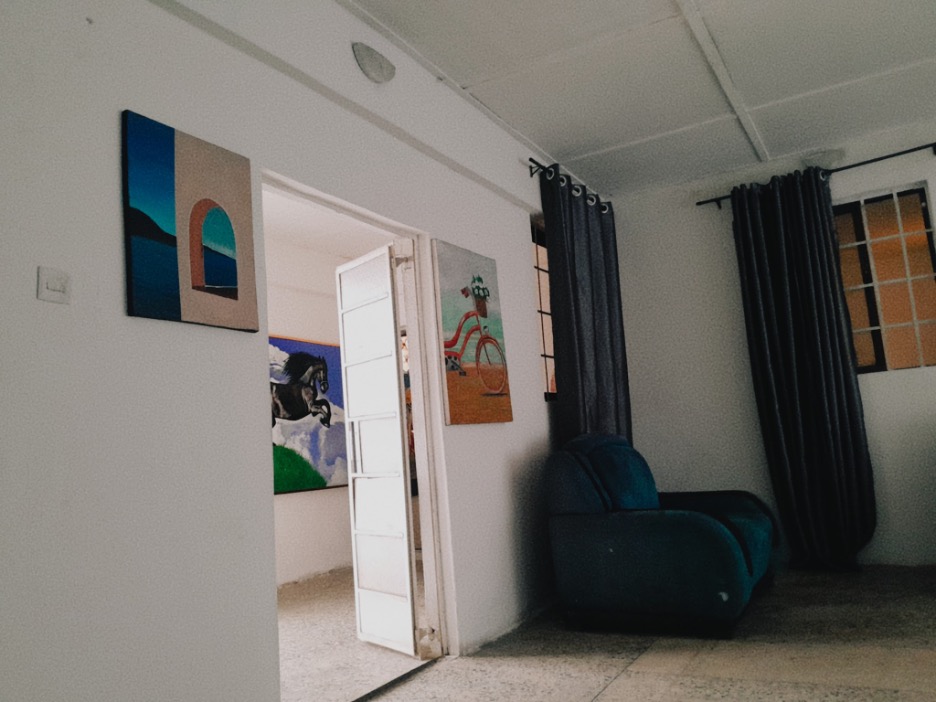
The fully immersive space holds me in fascination during my stay. The living room’s size, with four couches, the terrazzo flooring, and the white walls interrupted by paintings of all dimensions and styles here and there. My favourites are the two that hang on each side of the glass panel double doors. These elements show the building’s age, which reminds me of the house I spent some years of my life in. I love the large bathroom with a window that does not pretend to hide you from the world outside. The wide window lets me look far into the horizon. The enclosed verandah from where I see Benin City in many shades and shapes. From here, I gaze at the Holy Cross Cathedral, facing westward from the gallery, so I see it from the side. On top stands another statue of Christ, this time on the cross, placed on a boulder. Throughout my stay, I will look at this statue like a north star.
Rain falls incessantly in Benin City. But it is easy to forget that it is raining outside when we are cocooned within the embrace of the residency. We write in something of a conference room in the art gallery where more paintings and sculptures sit. One that catches my eye is a two-faced figure that syncretises an Ife brass head and a Benin bronze head.
A couple of days into our stay, Isaiah talks about taking a walk. To see what we can of the city on foot. Testimony is hesitant to allow us to roam about on our own. “We are lacking sunlight. Vitamin D,” we say. Eventually she concedes, and we all go for a walk. With feet on the ground, I finally see the front facade of the Holy Cross Cathedral and its Christ statue. We walk down Mission Road to what is couched as Benin’s computer village, but it pales to its raucous equivalent elsewhere. The most chaos we encounter comes at the market ahead, with the familiar smell and sights that all Nigerian markets seem to share.
A mist hangs over the city every morning, heavy and white. I see it from the bathroom window. A bell tolls from the cathedral by 6 am and 6 pm every day. I enjoy counting it. Sometimes it is twelve, or eighteen, in batches of three times three, with three rings. Most times I miscount. Once, I saw a priest in a blue cassock pulling the rope that moves the large bell hanging from a tower on the premises.
We write and write. That is what we are in Benin for, and it is interesting to watch everyone get so focused at certain times, wanting to get work done on our intended creative projects that cut across, and even fuse, genres—Poetry, Prose fiction, and Creative Non-fiction. But the conversations interest me the most. “What is society if not me and you?” Talking about the romanticism and idealism of writers. Isaiah pontificates on craft and literature. Ntui asks and asks. Sarah talks. Blessing chips in, throwing her hands as she speaks. Ridwan does the same. Outside this seriousness, we try to shoot content ideas Sarah initiates; we have a game night, we joke, we laugh, and a couple of people end up rolling on the floor in absolute joy.
We watch films at night. Testimony is keen on film time. The projector casts a blue tint, and then the faces, words, and actions of characters appear on the same wall that usually holds the window’s reflection of the sunset. I recommend Alfonso Cuarón’s “Roma”. It isn’t liked much at first. Too slow, they say. But we return to it, and the slow-burn story hits its pace. Those who watch it love it. We have, perhaps, four more film nights after that. On the last one, I recommend David Fincher’s “Fight Club.” At least it is not a slow burn.
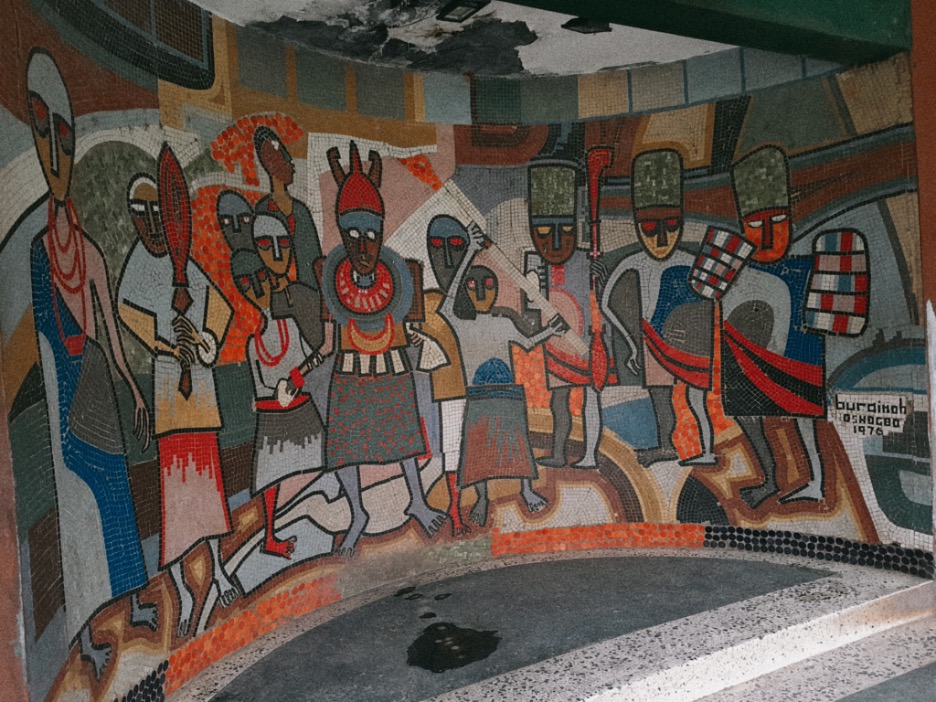
Under Ruona’s lead, the program director, we visit the National Museum and see recently repatriated bronze heads, plaques, and items the British looted from the city in 1897. None of these repatriated items come from Britain, of course. The museum guide’s narration is unsatisfactory to me. I even note a couple of oversights. But seeing heads and plaques from centuries ago up close will always stun me. We visit the Institute of Benin Studies. The woman who speaks to us is versed in Benin history and works in circles to get more looted items repatriated. She shares insights into how it all works. We visit a section of the Benin moat behind a mechanic shop. The path to it is bushy, and tiny thorns stick to the hems of my trousers. The moat is now a gorge with banana trees and weeds, but its erstwhile vastness and intent are still detectable. The lack of preservation of Nigeria’s cultural past is always a sad sight. Before the day ends, we visit Igun Street, famed for its artistic pedigree, where the descendants of those who wrought the bronze plaques and heads in museums worldwide still work.
One day, I see Christ(s) in conversation off Mission Road just as our time at the residency winds down. The white statue above the residency’s gate suddenly triangulates with Christ atop the Cathedral, then with a new addition: a golden crucifix on a white coffin carried by men in white agbadas, accompanied by the sound of drums, saxophones, and trumpets on the street. I watch this procession and imagine a conversation between each artistic depiction of Christ. I tell Testimony how uncanny it is that the story I have been working on starts with men carrying a white coffin with golden finishes. How life always mimics art. Or is it the other way around?
The morning before our reading and conversation with the Coral Literary Circle, we have everyone read excerpts from what they have been working on. I am absolutely mind-blown by the work these amazing writers have produced. We share thoughts and insights about each work; we spiral again into conversations about what makes a writer or a poet. To be published or not? We read to the group of amazing people who come around and engage us and our work on themes of society, grief, loss, identity, friendship, amongst others. The evening ends emotionally as we share thoughts on each other and the residency itself with Ruona and Testimony. We bemoan an imminent parting.
Ntui leaves first. Then Isaiah and Sarah. Ridwan, shortly afterward. Blessing and I take a bit more time with Testimony. Then, we leave too. We leave the walls, the paintings, the flooring, the windows, and the staircase that seems to go on forever. To the street we go, and onto Mission Road, where a driver of one of the orange and red buses slows down and asks, “You dey go?” more like a statement than a question, and I am tempted to say, “Yes, you are right.” Despite our reluctance to do so, we indeed have to go.

Súnmisọ́lá Olúdé
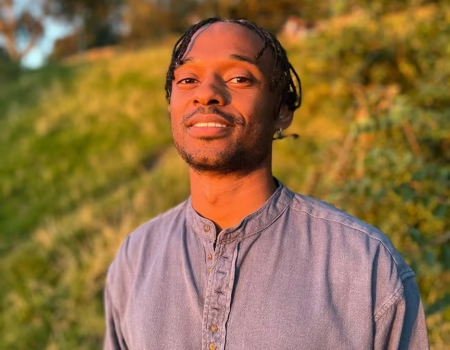
Súnmisólá Olúdé is a Nigerian writer of fiction and essays. His work has appeared in Litro Magazine, Brittle Paper, The Journal of African Youth Literature, Akéwì Magazine, and elsewhere. He was longlisted for the Quramo Writers’ Prize in 2025, shortlisted for the Awele Creative Trust Award in 2024, and shortlisted for the Cahava International Short Story Contest in 2026.
Find him on social media @ludesunmi on both Instagram and X.