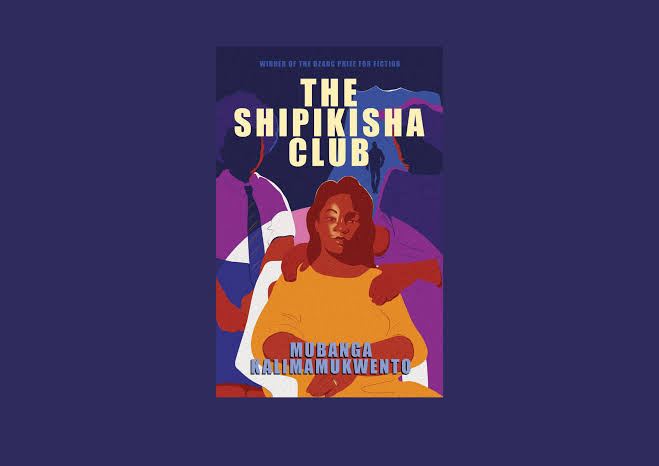
Salifyanji Ada Nanyangwe-Penda is on trial for the murder of her policeman husband, Kasunga. She claims it was in self-defence because he shot her first. There is proof of his assault but no witnesses to corroborate Sali’s story. As the novel rotates between Sali’s diary entries, her mother Peggy’s perspective, and her daughter Ntashé’s point of view, it becomes obvious society has already judged Sali: she should have been a long-suffering wife. This forms the crux of Zambian writer Mubanga Kalimamukwento’s second novel and fourth book overall.
The Shipikisha Club (Dzanc, 2026) is part legal drama with gripping courtroom interrogations, part multigenerational epic, and part intimate character study rendered in diary entries. Mubanga Kalimamukwento’s previous works have explored womanhood in multiple shades. With her new novel, she continues her interrogation of gender roles in conservative Zambia. Her debut novel, The Mourning Bird (Jacana, 2019), traces Chimuka’s tumultuous trajectory into street life and sex work after her father dies of AIDS and her mother dies by suicide. Another Mother Does Not Come When Yours Dies (Wayfarer, 2025) charts the death of the author’s mother and its aftermath in a vibrant hybrid of prose and poetry. Her debut short story collection, Obligations to the Wounded (University of Pittsburgh Press, 2024), features an eclectic mix of characters in crisis, a number of whom are women and girls suffering at the hands of men, whether by physical and sexual assault (“Reflections,” “Feral Children,” “Where is Jane?”), kidnapping and trafficking (“Chidunune”), or neglect and infidelity (“Mastitis”).
In The Shipikisha Club, the writer creates her most fascinating character yet: Sali, a woman who fights back, a daughter who defies her pastor father by getting pregnant out of wedlock for a married man, a wife who shoots her husband with his gun, a woman who refuses to be silenced or erased, journaling her irreverent thoughts and colourful life events. With Sali, Kalimamukwento solidifies her place in the echelons of women writers exploring what it means to be “A Difficult Woman.” When Sali announces her engagement, her colleague welcomes her to The Shipikisha Club, an invitation the woman quickly rejects. In her journal, she writes:
“I’d heard this threat before—that to be married was to become tethered to an unspoken misery. But she didn’t know me. I wasn’t joining the Shipikisha Club; no, I would make this work for me, just like I had done with everything else.”
Elsewhere, she states:
“I wouldn’t reduce myself to a “Dear Admin, please hide my ID” message only to be scorned by pretend-happy women on social media.”
In some ways, Sali’s actions are reminiscent of the mother figure in Kalimamukwento’s debut novel, who offers sexual favours to her landlord to secure accommodation for her kids. Where Chimuka’s mother takes her life and dooms her children to a life on the streets, Sali’s mariticide exposes her kids, especially Ntashé, to ridicule and gossip. Both women reject the roles society expects of them, either by ways considered reprehensibly weak (suicide) or contemptibly violent (murder). Sali joins a lineage of women who harm their abusive or philandering husbands: Beatrice of Chimamanda Ngozi Adichie’s Purple Hibiscus and Amy Dunne of Gillian Flynn’s Gone Girl, the latter who also documents her marriage in epistolary form. But while Amy gets away with her arguably sociopathic crimes and Beatrice Achike is dismissed as a fragile woman incapable of murder, Sali faces the full brunt of the law. She has crossed a line that is too transgressive for a wife who should be more enduring of her husband’s near-constant assault. One could argue that Sali is a spiritual successor to Firdaus, the protagonist of Nawal El Saadawi’s Woman at Point Zero, who awaits execution for the murder of a pimp. Both characters navigate the legal and social consequences of resisting domestic entrapment.
In the seminal work, The Madwoman in the Attic (1979), Sandra Gilbert and Susan Gubar argued that nineteenth-century literature frequently positioned women as either passive angels or monstrous madwomen, and this representation reflected a restriction within a rigid patriarchal binary. Although the madwoman was first examined in Western literary contexts, the archetype’s significance cuts across national and cultural lines, where contemporary African women writers are continuously redefining what it means to be a “good woman” or a “bad woman”. Kalimamukwento is clearly working in that later mode: the “difficult woman” in The Shipikisha Club is refusing the intimate patriarchies of marriage, religion, and community expectation. But while Sula Peace in Toni Morrison’s titular novel refuses to marry, have children, or follow the traditional roles expected of women in Medallion, Sali straddles subservience and disobedience. She does marry, but only after getting pregnant by a married man.
At every turn, Sali refuses to suffer at the hands of her husband. She retaliates by having an affair with a richer man when she discovers her husband’s infidelity. She vows to avoid being reduced to the role of a wife or mother, maintaining her job as a teacher and securing a sense of self. She scoffs at the other women, including her friend Faye, who complain about victimhood in marriage. Sali is Sula in Lusaka. If the latter floats above patriarchal institutions, the former worms her way through them, bending them to her will. Sali’s woes begin when she realizes the limits of her power against these institutions.
Throughout her oeuvre, Kalimamukwento explores institutional oppression in its various forms. In her latest novel, her observations have sharpened to present striking ironies in modern-day Zambia. Sali’s father is a pastor who is incapable of expressing his thoughts in words other than Bible verses. His infidelity with church members does not go unnoticed by his wife, Peggy, but she remains by his side, aspiring to the ideal woman described in Proverbs 31. Sali goes from being a pastor’s daughter to a policeman’s wife. The Bible and the gun tower above her, and her transgressive actions remain within limits. Despite the main character’s startling self-awareness, she cannot seem to realise—or admit—how much of her psyche has been shaped by the institutions she rebels against. Bible verses open diary sections about pre-marital and extra-marital affairs. Before marriage, Sali’s attachment to an older married man granted her favours. Later in her union with Kasunga, she cheats back with a wealthier man. This complicates her as a symbol of refusal because she isn’t refusing patriarchy altogether; she is trying to win at it by finding a better patron. And for all her preoccupation with self-determination, she opposes her daughter’s dream of becoming an actress and wants the girl to choose a safer career. These contradictions make Sali a fascinatingly complex protagonist.
However, Sali’s brilliant characterisation overshadows the other characters who are not as fully inhabited as the protagonist. Although Ntashé and Peggy are given generous interiority, the characters are not as fleshed out as the woman at the heart of the novel. Peggy’s chapters offer convincing multidimensionality, but the immersion in her perspective is somewhat dulled and creates distance. Ntashé’s internal turmoil is beautifully rendered on the page, but there is a sense of detachment from the teenager’s point of view. The psychological landscapes of these two women are not as intricately mapped as Sali’s internal world. This uneven characterisation weakens the impact of the novel’s exploration of intergenerational trauma. A fully-realised multigenerational epic would have made Sali’s tragic descent and its aftermath even more resonant. Kasunga and Peggy’s husband are nuanced, but they largely remain at the peripheries of the protagonist’s perception. Faye, Sali’s best friend, is frustratingly thin for a character who serves as a foil to our transgressive heroine.
These shortcomings, however, do not undermine the novel’s achievements. The Shipikisha Club is Kalimamukwento’s best work yet. The conflict at its core is the most striking across her award-winning works, and the prose here is sharp, witty, and electric in ways that make the characters and scenes jump off the page. Kalimamukwento brilliantly straddles page-turning courtroom interrogations with introspective passages that illuminate the human condition. The writer’s background in law shines here: the present-day chapters showcase a lawyer’s intimate knowledge of Zambian justice system’s inner workings. The humour scattered through her short story collection is ripe in this novel, providing comic relief in tense scenes. Just like her previous works, this novel is a love letter to Zambia. Lusaka and Kabwe are alive with their sights, sounds, smells, and tastes here. It is also laudable that every character sees the same setting with different eyes; we discover new details of the places from each perspective. When Peggy is returning from the prison visiting area, she views everything with a sense of despair:
“Riding the bus back to Lusaka on the tail end of Sali’s confession, Peggy’s entire world vertigoes. When the bus speeds up and sways, having left the police checkpoints and the short procession of cars exiting Kabwe, looking out of her window, she wonders: Was the grass always this dead brown, as though the rain that drenched the country between November and March did not touch it? Those piles of potatoes sold at the edge of Kabwe, were they always so shriveled and dappled with black? The markets whizzing past, did their wares always look bland? Were the vendors’ expressions always this stale? Like Sali’s face as she told her what she had done.”
This contrasts with a more hopeful rendering of the same place when Sali fantasizes about returning home:
“[Sali] imagines watching that big yellow bus rolling out of the filling station and watching the landscape slowly transform. Even with her eyes closed, she can outline how the city changes as the bus approaches the army barracks. Her mind’s eye sketches out the meter-high grass. She sees trees and escarpments rushing in and out of the landscape. Nearing roadside markets, she hears the women shouting their prices as they chase down the bus. She sees the marketeers balancing white metal bowls of tomatoes, slick bulbs of onions, fat pumpkins, bunches of bananas, lush, green chibwabwa, kalembula, and repu leaves bundled into strings ripped out of sacks. When the bus speeds past the roadside carpenters, whose numbers are written with charcoal on wooden placards nailed to the trees’ bark, it means Lusaka is approaching—past the old shanty houses, across the expansive farms of the newly wealthy.”
In line with the writer’s laudable dedication to documenting the intricacies of Zambian culture, every story in her collection Obligations to the Wounded opens with a Bemba proverb. This novel continues with a similar tradition, with every chapter from a character’s perspective beginning with such proverbs, with the exception of Sali’s diary entries. The novel alternates between third-person narratives and epistolary chapters in first-person point of view. Sali’s musings about womanhood, wedding rituals, pregnancy, post-partum depression, and gender roles run parallel to Ramatoulaye’s letter to Aissatou in Mariama Bâ’s So Long a Letter and Celie and Nettie’s correspondence in Alice Walker’s The Color Purple.With this robust structure, Kalimamukwento juxtaposes truth and perception, objectivity and subjectivity, past and present. She criticizes a society that trivializes femicide and punishes the women who fight back; a country that holds women to higher standards of morality. She asks about the future too: What happens to girls who watch their mothers get punished for rebelling? What path will they choose when the time comes? The Shipikisha Club is a fierce and unflinching addition to the literature of refusal.

Rigwell Addison Asiedu
Rigwell Addison Asiedu is a Ghanaian writer and editor. He is a 2025 Fellow of The Literary Laddership for Emerging African Authors and a finalist for the 2025 Morland African Writing Scholarships. His work has been longlisted for the DISQUIET Literary Contest for Nonfiction (2026), the Commonwealth Short Story Prize and the Afritondo Short Story Prize (2025), and the African Writers Awards for Poetry (2022). A 2019 Dei Awuku Writer’s Contest winner and a Best of the Net nominee, his fiction and nonfiction have appeared in Lolwe, Isele Magazine, Ubwali Literary Magazine, Ta Adesa, Lọúnlọún, The Muse Journal, and elsewhere. An alumnus of the 2024 CANEX Book Factory Creative Writing Workshop and a recipient of the Ubwali Masterclass Scholarship, he serves as Fiction & Nonfiction Curator for Nenta Literary Journal.