I
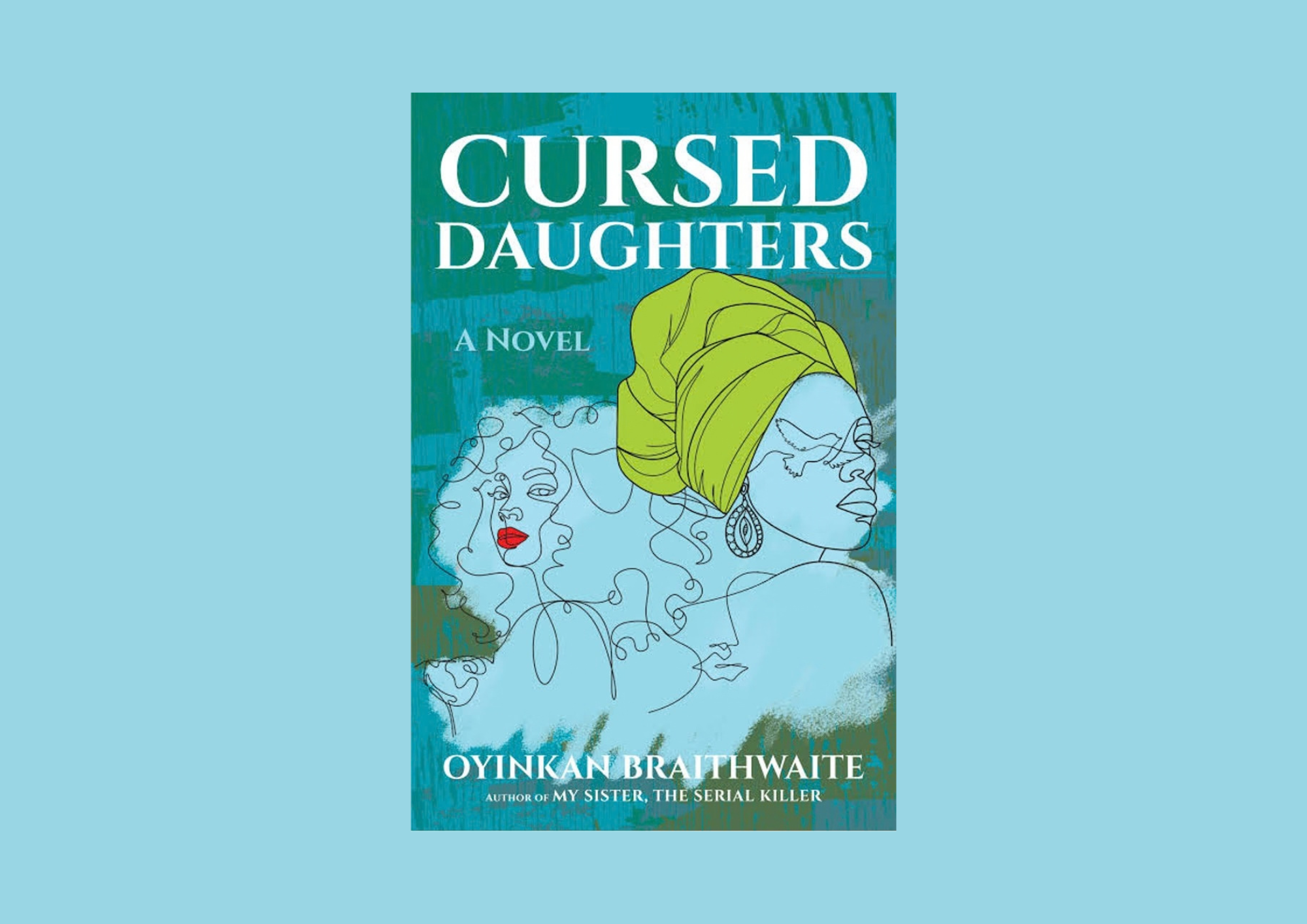
An enquiry into the sensibilities of Cursed Daughters is implicitly an enquiry into the sensibilities of Nigerian livelihood. Oyinkan Braithwaite’s second novel draws on Nigerian class and cultural dynamics. She continues her distinctive style in exploring a more culturally ingrained subject: generational trauma. Within the first dozen pages, I was pulled into the muddled lives of the five Falodun women –Bunmi, Kemi, Monife, Ebun & Eniiyi- as they negotiate marital/romantic lives stalked by the overhanging knowledge of an ancestral curse. This curse begins with Feranmi, the Falodun matriarch. A seductive night leads her into a hasty marriage with a wedded man. Discovering the scandal, the jilted first wife places a curse on Feranmi and Feranmi’’s lineage: “No man will call your house home. And if they try, they will not have peace”.
Reading this book was a mixed experience. At various intervals I clamped my copy out of joy and pain. Moments of pain were mostly motivated by the novel’s lack of confidence in the reader’s intellect. The narration laboriously repeats, as if to remind the reader, what already has been established several times over. We are regularly reminded just how thick Mo’s hair is, how very golden Golden Boy’s eyes are, or the size of Mama G’s bosom. This aside, unexpected information is dumped randomly on the reader. In response to a question headed in a different direction, Chuka gives a literal rundown of the latter’s hygiene and academic history.
What I relished with joy was the range of femininity the author explores. With female characters, Oyinkan Braithwaite does similarly in Cursed Daughters what Tsitsi Dangarembga does in Nervous Conditions. Monife, like Lucia, is wilful, confident, and overtly sexual in an environment where female restraint is systematically insisted upon. Monife is not coy in advancing her sexual urges with Kalu like Lucia is with Takesure. Ebun, like Nyasha, is precocious, headstrong, opinionated, and painfully aware of societal constraints. Both characters are stellar students who rebel against restrictive parents. Aware that their anti-patriarchal ideals are dissuaded by other women in their lives, they both recede into themselves. This awareness complicates Ebun’s relationships with other characters, and it was a pleasure to read this dynamic play out.
Reconciling laborious narration with these intriguing dynamics is a pleasure and a pain. This mix is the motivation for this review.
II
Characterisation is one of the book’s strongest features, and also one of its weakest.
What drives the tragic romantic lives of the Falodun women? Is the recurrent tragedy a result of the curse in effect or of the inherited fear of its potency? These questions are largely left to the reader’s discernment. Eniiyi, in self-preservation, declares it a genetic problem, unlike the spiritual plague her family believes it is. This complicated relationship between fear, faith and fetishism becomes central, consequently rendering the novel an offering into the complexities of Nigerian spiritual life.
The characterisation of this spirituality, however, hardly provides the nuance such a subject demands. It is rather flattened into stereotype. Mama G, traditional interpreter of paranormal maladies, is a representation altogether uncommon in contemporary Nigerian fiction. For a character so dynamic, the novel offers little interiority. Instead, the text substitutes self-defeating arguments embedded in superficial descriptions. An early introduction to Mama G features her “scooping amala and ewedu from the bowl balanced on her breasts”. We are told, “Her breasts were so large that it was easy to fall into the trap of using them as her sole form of identification”. By itself, this hardly raises an eyebrow. However, the novel subsequently negates itself. Laborious references are made to the same quality at almost all direct interactions with Mama G.’s character. As the plot ends, Mama G is effectually summarised into a sketchy mamalawo with “enormous pendulous breasts”. This effects a disservice to an otherwise compelling character.
This reduction extends to the idea of masculinity espoused in the novel. The portrayal of male characters –Golden Boy, Zubby, Osagie- is inordinately fixated on physicality. Male characters are predominantly introduced and reintroduced, and their presence is largely marked by looks, good looks, or proximity to them. Reading the book in its entirety, one realises that for characters with such pivotal impact on plot, we have been so generously armed with physical descriptions that it significantly dwarfs every corresponding insight into the interior lives of these men.
It is perhaps for similar reasons that the novel has been described as male-centred. This, though, can be substantiated by its premise of inherited marital anxiety. The younger Falodun women are raised with the recurrent urgency to find and keep a spouse. This plays out with a 20-year-old Monife eager for marriage, with the full encouragement of her mother and aunt. Ebun is alone in questioning this: “Why are we so obsessed with guys, and marriage, and—”. The other women promptly rebuff her. The inherited anxiety to be in and keep a relationship is what plagues the Falodun women. As a result, the novel’s male-centric air does not lack substance.
III
Amara establishes how “The use of Nigerian Pidgin within the text is unconvincing at best and frequently disrupts the otherwise seamless absorption of the novel”. This, unfortunately, extends to the use of Yorùbá. For a language central to the plot environment, it is used haphazardly, particularly with consistently inaccurate Yorùbá orthography. The most confusing of these piles up early, at the narration of Eniiyi’s naming ceremony. Here, Oyin (honey) is written as Oyín, Ataare (Alligator pepper) as Àtàrẹ, Omi (water) as Òmí, Epo (Palm Oil) as Èpò, iyọ̀ (salt) as Ìyọ̀ and Orógbó (Kolanut) as òrògbó; all of which bear no semantic import in Yorùbá. In successive chapters up to the end, Yorùbá orthography, tonal marks especially, remains consistently inaccurate or completely absent. As a reader familiar with the language, this scene alone dabs the less familiar cultural environment. Further instances render it plastic. The tradition, preceded by novels such as Adebayo Ayobami’s A Spell of Good Things, ties to the larger debate about the positioning of Nigerian languages in contemporary Nigerian fiction. The argument is simple: Nigerian languages should not be used as mere cultural markers. Like many other languages, they are a recurrent reality and should be treated as such.
IV
One impressive quality of the book is its plot structure, which I thoroughly enjoyed with each reading. The disjointed narrative view alternates between Ebun, Monife, and Eniiyi. This creates space to examine the parallel lives of Monife and Eniiyi more closely. With Ebun as a sort of stopgap, the novel presents a more objective view of the similarities, pain, and progress of these crisscrossed lives. With the temporal shifts, the stagnancy of the Nigerian environment becomes apparent. In a sense, Nigerian reality shares striking similarities with the intergenerational effect of the Falodun ‘curse’.
My experience reading this book will remain in my memory, largely because of the epilogue. By the penultimate chapter, I thought I had reached a brilliant end to a tragic story, but I was elated to turn the page and find more words left to read. This soon soured when the final page shattered all doubts about the existence of the curse. Scepticism about the curse’s existence provides the underlying nuance in the plot, fuelling tension betwixt psychology and superstition. In turn, this drives much of the conflict, internal and external, keeping the plot alive. By confirming the curse as real, animate even, the epilogue effectually deadens the carefully curated scepticism established in preceding pages. This is especially true because these unanswered questions make for a more compelling ending than the epilogue provides.
V
Cursed Daughters bears witness to Oyinkan Braithwaite’s ability to consistently conjure intriguing plots augmented by interesting characters. Despite the progression to a more culturally ingrained subject, Cursed Daughters falls short of the earnestness it promises.

Tomi Ojo-Fakuade
Tomi Ojo-Fakuade writes poetry and non-fiction. His works appear in BRAWL Lit., Obindo Magazine, Brittle Paper and elsewhere. He enjoys photography, filmmaking, and is currently researching Kwabena Nketia's Etnomusicolgy and Nnedi Okorafor's Africanfuturism. When not studying English Language at Obafemi Awolowo University, he reads for Olumo Review.