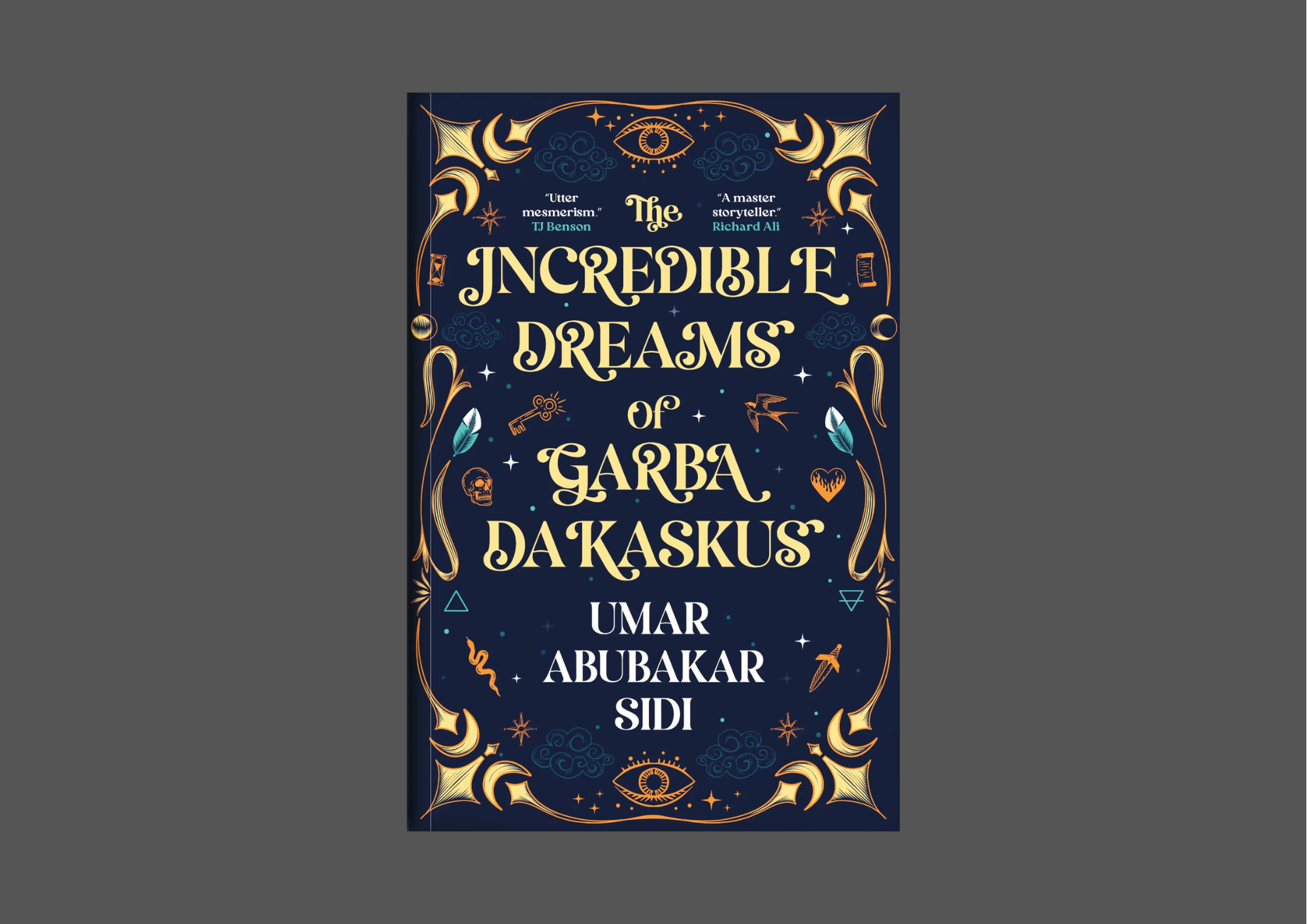
Certain questions can be asked in Speculative Fiction that can be dangerous to ask elsewhere. Kaveh Akbar, in a Lecture on ‘Poetry and Spirituality’, quotes a poem that ends with “such vertigo of the infinite.” In penetrating Umar Abubakar Sidi’s two hundred and sixty-seven paged novel, I take that phrase as necessary. The piece is an experimental fantasy produced with a Sufist interiority Paul Liam says “is rooted not in the formation of an original poetic leitmotif but in the adoption and revival of seemingly forgotten traditions whose emergence was rooted in deviancy against the formalities of logic.” Liam also notes that “the fulcrum of this fiction is premised on dissonance, of circumventing the conventional mechanics of storytelling in preference for and romanticization with artificiality or literariness.” This textual deviancy substantiates the odd nature of the work. An oddity situated in traditions of mysterious secrets, narratives, and myths. One that comes to mind is the age-old Middle Eastern One Thousand and One Nights. Sidi writes in the fashion of famous Scheherazadean tales!
The “infamous” complexity of the novel is grounded in its attempt to – through the Book of Mysterious Narrations, Memoirs of Al-Sudani, Book of Sorcery and the Evolution of Superstitious Allusions, and Book of Injurious Disclosures – find the essence of language (the alphabet) and reveal its inseparable link to the Otherworld. At one point in reading this novel, one might be forced to scream “help! help! help! a book wants to kill me! or post on Twitter #IamAloneInARoomWithAKillerBook” (201). The Incredible Dreams of Garba Dakaskus is “a sea which leads to the ocean of unbelief, gateway to the void of extinction: the starting point of nothingness . . . (11). This nothingness is the meat of the book. In that it has no exact thematic or structural focus, it’s an exploration of the art of writing itself. In its surrealist temperament, Okri’s The Famished Road comes to mind. In its exploration of ancient mythologies – although more Orientally foregrounded – it is Tutuola’s Palm Wine Drinkard we recall. But perhaps the closest reference is Calvino. Sidi admits, in a panel session at 2024’s Port Harcourt Poetry Festival, that Calvino’s literatures inspired the origins of his novel. Little wonder the first paragraph of Sidi’s book seems like a replica of that of Calvino’s metafiction, If on a winter’s night a traveler, which reads
“You are about to begin reading Italo Calvino’s new novel, If on a winter’s night a traveler. Relax. Concentrate. Dispel every other thought. Let the world around you fade. Best to close the door; the TV is always on in the next room. Tell the others right away, “No, I don’t want to watch TV!” Raise your voice—they won’t hear you otherwise—“I’m reading! I don’t want to be disturbed!” Maybe they haven’t heard you, with all that racket; speak louder, yell: “I’m beginning to read Italo Calvino’s new novel!” . . . (7).
II
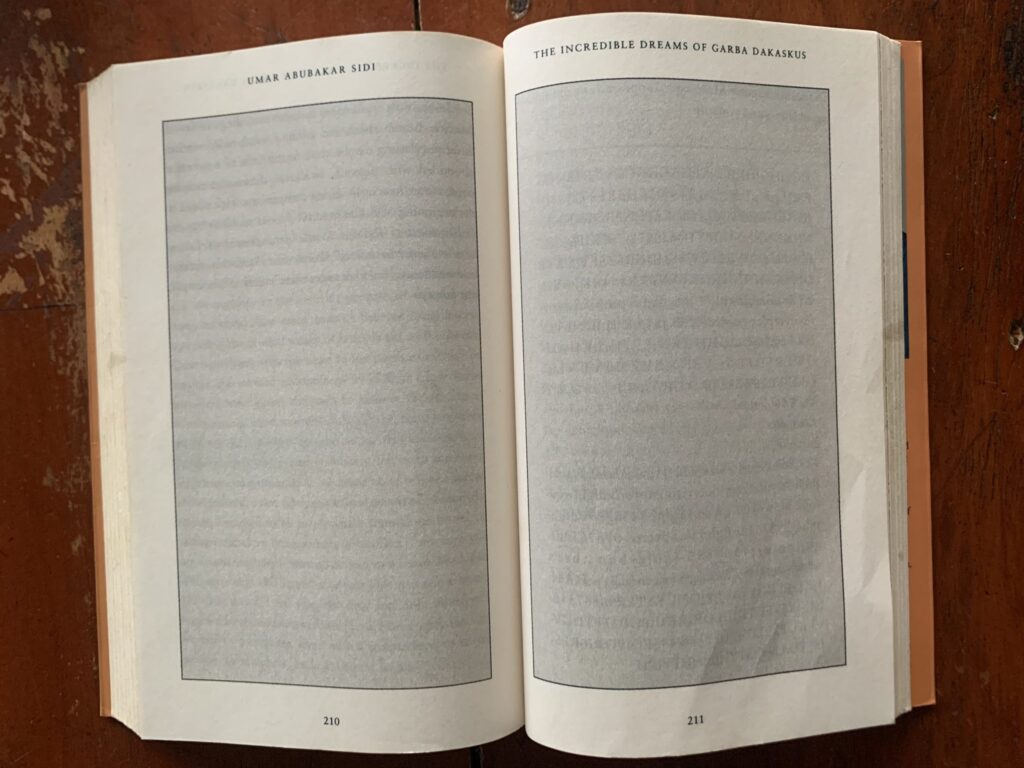
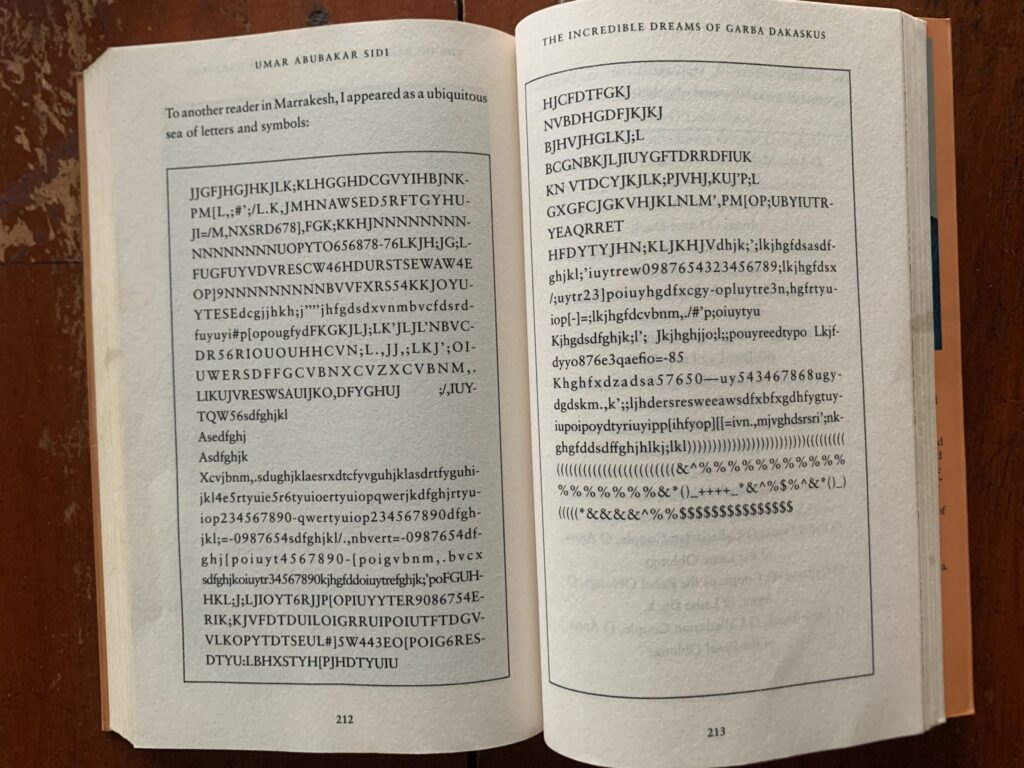
The Incredible Dreams of Garba Dakaskus is adventure, it is quest that produces a linguistic playfulness I first recognized through its deconstruction of form. The story of stories’ structure is so convoluted that “someone proposed searching by regression: to locate book A, first consult book B, which tells you where book A can be found; to locate book B, first consult book C, and so on, to infinity” (Borges, Ficcions). The most “extreme” experimentation that occurs in the novel is between pages 210 to 211 that are just empty pages and 212 to 213 where there is an incoherent sea of letters and unintelligible symbols. Both passages demonstrate the fluid or subjective perceptions that could be gotten from literary works. See images 0.1 and 0.2 below.
Furthermore, The Incredible Dreams of Garba Dakaskus is somewhat “academic.” It uses registers from different fields, bibliographic embodiments, references, and quotations (so surplus one could forget the actual novel and think it an anthology of writings from countless authorial and spirito-induced sources). In the tradition of modern absurdity, Sidi – although through relatively simple diction – uses multiple narratives, complex character portrayals, alternating points of view, double metaphors, and settings (constantly shifting across different continents, cultures, civilizations, histories, and spiritual sites). As one follows the first thread – i.e., Jackson Miguel’s The Circle-commissioned scramble to assassinate Dakaskus, or a thread like the tales of Bulbul the Parrot, grand vizier to the Caliph in the fictional Baghdad, epics told in bits and pieces begin to reveal themselves. These sub-plots (and there are a lot of them) postpone total understanding until when another sub-plot brings epiphany. An example is the tale of Gazga – “a giant like no other” – which cannot be fully grasped until Al-Maqdisi later goes on a spiritual adventure with Labaran, the King of Lies. This manner of meaning-making strengthens the much-needed coherence and cohesion in the novel. Like Carl Terver writes, “these stories are narrated in an interwoven structure that is both protean and palindromic at the same time . . . —speculative fiction, fantasy, fable, and magical realism altogether.”
Although the core point of The Incredible Dreams of Garba Dakaskus is to show that “it was only in the letters of the alphabet that the mysteries of the universe can be found” (53), a sermon by Ibn Tambah (fanatical leader of a Sect dedicated to obliterating every form of knowledge) subtly demonstrates Sidi’s anxieties and ultimate regard for the Godly divine over everything, even writing. It reads:
“Writing is sacrilege, writing is evil, writing is innovation, each innovation is evil, and every evil is commendable. The alphabet is accursed. The book is an enterprise of the devil designed to lead man to his final annihilation. The original state of the mind of man is emptiness. The noble prophet was “unlettered,” Adam’s mind was a blank page–not knowing and not desiring to know–until it was taught by God. The book is invented: it is sacrilegious, evil. There is only one God, and He alone possesses true power” (76).
However, the success of a counter-Sect led by Ibn Katib who had a vision where Al-Burgus, the legendary father of letters, admonishes him to “rise and defend the dignity of words, the letters of the alphabet and books” (79) equally show Sidi’s faith in the power of Literature. “The moment we begin to understand that every book is a door to a wondrous city and this city is the gateway to a world and this world is an entry point to a strange universe; the moment we begin to understand that books are not containers of dead symbols but beings . . . that are parts of a larger being–the Book of Life–[m]an will be able to conquer time and traverse mediums and dimensions hitherto inaccessible” (80, 81).
III
The term ‘Metafiction’ was coined by William H. Gass in his book, Fiction and the Figures of Life (1970), to signify a self-referential modern fiction that centres the making of fiction itself, the role of the author and the act of reading. While Gass defined the term, the technique was pioneered earlier by authors like Miguel de Cervantes (Don Quixote) and Laurence Sterne (Tristram Shandy). This style consciously draws attention to its formative process. Sidi’s novel starts this way: “This is the opening sentence to The Incredible Dreams of Garba Dakaskus” (11). It also ends in similar fashion: “The sun expanded, whitened, and began its slow sojourn towards a luminous river in the closing sentence of The Incredible Dreams of Garba Dakaskus” (267). While this is not popular in the Nigerian literary eco-system, writers like Vonnegut in Slaughterhouse-Five, Pynchon in The Crying of Lot 49, Nabokov in Pale Fire, Fowles in The French Lieutenant’s Woman and Rushdie in Shame has established its creative foothold.
Two things are note-worthy in Sidi’s novel: (a) it is a text of texts; (b) it is a pathway to the actual book, A Guide to the Secrets of the Alphabet or Text of the Parrot written by the fictional Al-Juzjani, an eleventh century scholar and mystic. The existential search for this manuscript is the overarching cause of conflicts in the novel. Pages 1 to 192 is thus the actual The Incredible Dreams of Garba Dakaskus. Pages 193 to 267 is however the highly sought after ‘spiritual text’ of the Parrot complete with its own publication “rites” (i.e., dedication, acknowledgements, etc.) and divided into two sections: Book of Sorcery and the Evolution of Superstitious Allusions and Book of Injurious Disclosures.
In its intertextual plot structure and intertwine of stories underneath the main story, The Incredible Dreams of Garba Dakaskus is metafictional. However, the introduction of an authorial voice in-between the flow of meta-telling that says things like “Ha ha ha! Are you disappointed? Is the title too simple? Wait. Let me take a break. Fidget. Blink. And relax the muscles of my hand. Okay? Good” (26), complicates the novel to be better regarded as a ‘meta-meta-fiction.’ With this postmodern style, Sidi’s consistent intervention makes smooth reading impossible. The author is not dead. He is alive – bright and troublesome, hidden behind the voice of the narrator-translator, Dakaskus. This mode of storytelling becomes a kind of distraction at some point because even when the author isn’t questioning, edging on or forcing the knowing of the novel’s literariness on the reader’s reading, the ghost of that meta-meta-fictional voice is ever present. This penchant of Sidi’s meta-writing to instruct, to teach the craft of the art, to be self-referential, also runs through most of his poems and earlier released poetry collections.
IV
The question of Dakaskus’ identity hunts the reader of The Incredible Dreams of Garba Dakaskus. Sidi problematizes the person of the protagonist as much as there are controversies around the authorship of the novel itself. One narrative is that “the name ‘Garba Dakaskus’ is a nom de plume created by a group of mad poets, or rather, members of an underground cult of letters in Sokoto” (254) while the other is that “The Incredible Dreams of Garba Dakaskus was possibly authored by a parrot because of an experiment conducted by two professors, Shehu Gidadawa and Ibrahim Malumfashi” (255).
Garba Dakaskus is protagonist-narrator, lead-voyager in a mass of wild dreamscapes, translator of the Text of the Parrotfrom Ajami, occupant of Room 206 in the mad house at Kware Village, Sokoto, and meta-author of The Incredible Dreams of Garba Dakaskus. The Cabinet of Curiosities that keeps popping up in several parts of the novel serves as dramatic access into the mind of this Dadaist-like character. It is described in the novel as “a junk box, a depository of things, smells, colors, textures, and names that have caught our author’s fancy, which he intends to use in his books. These curiosities are jumbled in this cabinet . . . Sometimes these ignoble fellows clash . . . trying to forcefully haul themselves out of the cabinet in order to get access to The Portal of Potential Characters and Ideas” (229, 230).
Dakaskus was also inside this Cabinet (the author’s mind) where different figments of thought continually struggle for literary realization. He is everything and nothing!
Coda?
The whole point of this book of books is that it is gloriously useless – an end in itself very different from the Ngugi-kind of socio-political novel. It is a solid contribution to contemporary Nigerian deontological art (that form popularized as ‘art for art’s sake’). In the wake of widespread anxieties and national socio-poli-economic urgencies, most critics have questioned the utility of this kind of Literature. But I believe socialist Literatures are also as useful as the Sidi-kind of Literature. While the former directly explore and query actions/inactions that produce and sustain reality, the latter explores the unconscious, the marvelous, and the mysterious – all of which could help us understand what it means to be human in both the physical and more especially, the spiritual plane of being.
In a fourth-generation Nigerian Literature populated by novels unlike his, Sidi’s writing is very ambitious. And this ambition is what I believe makes The Incredible Dreams of Garba Dakaskus incredible.

Joel Oyeleke
Joel Oyeleke is a Nigerian culture curator, poet and essayist. Author of a chapbook, God is a Poet (FGP, 2024). Shortlisted for the 2026 Evaristo Prize for African Poetry, he is a Fellow of Ken Saro Wiwa Int'l. Writers' Residency, and Griots Lounge Publishing Mentorship. He is also the current Features Editor for Olúmọ Review. Find him on X @joel_as_poetry, Facebook @joeloyeleke and Instagram @joel.oyeleke.