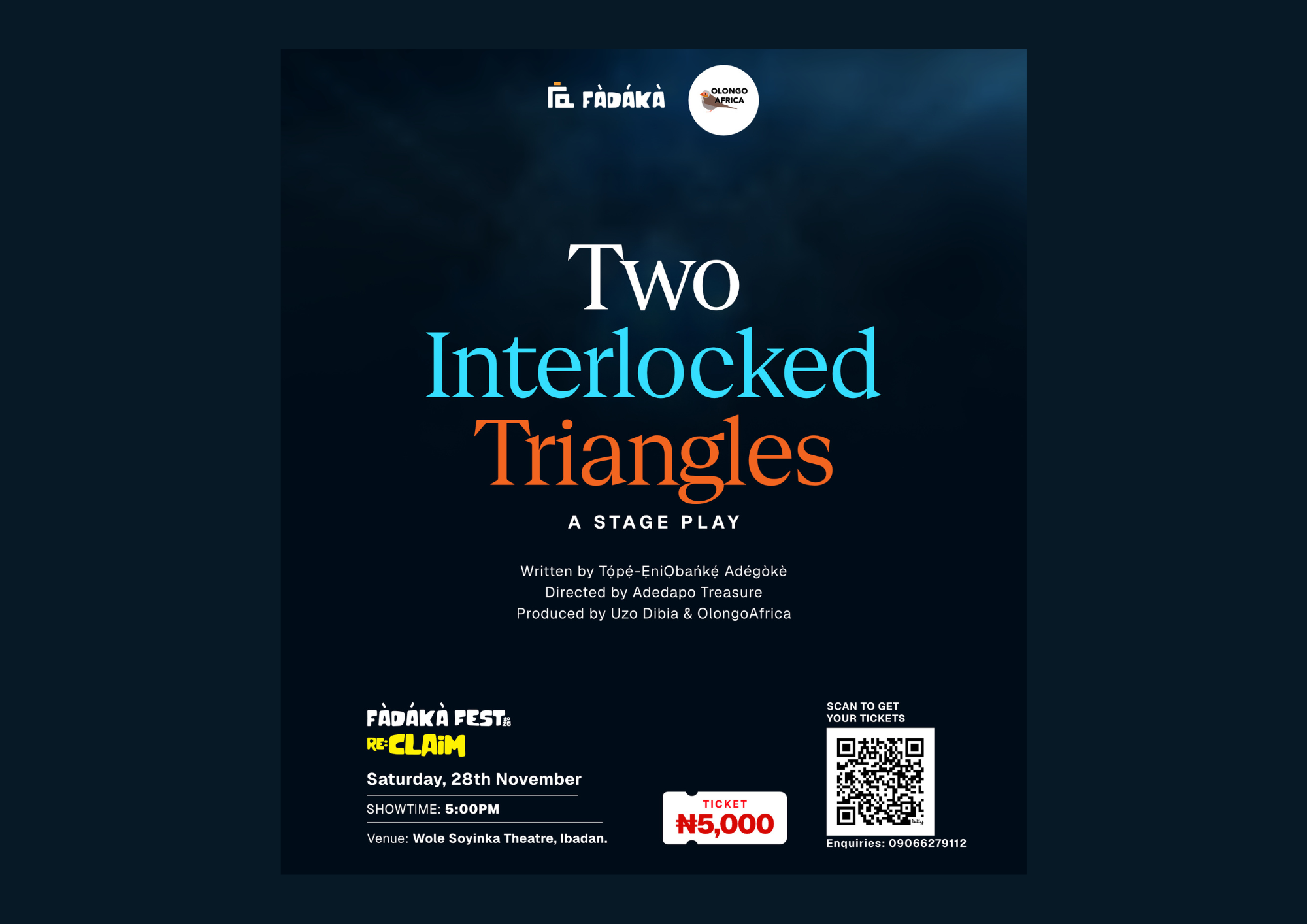
Two Interlocked Triangles, a new stage play by Tọ́pẹ́-ẸniỌbańkẹ́ Adégòkè will be staged at the Wole Soyinka Theatre, University of Ibadan, on November 28, as part of Fàdákà Fest 2026 tagged RE:CLAIM.
The play opens on an ordinary morning in a middle-class home. Mum has reached the end of her patience with her son, JB, who has come home from Montreal with two degrees in philosophy and no interest in the ‘real job’ every responsible young man is supposed to want. JB, for his part, insists he is an esports athlete who needs no office to function, and he reaches again and again for the myth of Sisyphus to explain himself.
What begins as a contretemps between mother and son slowly becomes an excavation of absence and psychological trauma. Adégòkè’s script takes in postpartum depression, generational rifts and the invisibility of mental health in African homes. It also dramatises how the hangover of military dictatorship in Nigeria, class anxiety and parental expectation shape identity and fracture a family.
The production, scheduled for 5 pm, is directed by Adedapo Treasure and produced by Uzo Dibia and OlongoAfrica. It features Michael Folagboye as JB, Temitope Agoro as his mother and Mabel Nwaoliwe as Auntie Ediae.

In his words, Adégòkè speaks on how he got inspired:
“I was inspired to write it during the COVID lockdown, when I saw a cartoon by Adam Katzenstein in The New Yorker with the caption “Sisyphus works from home”. That was the catalyst I needed to start writing the play.”
The literary and theatre critic Ugochukwu Anadị describes the play as ‘a therapy session and a history class, a reckoning with modernity and national doom’, and praises it as ‘a product of a mind given to theatrical excellence and literary illumination’.
Adedapo Treasure says:
“Two Interlocked Triangles is at Fàdákà Fest because of my friendship with the playwright and the play is a story worth staging. It also fits the festival’s third year RE:CLAIM theme, which asks what we take back and what we build next. Tópé-ẸniỌbańkẹ Adégòkè’s play follows a mother and son as a buried memory forces its way back into their living room, and a family reclaims its own story to move forward. Fàdákà Fest’s energetic, conscious, forward-looking audience is exactly the kind we wanted to share it with.”
Kọ́lá Túbọ̀sún, publisher of OlongoAfrica and producer of the documentary film, ‘Ebrohimie Road: A Museum of Memory’, added.
“The premise of the play is strong, and the turn from a family quarrel to the long shadow of the military years is exactly the kind of conversation worth having before the elections.”
OlongoAfrica is a literary and cultural space devoted to documenting African life, geography and imagination, publishing long-form journalism, travelogues, essays, poetry and photography. It was founded in 2020 by Kọ́lá Túbọ̀sún, who remains its publisher. Its projects include the digitised Black Orpheus archive, a fellowship programme and a multilingual anthology of African stories in African languages. In 2024 it produced the documentary film “Ebrohimie Road: A Museum of Memory,” directed by Túbọ̀sún and shot by the veteran filmmaker Tunde Kelani. The film traces Wole Soyinka’s life through the University of Ibadan bungalow where he was arrested in 1967, during the Biafran War. It has won awards on the festival circuit. It has also screened at Fàdákà Fest in Ibadan, in Lagos and in the United States.
Tickets for the production are available for ₦5,000 through the official booking page!
For more information, click here.