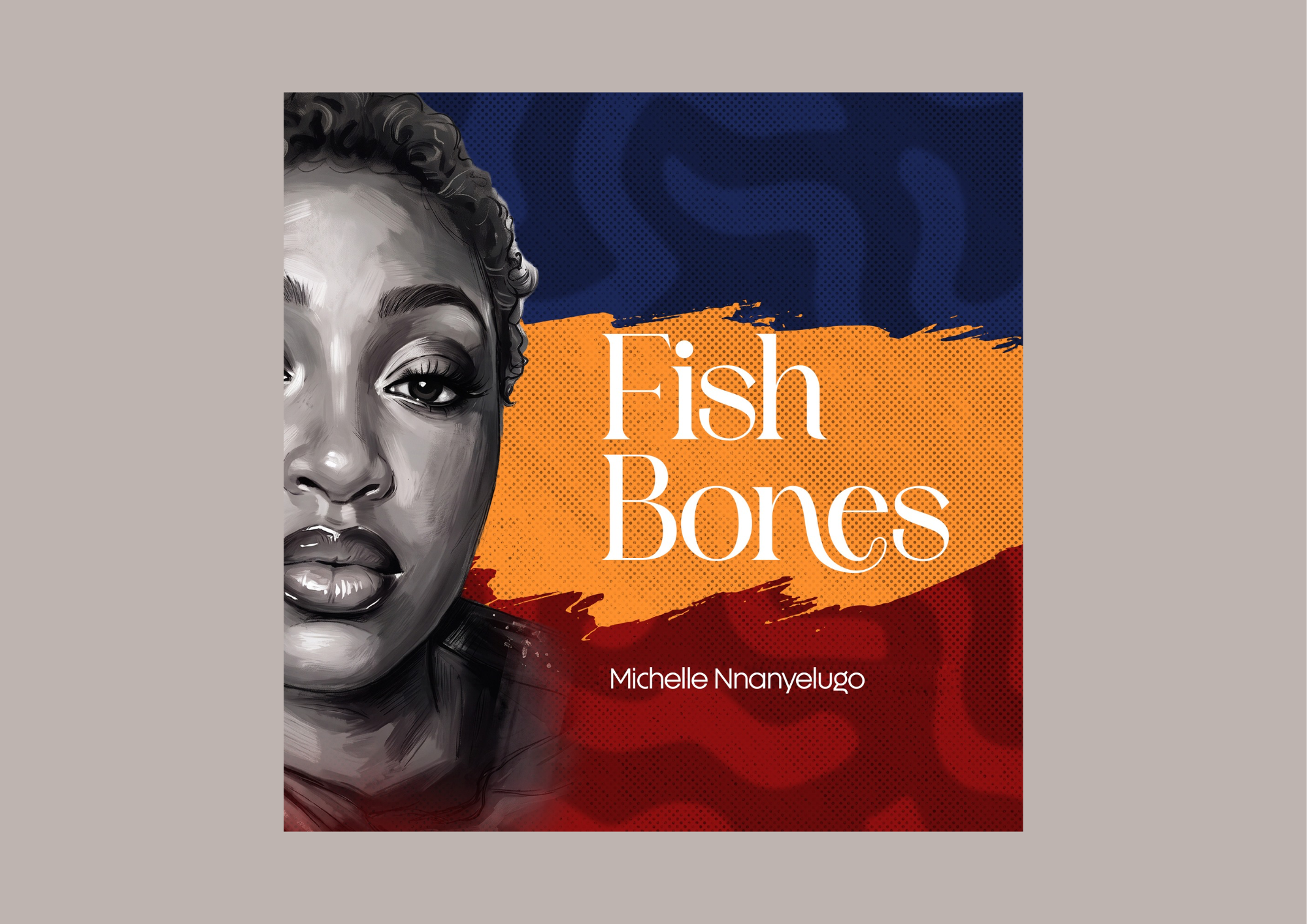
There is something particularly unsettling about the idea of fish bones. They are soft and often a palatable part of the meal. But fish bones often become problematic when stuck in the throat. Michelle Nnanyelugo attempts to introduce us to the many apparitions of grief, the grief integral to her womanhood, hence her body, and her daily life as a woman, the pain so woven into the firmament of her daily life like a kind of fish bone stuck in her throat.
Opening this heavy art piece with Dressing my Hiccups for Fun, “this body” interacts with grief. It is an unpredictable meeting, absurd even. “There are many rooms in this body. The walls inside me bleed red.” Grief becomes “this body”. Nnanyelugo surrenders to corporeal imagery to describe grief not only as an emotional experience but as a thing that acquires anatomy.
The second track, “Cover Photo”, opens with an ominous undertone. “There’s a bully inside my head. Feeding me lies hands-free. Teaching me how to paint my grief. I die daily.” Grief has acquired anatomy. Now, it must maintain its control over this body. Nnanyelugo has begun to tell a rather dark, poignant story only two tracks in, of a grief that holds the graces of a bully. There is an underlying eagerness to flex her poetic muscles, as one provocative metaphor gives way to another right on its heels. Some of the metaphors are striking; others feel a bit better placed.
“When I am a mouth full of sighs, I belch into other people’s joy.” She conjures a striking image of grief as an alienating obstruction to joy. One is transported back to moments of being surrounded by many but feeling most alone. Each line bears an emotional weight that seems almost too heavy to bear. In “Cover Photo”, she is a mere passenger in the vehicle of her body, taken violently hostage by grief. She is keeping cover over the wreckage that exists.
In “Headwrap”, Nnanyelugo reveals the intimate ways grief gnaws at the body. Her cadence quickens. The words tumble out in urgency as though she is building an emotional crescendo. “I know that God will not make me a mannequin.” In Nnanyelugo’s fierce tone, you can tell she is coming from a place of resilience. Her background music also elicits hope and belief. When a poem explores dark emotional territory such as this, poetic bravado cannot do all the heavy lifting. This is where pacing and storytelling become as important as the poetry itself. Nnanyelugo revs up the engine in track 3.
In “Halfway Home”, the tremors of grief persist, its residue still clinging to the speaker, but there is a discernible movement towards healing. She opens with the striking declaration, “I am embalming my scars”, an image that suggests an attempt to stir herself towards healing, and a determination to outlive her pain.
Nnanyelugo portrays herself as a poet with an appetite for arresting imagery; she demonstrates a firm grasp of the art of storytelling. She understands that an emotionally affecting piece must do more than present provocative lines. It must take the listener somewhere. And in “Halfway Home”, we are halfway home.
“I am learning to grieve with all my five senses”, she announces on her fifth track, “Banana Skin”. There is a spatial awareness of the dealings of her loss. Here, the catharsis is permitted to begin. If you listen close enough, you can hear a crack. It is no mere performance. It is an outpouring. There is a peculiar sadness, almost disbelief, in her observations of what grief has made of her body. “My body is an astonishing skeleton.” But there is also a shift in her understanding of what healing requires.
Will she overcome her grief? Is grief a concept that can be overcome? Nnanyelugo understands that grief is not something one simply outgrows or leaves behind. It may always occupy some corner of the self, but it need not remain in control. Through a sustained narrative, we experience an emotional arc. We began with grief violently colonizing “this body”; now she tells it “no”. No to a complete colonization of being—a search for a semblance of freedom.
There’s a subtle brilliance to her words. “…watching my confidence gasp for breath.” Confidence will not gasp if it has not been put into action. We find she may have won her first fight against her grief. There may be shivering, there may still be some masking, but she is emerging. She is peeking through the remnants of the person grief has left behind, even as she searches for the woman she once knew. In “Floor Length”, the seventh track on Fish Bones, reconciliation is triggered. She is looking to familiarise herself with who she is and the woman standing in the aftermath of loss.
“Grieving is a work in progress,” she declares in “Line Break(s)”, a recognition that seems to prepare the way for the EP’s final reckoning. Having traced the many ways sorrow inhabits the body and unsettles the self, Nnanyelugo now turns towards God, in search of a more complete purgation of her grief. But “God is Slow”, the evocative title of the closing track, reveals a growing estrangement from the spiritual authority she has turned to for relief. She has participated in the rituals, uttered the prayers, spoken in tongues, listened to the prophecies, and sat through the sermons. Still, she is desperately waiting to hear from Him.
“God is the genesis of my lamentations,” she declares. One cannot help but think of Job, whose suffering gives rise to an unrelenting interrogation of divine justice. Like Job, she asks why the tide of her grievous experiences cannot be turned, and why the God to whom she has brought her anguish has not intervened to take it away.
She pronounces herself a prodigal child—tearing away from the spiritual authority that seems to be withholding its love for sport. Although she is no longer submerged beneath her grief, she is marked by it. She is angry about it. That it cannot be taken away. Perhaps this is the success of Fish Bones. That it succinctly portrays grief in animation yet renders life to the aggrieved.

Michael Chiedoziem Chukwudera
Michael Chiedoziem Chukwudera is a writer, community builder, and entrepreneur. His works have appeared in Jalada Africa, The Republic, OkayAfrica, Havik, and elsewhere. He is the director of Umuofia Arts and Books Festival, and the author of the novel Loss Is an Aftertaste of Memories (Mmuta Books, 2024).