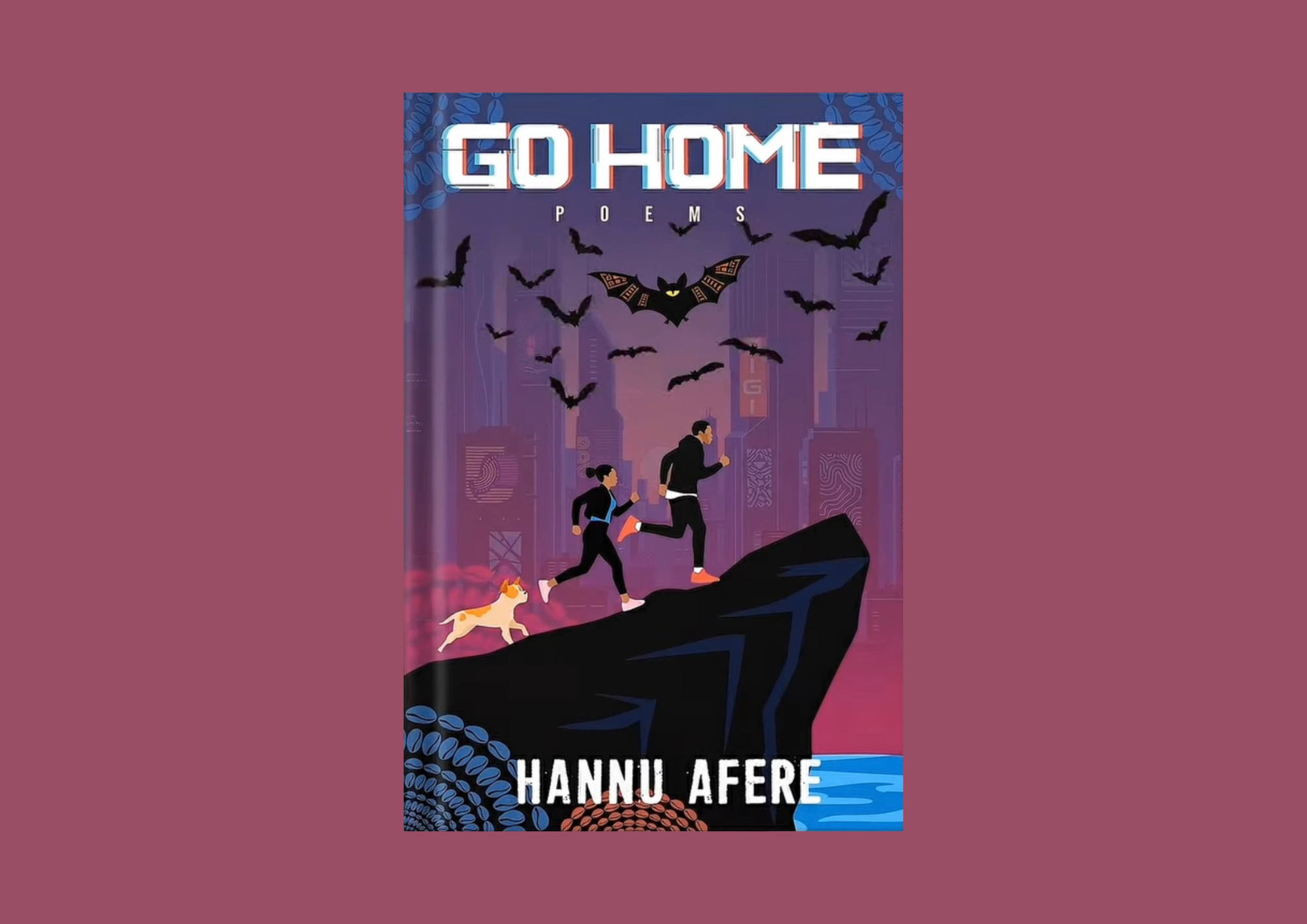
Hannu Afere is one of the young writers who were inspired by the Facebook wave of social media writers who began to write on Facebook in the early to mid 2010s. Known for his muscular prose, filled with witty and shocking revelations in commas, which he has also doubled into fantasy as a result of his gifts as a writer. And his poetry has since gained prominence among the wave of readers from those days, and he has continued to write to now. In his works, one finds a writer who has, over time, given his writing time and energy and developed it to the present state in which it appears in Go Home. And though it is obvious this writer seems a bit obsessed* with how much he knows, and his language often becomes a bit technical, the collection heralds an impressive power through the vision it attempts to espouse.
Poetry often aspires to unravel at the heart of things through language. And sometimes, the poet measures their lives and experiences with the teaspoon of language. In the poet, Hannu Afere’s Go Home, we encounter poetry rendered often from a first-person perspective on various themes ranging from his roots, the issue of identity in his immediate society, immigration, his personal life, self-determination, teenage romance, and self-revelation. Through his poems, the reader is offered a glimpse at the angst of a poet at the troubled civilisation from where he comes, and his lamentations through his art, towards the effect of these issues, to the Yoruba civilisations, and by extension to all the places his people extend across the rivers, as we can see in the imageries expressed in… to show the inclusivity of the problem both home and abroad.
In the opening poem, he writes, “Home is the place, but it is also the face./ The contradiction I carry through immigration…../Orisa breathing softly in their respective colours….and so you ask yourself–Will I be accepted, will I be scorned, will I be able to ignore the mockers and find community…” This sets the tone for a collection that sometimes can be likened to the lamentations of a psychological vagabond trying to make sense of his place in the world, and being a poet, he sets out to do it by shining the torch of language on the critical facets of his life, where the questions arise.
In this collection, the poet is playing with the tool of consciousness, which in a utopia is quite a rebellious thing to do. Consciousness alienates you in a society where people live as though following the programmes of a simulation, not fully able to be deliberate about their lives, and not fully aware of their crisis, and what they’ve lost. And hence, The Void Talks Back, “This is the badlands where they are hunting down prophets/ hunting down ink/ They’re hunting gangs and doppelgangers; they’re making a stink/ In the eclipse, in this sudden darkness, birds stop singing, hornets disintegrate/ As consciousness is peeled away from vessel, silence gets claustrophobic…” And we find that the poet is writing from a place of battling with uncertainty and curiosity. Uncertainty from being puzzled about the reality as he begins to understand it.
The poet is headstrong about his sense of place and the identity of where he comes from, and the numerous changes it has undergone. In what he writes, we find a writer outspoken about his emotions, we find anger, we find curiosity, we find the work of a writer who, through his work, expresses his frustration at society and expresses his wish in poetry that things were better, and also points the reader in a certain direction in which things could be better. In Queen, he writes about Africa in such nostalgic light, “her name’s changed so many times,/ but what I remember is we sitting in the sunset/ holding hands and duiker-watching./ she had this pretty dress on, sequins in sequence/ I put a rose petal in her hair/ & she took it out/ she seemed so mad that the camera only worked in sepia…” In this poem, he paints a nostalgic image of a woman cheated out of her beauty. It is one which heralds a memory of beauty and regrets, which laments the mode of the narrative, which she questions. Why does the camera only relay her image in sepia? Even in one of the simpler poems titled The Importance of Names, where the writer simply writes about what his father teaches him and what he realises and how he correlates with the rhythmic language that swings forth and back to the significance of Orunmila, the father of Ifa, to the poem and the message; Orunmila being the custodian of Ifa being a stronghold of knowledge and divination to the Yoruba corpus. By putting himself in the shoes of Ifa, who learns from his father, through his poesy, the poet embodies the pursuit of consciousness.
One of the important things of poems like those, like some of those in Hannu Afere’s Go Home, is the unpretentiousness and how you find that an author like this writes poetry from his convictions, from the rhythm of the convictions of his original feelings. And the poems often get intentional in telling stories; of coming of age, of youthful love, which one leaves because they do not feel they are ripe enough for their partners, a poem where the poet asserts his decision not to have children, and defending his decision to be a tree that chooses not to branch. Hannu Afere’s Go Home, hence, embodies consciousness, self-determination, dissidence, nostalgia, and it experiments with history [a typical example is the poem titled 1885].
In this collection of poems, Hannu Afere has put his characteristic audacity to use in crafting a collection of poems that is striking, experimental, and intellectual in its own lane. It is the work of an unrelenting craftsman known for the fierceness and intelligence of his stories, and now his poems.

Michael Chiedoziem Chukwudera
Michael Chiedoziem Chukwudera is a writer, community builder, and entrepreneur. His works have appeared in Jalada Africa, The Republic, OkayAfrica, Havik, and elsewhere. He is the director of Umuofia Arts and Books Festival, and the author of the novel Loss Is an Aftertaste of Memories (Mmuta Books, 2024).