1.
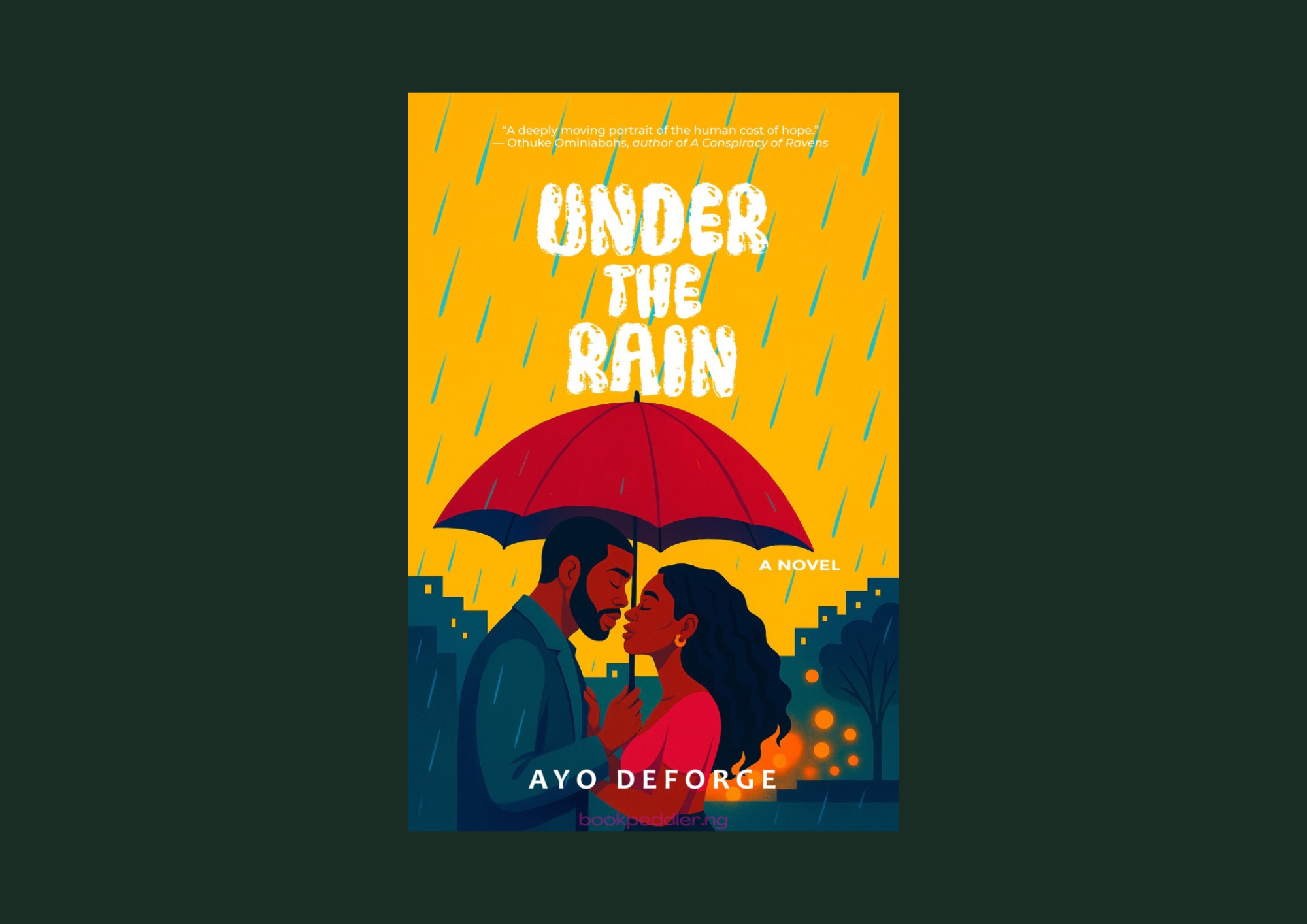
What the jury knows about dating in Lagos is that it remains a horror story. It did not even start with Damilare Kuku and her dreary chronicles of the same in Nearly All…. Our love interests in Ayo Deforge’s new book, Bolaji, and Shola, think they have hacked it. Dizzy desire would drive them to great lengths, sticking it to the rogue city of lore, to hear what Bola Johnson told everybody all those years ago: Lagos will outmanoeuvre you.
A central portion of Ayo Deforge’s Under the Rain takes place in—or is affected by—Shola’s small apartment in Ozumba Mbadiwe, and yes, the sky “hangs heavy with brooding clouds” most of this time. Ayo’s pen is thorough, and sentences convey force from a hand that greedily absorbs and observes life. She turned to poetry as a teenager, confused by grief. There, she must have stumbled on a field of carnations, began to make garlands of misery, worlds from a black hole. Lagos, 2007, a learning journey in genre through Adichie’s eyes. The manuscript for Tearless was completed soon after, and it was self-published in 2023. A coming-of-age character discovers post-trauma, precisely psychoanalytic. The book is shortlisted for the next year’s ANA prize.
France, 2025, Ayo’s own convalescence. She lodges in nonfiction, a memoir about a child without a mother who becomes a mother without her child, Grips of Grief has a happy ending, though. A poetry collection of restored tendrils. And, a follow-up novel about second chances and the other side of heartbreak.
2.
Under the Rain, published by Witsprouts Willow, reiterates one industry truth: the dividing line between good and great boils down to compelling characterisation. Characters whose manner of balancing the world puzzles you for many rainy seasons, like Ifemelu and Obinze, with whom our star-crossed pair happen to share some acquaintance. Bolaji’s legal wife, Yetunde, despises rain and abhors sex. This is important because the last bit is Bolaji’s justification for running around the book with another man’s vacationing wife. That, and childhood nostalgia. In the opening 100 words, she’s spurning post-coital cuddle, “Did you enjoy it?” “Is it food?” Yetunde mutters. Then she disappears into the bathroom and is not heard from for the rest of the story. Your many questions would scarcely be addressed during Bolaji’s copious backstory—it makes up half the reading time, a precisely researched plot of his career growth. Okay, the love of your life dumped you for an Americanah, we still demand justifications for your decision to marry, of the exceeding women in Lagos, the one who “hated kissing, and tolerated a peck,” whose foreplay consists in “mentally preparing for the worst experience of her life.” And then grumble about it. They have children, mind you, and charming Dr. Bolaji Akalla knows more about combining romance and reproductive therapy than three of us. One could go on a tangent. Simply, Yetunde is flat, common with many minor characters in this book.
Shola has a taste for the wild life, privately shamed of her inability to conceive, and properly shaded. Bolaji, whose eyes lead us along, is most intriguing; an inspiring sex-positive icon preaching reproductive rights on the radio. Publicly seen around single women, may occasionally perk Shola’s bus on his examination table ahead of surgery on a haemorrhaging patient. In the early chapters, we learn he is a security risk due to his activism on abortion legislation. Threatening emails, social media hate, suggesting there is aversion to him from men who deeply care for traditional family and religious values.
This subplot highlights Bolaji’s radical streak, his principle-rooted bravery. Perhaps even balances the infidelity? This setup is an opportunity to appraise a balance of his personality, in love and in war, as well as to take explorations a step further into the socio-religious tension around reproductive autonomy and, by extension, gender power dynamics. Issues like this are incredibly explosive in real life. Activists are assured a work atmosphere of disgust, slander, and persecution. Damningly, the plot thread is filed in the same cabinet as Shola’s marriage to the gold-loving investment banker; little is developed of it. It is all written off later on in the denouement as architectured by “just an angry man.”
3.
Deforge is sprucing up one of the oldest story arcs when she opens the universe to multiple plots on different levels. And it works, as far as the price in compacted narrative is paid. The rain motif is a thread connecting Bolaji’s past to present, an effective plot device when needed. This is also one of those contrived narratives where conditions fall in your lap; he yearns for his university trysts with Shola after the eventful open (finish, as it were,) with Yetunde. He is driving the next day, and voila, Shola, taking a call right in his backyard. He feels he has “summoned her from the depths of the United States with his thoughts, as if he were a magician performing an astounding trick.” The name of the trick is authorial convenience. It is not a gizmo she forgoes beyond this one time; Deforge’s and her self-assured pace already set the bar high, and her hold on moving parts, as the story progresses, ensures that things do not degenerate into a bad book. But who can keep up with a rushed plot? That being said, this is why Under the Rain is worthy of your book club’s time anyway.
The author renders context and environment with precise clarity. For the time spent in the psychic commotion of the Dr., we are treated to meaty portions of the sweet side of Lagos, upper crust living, as well as “cheerful vendors who roamed the streets, the Ewa Agoyin sellers carrying a bundle of pots, tailors created mellifluous music with their scissors.” Organised in five sections, the story weaves between the present (heady days at the apartment) and the past (Bolaji and Shola’s friendship from childhood through university). “…with numerous duplexes still unoccupied. The air was still pure—the sand lining the roadside was still as clear and sparkly as the white beaches along the Atlantic Ocean. The drains, still unclogged . . .” We almost watch the gradual abasement of the former capital in the backdrop as leadership overlooks overpopulation and the pressure on the lacking systems.
In the foreground, our charming doctor ascends a miserable life centred on his sickle-cell younger brother. He falls in love with his new neighbor, Shola, in a manner that would not have raised as many eyebrows among close friends if it were written before After, released in 2019. We listen to him negotiate and mature from the experiences that make him the man he becomes. Demonstrating the transformative power of love, view this scene with a particularly fascinating minor character. The taxi driver who rides Bolaji to confront one of Shola’s boyfriends—Ayo writes proletariats as incisively as she does new money people of the Island—though they previously decided it was a bad idea and he has no hope in a fight. But the seeds of courage are watered by defying circumstances that terrify, as this. In the middle of extracting the most cash from this visibly agitated boti passenger, the driver switches allegiance to interfere when Shola’s boyfriend is heard physically illustrating power points on her. “If I hear say you carry hand beat her or any woman again, you go cripple comot for this area. You hear me so?” “You no fit do anything joor,” “Ok na, wait—just know say you no go go Unilag again be that.” In dialogue, the story truly comes alive.
In Under the Rain, Ayo Deforge captures an emotionally graphic and rewarding story on the enduring, overriding power of what is popularly labelled “true love.” The secret is nothing but a series of daily presence, reaffirmation, and commitment. We live through missed opportunities, terrified bravery; laughing, despite ourselves, because the couple has magical chemistry. The novel connects to broader human experience, depicting a consistent interwovenness of womanhood and sexual vulnerability in modern Africa. Well, it is still a story about grieving. It is written quite well, despite all the open questions and plot holes. On the whole, it is still a book I have no qualms going back to a third time, traveling in a fast car.

Ebri Kowaki
Ebri Kowaki is a culture journalist, a music commentator, and a MAAR 2025 fellow. His work has appeared in The Republic, Afapinen, Afrocritik, African Writer Magazine, and elsewhere.