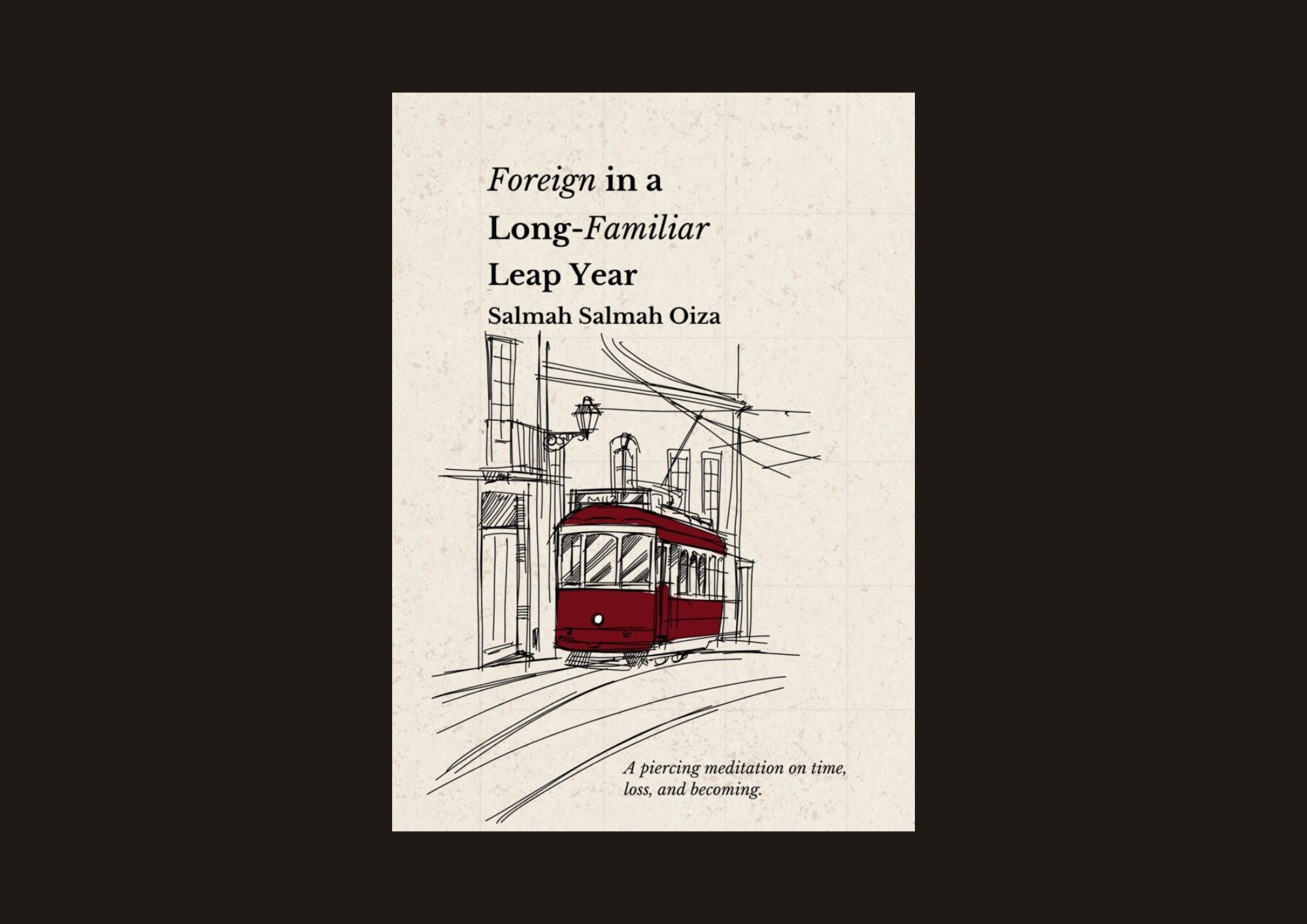
Migration is today one of the concerning subjects in contemporary African literature. Partly because it borders between status symbols and the consequent need to find a safer space for ‘survival’, it has gained attention as one of the critical conditionings of socio-political realities – at large. But the writer reserves the right to reflect on its impact. That is, the reality staring one in the face as a matter of personal and/or interpersonal crisis. This provides the background for reading Salmah Salam Oiza’s Foreign in a Long Familiar Leap Year (Foreign…Leap Year hence) as an account of the diasporic experience.
The subject matter of this anthology is the recollection of a year-long feeling, consequent on the persona’s relocation abroad. The persona feels different each month, attributing these mixed signals to several human and natural factors such as weather changes, emotions, nostalgia, health, etc., etc. More fascinating is how these feelings dictate characters – implicit and explicit – whose interactions with the poet-persona provide a comprehensive detail in a thumbnail. Foreign…Leap Year is, in brief, a diary detailing the subtle, highly significant events an individual experiences in the course of adapting to the definitive changes that redefine man as a survivalist.
At the preliminary phase, the poems are meditations on the stark realities of migration. One might wonder why the poet-persona feels quite ambivalent. Of course, it is one of the unspoken conditions that migrants have had to contend with. However, in Salam Oiza’s delivery, the feelings are layered with personal and interpersonal roles in the extent of home impressions abroad. This, although it is the first take from the diary-like poems, creates a paramount and ultimate view of what migration means.
Perhaps no one wants to be so bold as to say they miss something about home (not home!), which makes life an integration of the journey motif. If the reader then takes the journey motif into account, there is that unmistakable observation of different feelings attending certain stages. Because that journey is an amalgam of personal and largely socio-political interventions, there are anxieties and uncertainties. But poetry is purely human. It uses the voice of one person to project a universal situation. Foreign…Leap Year, therefore, captures that world in a thumbnail. Within this circle, there are personal conflicts to be unearthed, broadening the reader’s vision of migration as a kind of ‘class’ predicament, so to speak.
This is so because man is said to be a product of his environment. In this regard, Salam Oiza’s account in this personal reflection portrays that universal concern of man’s adaptation. For context, there are differences in weather conditions, social security, food, culture, and other aspects of the broader social environment. In both explicit and implicit terms, the poet-persona captures the impact of these conditions. In a much deeper sense, the all-encompassing effects of this change come down to inner conflict – a term that, in this context, means coming to terms with the discomfiting experiences of emotional crises.
Within that margin, it is not irrelevant to attribute personal failures to the compression of a larger failure of society. For the migrant, there could be internal dysfunctions in the political atmosphere (which cannot be divorced from the pool of contemporary African literature), which can mitigate the compartments of individual happiness. Immediate social insecurity also contributes to the subject. Whichever is the case, the internal conflict lingers, regardless of the satisfaction of crossing the Atlantic, even as the poet aptly captures in Mother Calls on the 29th: “But even prayer must learn new vowels/when crossing borders.” This statement is quite rhetorical. And it sets the poems in motion for the unsettled (and/or unsettlable) rifts occasioned by what the poet lyricises thus: “perhaps we’re living someone’s dream / or a version of their nightmare (FIALFLY, pg 17).
Consequently, the poet-persona proposes a metaphorical implication of weather. Changes! Existential changes! Love and friendship may begin to sink as we lose touch with acquaintances. Perhaps even romantic love is a noteworthy casualty of this drama, as Salmah Oiza suggests in one of the poems. This declension is not strange: it is simply a recurrence of the fate leitmotif proposed by Shakespeare in his love plays – being a universal picture that prefigures all others unmistakably. So, changes in overseas weather have implications for how we perceive our world and what we make of it. Also, health changes consequent in the environment are permissible. So, Foreign…Leap Year is a critique – if not criticism – of the redefining changes that happen to a migrant to the degree (or in the proportion) that their sanity can bear and beat.
But the driving point remains this: this anthology shows us what we might term literature of the sad person. Apparently, grief on the occasion of the death of a loved one is not the real melancholy of the modern world. It is how we are severed from the pristine ways of functioning in interdependence. An informed reader will not misconstrue the wit thereof, as given in the poems’ fluent delivery of emotional purgation.
In another character, the style in which the poems are written portrays an affluence of thought process and language control. True, it is obviously suited to contemporary lineation; however, the depth of emotion (an exclusive preserve of poetry) that Oiza touches is overwhelming and persuasive. A fine diary of spectacular moments. Reading Foreign…Leap Year brings the reader closer to the lifeblood of poetry. That is, the poems are delectable with their accessible literary devices, absolving art of being an esoteric exercise and the reader’s admission to its meaning of an act of God.
For context, the cultural obscurity in Mother Calls on the 29th creates a rhetoric of religious values. This, in turn, deepens the reader’s understanding of the fundamentals of poetry that Oiza incorporates: the implications of background – cultural, social, and other windows. The poetry here is immediately objective, altogether mimetic, symmetrically expressive, and fairly pragmatic. That is, it speaks to the reader accessibly and generally screens a component of society.
The themes are therefore true to these provinces. Chief among them is the journey motif. This is both literally and literarily placed in the poems. For the former, the poet simply undertakes a course of exploration for a specific function, outside their homeland. In the context of African reality, this may be for education, work, or any other case. For the latter, it is the transformation of the internal struggles against matters of fate. Love being prominent – love and friendship, love and acceptance, motherly love, etc. There is also the theme of evolution and acceptance. Nature’s wonder. Beauty and environment. Personal conflict. Skepticism and anxiety. Love and welcome. Healing, etc.
The tone of the poems is ambivalent. The poet feels both optimistic and anxious about coming to terms with migration. But more profoundly examined, is this not even the swell of civilisation? Of course, both feelings are inextricable, given the modernist angst fueled by the governmental dysfunction in developing nations. But while this is not immediately suggested, it cannot be sidestepped. The meaning of a poem, it is said, works throughout the rest of our lives. Therefore, the long-term spectrum of these lyrical verses calls for such sensitivity.
To conclude, Foreign…Leap Year is written with a unique eclat. The way the words swagger on the page dictates the elegance of the style, suiting visual appeal to meaning at large. And the content is very richly hatched and tactically curated. With such wit and fluency, the achievement of Foreign in a Long Familiar Leap Year is that fluency of emotional purgation that yokes personal experience in the clamouring vision of society as a whole.

Kehinde Folorunsho
Kehinde Folorunsho is a literary critic and a scholar of literature. His interest in literature spans poetry, visual arts and translation studies. He made it to the shortlist of the Atẹlẹwọ Prize for his Yoruba translation of Chimamanda's Ngozi Adichie's "We Should All Be Feminists"; shortlisted for the Gbemisola Adeoti Poetry Prize, 2025. As a book reviewer, he has been published in local newspapers. He is the recipient of the 2025 Ken Saro-Wiwa Prize for Book Review.