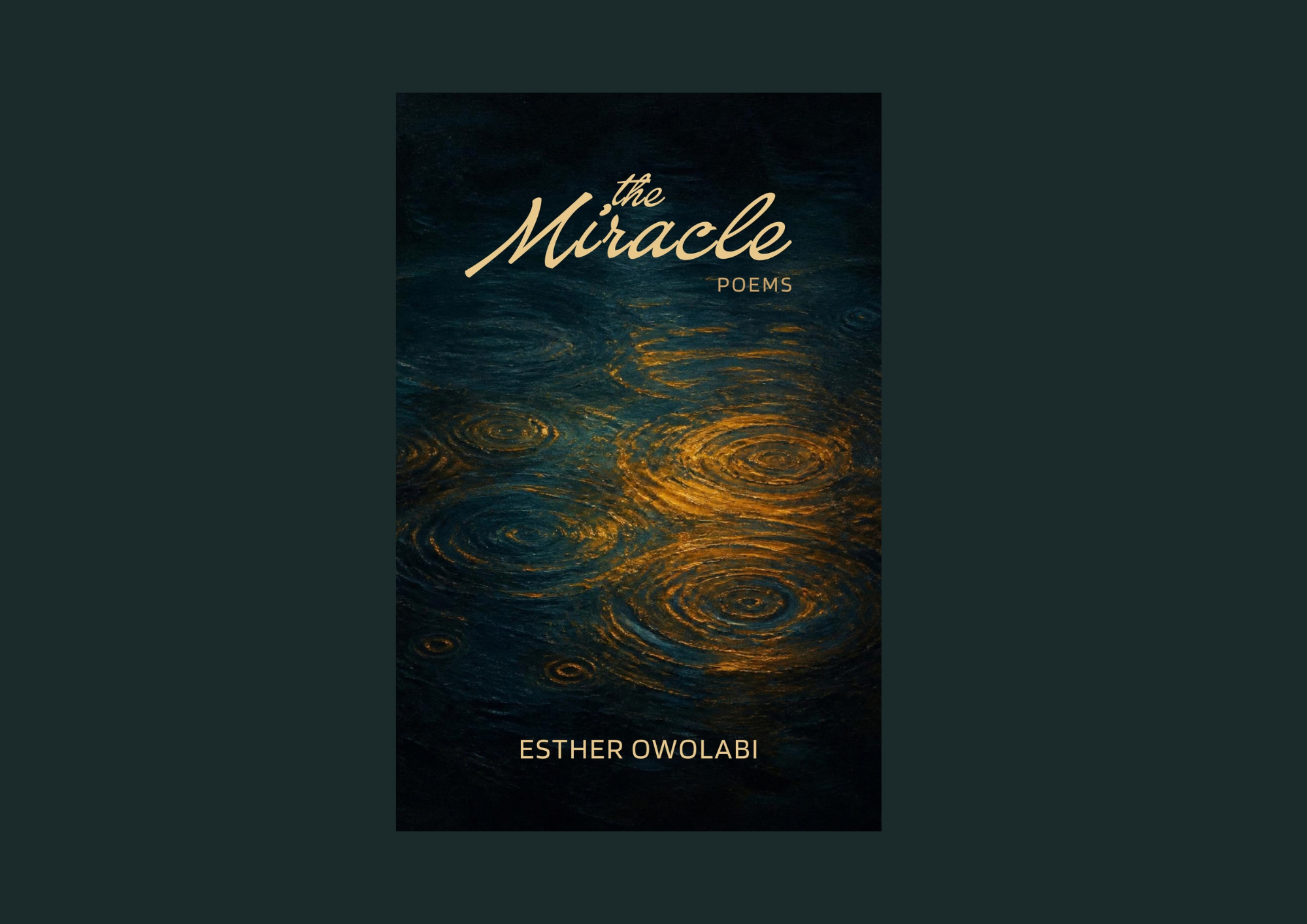
Many possibilities exist for how the contemporary poet captures disillusionment in dreaming, but the distinction always lies in the level of emotional awareness involved. Poetry, of course, is an emotional experience coming through language. For anyone who is intimate with the poet’s discontent, this is an era when several prospects are depleting at the same time. That diabolic nature of socio-political dysfunction remains a hurdle to cross when ambition is the case. In search of alternatives, migration happens. But even this indulgence has produced another kind of criticism among a demographic of Africans. It has proved all along that the tragedy is ubiquitous, albeit in a different context of societal membership. One of those subtle constraints of Migration is central to Esther Owolabi’s The Miracle.
The anthology is a packet of thirty poems that follow the persona’s impression of the present world’s insecurities within the ambit of familial love and patriotism. The poems offer a glimpse of what the world has become, where change does not guarantee a secure environment for ambitions to thrive. This is because nowhere is it truly safe and perfect. The world is torn by different shades of incapability, no matter the condition and setting. Thus goes the poet’s encounter with the wider world of glamour, but with a different layer of fault. But this is only an overview: the real business of societal analysis must be duly explored by the reader to have a rounded grasp. What therefore are the capsules of poetic brilliance that come to mind?
It is in the ingenuity of man to seek better grounds to express his creativity to live. Otherwise escape. That instinct has since transcended fantasy; it is fast gaining ground as a prominent alternative to fulfill some promises to oneself. But what are the prospects of migration today? Among the various reasons, what The Miracle offers the reader is a personal note on its implications for familial relationships. Whether immediate family or any other fondness that one may share with motherland: “…the roads run farther/And farther away from all the places/We used to call home (The Roads Have no End). But that’s for the immediacy. It goes further as offering a view into the oddity of certain social structures – which the reader will interestingly unearth in the reading process – that redefine the ecstasy of leaving the country.
No matter how one chooses to address it, the emotional and psychological atmosphere is not the same for the outsider – or intruder even. And before we hastily land the premise on the concept of identity, we need to be conscious that awareness differs. Either from what one thinks about oneself or what is said or spoken of one, there is such a thing as the victimization of self-importance. The very basis of how one sees oneself in an environment devoid of certain agencies of recognition. Again, it is up to the reader to draw from a different kind of awareness of person in The Miracle, wherein the persona asserts: “I have been called many names/By the many mouths of the world (Identifying Myself).” This requires a more intricate approach to what we know as identity. Therefore, identity serves as an umbrella term for what Owolabi presents in this anthology as a personal note on the reality of self-awareness.
Conversely, socio-political dysfunction has a universal dimension. The anthology also examines the layers of social marginalisation – from racial inequality to the prejudicial tendencies of class consciousness – and status sensibility. This is most clearly captured in “The Stories are all the stories are all the Same.” Stories, events, and situations definitely determine our condition in different political economies. But here, the poet’s address concerns the meeting point of the hapless conditions of social membership in visual domestic activities. From colour disputes to broader issues of controversial privileges and rights, as the case may be. Society as a whole is ravaged by intricate plots of differences. And as an observer, the persona makes a rich note to dissolve the presumption of a wonderland anywhere.
Consequently, the poems assume an outlook of the element of the absurd: “where all the myths begin to fade (After the Rain).” This is the beginning of self-consciousness as against communal belief. The poem’s intersection of two worlds provides a basis for the poet’s criticism of our inescapable circumstances. It is indeed a myth to cling to notions that cannot disambiguate the problems of identity and political economy. The yoke is inextricable. This is why the concept of migration achieves a more direct approach to its initial motive. Esther Owolabi’s personal agency in the present-day disillusionment comes across as a balanced view.
Furthermore, the anthology offers a successful, comprehensive critique of the postmodern world. It offers a historical (albeit implicit) background to the century’s physical devastation. It is also political, since that cannot be divorced from the dimensional plunder of this human society. But precisely, there is attention given to the physical waste of the world through war and industrialisation. The devastation visited on the physical and social environment; the severing of the cord of brotherhood between man and nature; man and man; continent and continent, all for resources and power in the fit of ‘colonial’ impulse. And the poem “The Wound as We Know It” suggests the interdependence in mutual anomie. It shows how economic depression in one part of the world ripples from squandermania in another.
Among its numerous themes, the following are dominant: migration, war, racial prejudice, identity, nostalgia, familial love, political crisis, optimism, etc., etc. The extent to which these themes are discussed boils down to the reader’s anticipation of a new approach to existing issues in contemporary poetry. In fact, the reader must determine for themself the real sense of the economic climate and social atmosphere that shape psychological responses to disenchantment.
Finally, the fiber of poetic richness in The Miracle continues to take the reader through the compact length of the poems. As such, the brevity of each poem is a fine éclat. This noticeable stylistic effect facilitates thought and engagement in the reading exercise. The anthology has emotional balance and decorum which reminds one of JP Clark’s lyrical verses! This is perfectly achieved through the poem “Early Mornings at Derby County.” In addition, sarcasm, paradox, and irony are its distinguishing devices. The Miracle has a distinct voice among the many poems that detail the traveler’s experience amid the ubiquity of social breakdowns.

Kehinde Folorunsho
Kehinde Folorunsho is a literary critic and a scholar of literature. His interest in literature spans poetry, visual arts and translation studies. He made it to the shortlist of the Atẹlẹwọ Prize for his Yoruba translation of Chimamanda's Ngozi Adichie's "We Should All Be Feminists"; shortlisted for the Gbemisola Adeoti Poetry Prize, 2025. As a book reviewer, he has been published in local newspapers. He is the recipient of the 2025 Ken Saro-Wiwa Prize for Book Review.