In the beginning, God moulded the earth from nothing,
He gave man hands to tend and not to destroy,
All things were bright and beautiful.
All creatures, great and small, were plentiful.
The lush pink of the rose flower,
The plush purple of the wild hibiscus,
All things were bright and beautiful until man set the flowers ablaze,
And earth learned the rhythm of fire.
In the year 2025, the Northwest winds carried dust from the Sahara and threw it into the Okitankwo River. The winds blew across the rainforests and the savannah. Like a goddess on a vengeance mission, it displaced everything in its path, sand, heat, and even the reptiles. We had never witnessed a dry season so vicious it made all the wells dry and the sand burning hot. The harmattan that year was not gentle either. It wasn’t the gentle one our grandmothers remembered, when the cool breeze brought relief from the rains’ humidity, and women rubbed shea butter on children’s skin to keep dryness at bay. That year, our river did not come home.
The Okitankwo River had always been of cultural and spiritual significance to our people. Grandma told us that in the days of her youth, a mother and her newborn usually stepped outside for the first time after four weeks postpartum. They would be cradled by the traditional priest who would scoop a handful of water from an enamel bowl and sprinkle on the forehead of the baby, who would usually cry as the cold water drenched her. There would be roaring and laughter from the crowd at the child’s naming ceremony. The child would be given to her father, who would raise her to the wet skies and call her names. The child would stop crying, watching as her father whispers her names: Mmiriozuzo- the rain has come, Obianuju- born into wealth, Nnenna- our mother has returned. That way, the child would never forget where she came from; she would always follow the river home. These were not mere rituals but acts of rootedness, tying each child back to the water and to the community. A child named after rain bore the promise of abundance. A child drenched in river water carried the blessings of continuity, of lives that refuse to stagnate.
As the river began to shrink and become polluted, those in tune with the ways of our ancestors kept the ritual. The mother and child would stand under an umbrella, and the father would take some sand from the earth, mix it with spittle, smear the mixture on the child’s head, and make a sign of the cross like a priest during Ash Wednesday. The father would pray that the child’s life be the memories of moist soils that grow greens, of rivers overflowing their banks. He would take the umbilical cord and bury it under the leaves of the udala tree, whose roots reached deep. The tree had been a wonder in its youth, my grandma pointed out, when Okitankwo still ran through its veins. Now, its snarling bark was ridden with woody wrinkles, reminiscent of agony in death, looking twisted and thirsty.
Under the relentless heat, I sat on the veranda and pondered the loss of where I once called home. I tried to cry, but my eyes were dry as the rabid November sun. Okitankwo River ran through at least five villages including my own Mbieri, in Imo State, Nigeria. It didn’t cower in the face of the fierce heat in the dry season. Bordered by sweet potatoes and sugarcanes that we grew along its edges, it came at the beginning of the rainy season and signaled the Ofa season. We would use the smooth white pebbles that lay at its bank to scrub our dry feet till they became soft. The waters were so clear that we often saw fresh fish gliding against the tough currents; so clear that one could reach out and catch fish with both hands.
Our elders taught us that Okitankwo was heritage, the blood of the earth flowing through the veins of our community. The river knew our names before we were born; it sang lullabies to the children who played by the banks and blessed travellers’ feet. More than a geographical feature on a map, it was the thread that wove our five villages into one fabric, the common language we spoke even when we had different dialects. It was a history lesson, bearing stories from the dead to the living and to the unborn.
White sands from the banks of Okitankwo were used together with pawpaw leaves to scrub the blackened backs of our pots and kettles till they shone. We would roll our eba into the thick spicy nsala broth, laden with catfish, and swallow it ‘gbim gbim’ down our throats. Shouts of ‘Mmiri ayola, mmiri ayola!’ would rent the air when the river returned. At the river’s edge, we forced the marshland to produce sweet sugarcane when we farmed with skill, waiting patiently for the sweet yellow bananas. The women in our household would carry the bananas in long baskets and ferry them to the next village, where other women would hustle for the white sugarcanes in exchange for cubes of soap and seasoning. We would sit under the full moon sharing fruits and telling stories.
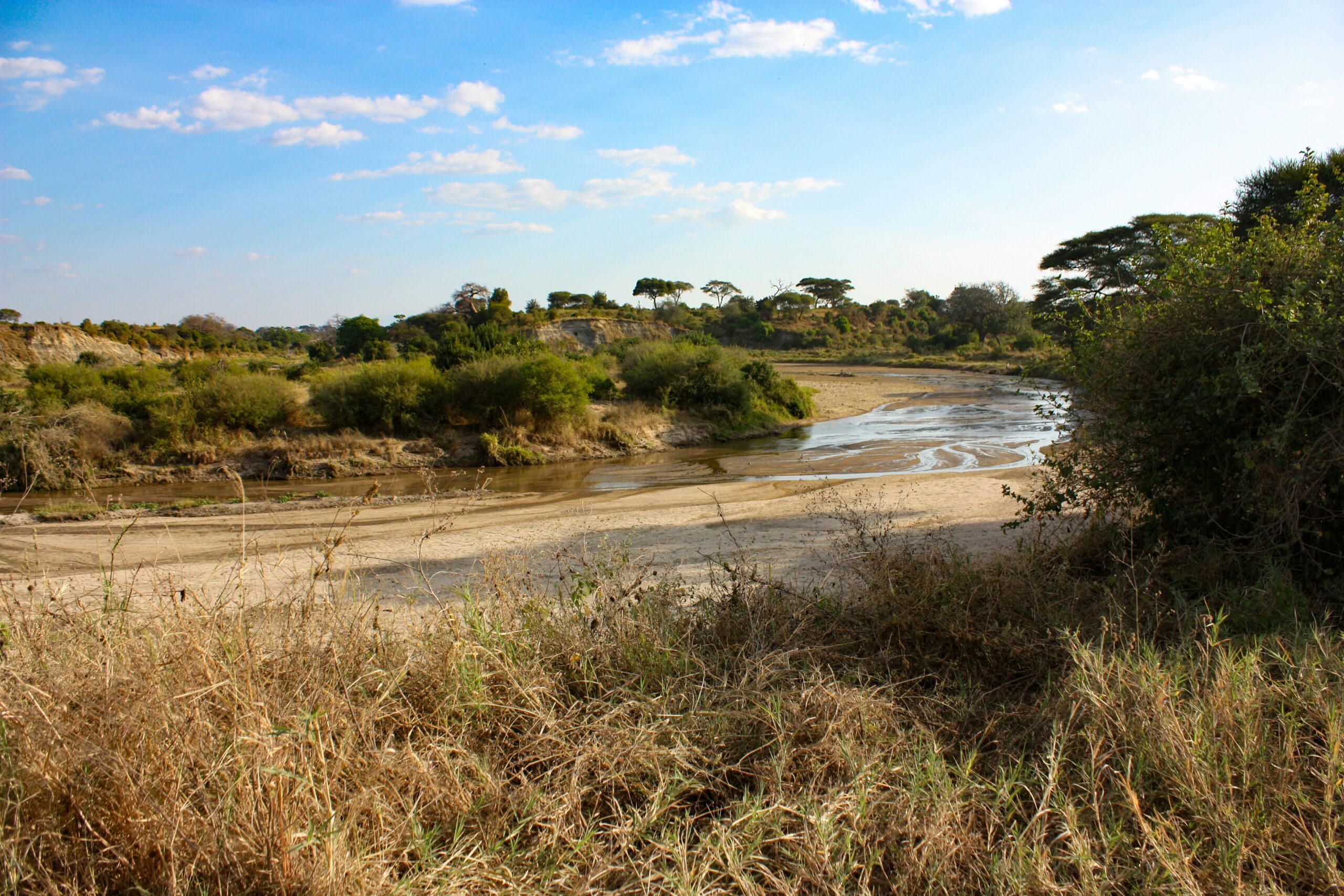
This generation of children will not sit under the moon. They will be taken to the Okitankwo River and shown the path the waters ran; they will see that the swamp that held our crops was now ridden with remnants of water grass, and the waters had retreated like a tortoise into its shell. The children today would not know what fresh fish from Okitankwo River tasted like; they will be content with eating smoked crayfish and tilapia. Now the water left is too warm and toxic to support aquatic life. The fish displayed by the fishermen has been dried so much it could leave cuts in someone’s mouth. No one uses the sands anymore; tiny green worms danced on the surface of what was left of the swamp alongside different generations of mosquitoes that invaded our houses at night, disrupting our sleep with the constant ringing sound and pumping malaria into our veins.
My mother said we had offended the gods. Anytime I went to what was left of the river, I saw eggs wrapped in red clothes and bottles of Fanta. All were offerings to the gods to bring back Okitankwo but it did not return. As I grew older and watched how nature changed all around me, I knew the gods were not to blame. The factories in Port Harcourt belched smoke into the pristine skies. The logging companies took our trees and caused erosion. The oil spills in the Niger Delta drove out fishing communities. Then, the rains stopped coming in April. There was only increasing heat and dust winds. My grandmother’s rivers became my mother’s streams which became my puddles, which will become my children’s dust. When you have never known a flowing river, how do you mourn its absence? When you have never tasted fresh fish from clear water, how can you reject the tough, dried, tasteless substitute? When the stars have become invisible behind city lights, how can you feel their loss? The children of today have forgotten that stars are part of the night sky. My little cousin has never put a paper boat on water before and watched it sail seamlessly with the water currents.
The earth was changing rapidly around us, and I was afraid. Psychologists called my fears eco-anxiety. The idea of what nature is, shifting as we move from one generation to the next, yet no one cares. People shrug when the Federal Ministry of Water says that Nigeria’s wetland loss increases by 6.5 percent per annum due to rapid urbanization. The statistics are too vague and distant to capture the grief of standing where a river once flowed and finding silence.
I chose my present residence because of the wild greens that grew behind it. Each morning, I would wake up to bird song and sunlight filtering through the leaves. A large patchwork of woods, fields, and umbrella trees stood behind my hostel, untouched amid the expanding suburban grid of streets and lawns. With my apartment, I had found an oasis in a desert of bricks and asphalt, a symbol of resistance against the machineries of advancement.
One morning, I woke up to the sound of a roaring chainsaw, the big ones with wicked edges used for felling giant trees. I watched the blade drive through the fleshy bark of the tree like a knife to the bones, and my back twitched in response. Rumors had been flying that the government was coming to build a secretariat on the land. The rumors were true.
Silence,
Melancholy,
The cooing of passenger pigeons stopped,
The whisper of sweet breeze on green leaves paused,
Loss, grief…
A part of me fell with the trees, like I had lost a dear friend to death. I went through what the psychologists call the stages of climate grief. First came denial, next climate rage consumed me; then burning, rising anger at the contractors who wielded chainsaws and the officials who gave them permits. Then followed this fear that it would only get worse; the floods would rise higher, and the heat from the sun would become very unbearable.
Every day, I woke up to something new on the land. Soon, a foundation was dug, and the building started taking shape. I took up my pen and wrote to the Ministry of Water and Land Resources, but no one came. Soon enough, a building rose from a massive area of land that once held Amazonian trees and different species of birds. Yet I kept writing to the Ministry, writing columns, not because I believed my words alone would stop the chainsaws and stop the rivers from drying up, but because my silence felt like complicity. Documentation is in itself, a form of resistance because bearing witness matters, especially when the world seems determined to look away. Each column I wrote was a refusal to forget, like a picture frozen in time was a memory to remember.
Until we understand that we have wronged nature, Okitankwo would never come home. But understanding is not enough. We need action, urgent, collective, and sustained action. We need to rebuild our relationship with the earth, to remember that we are one with nature, not predators. When we hurt earth, we hurt ourselves, and the river’s return is not dependent on offerings. The Okitankwo River in my village has taught me that some losses are irreversible, that some damage cannot be undone. But it has also taught me that every generation has a choice to accept degradation as inevitable or to fight for renewal, to pass on barren land or restored ecosystems, and to be remembered as the generation that turned away from the earth or turned back toward it.
Okitankwo can still come home. Maybe not the old river, but new rivers born from our commitment to healing and fed by our refusal to see this disappearance as normal. The question is not whether we can save everything we have lost. The question is whether we will fight to leave a world that children can inherit where rivers will always come home.

Chidera Udochukwu-Nduka
Chidera Udochukwu-Nduka is an award-winning Nigerian-Igbo writer, screenwriter, creative professional, and pharmacist. She won First Prize in the 2025 Iskanchi Magazine Prize and the Letters Category of the 2025 LIGHT Magazine Contest. She was runner-up in the 2024 South African Bloody Parchment Horrorfest and received second prize in the 2024 Dissolution Climate Change Essay Contest (Litfest Bergen, Norway).
A recipient of the Kokonut Head Writing Residency, Chidera has been shortlisted for several literary awards, including the Afro-Abebi Award for Non-Fiction and the Akachi Chukwuemeka Prize for Literature. Her poem was selected for the PIN Best Poems of 2024 Anthology. Her work has appeared or is forthcoming in Isele Magazine, Midnight & Indigo, Brittle Paper, Harriet’s House, BIPOCrypha, Lagos Review, Akpata Magazine, Ngiga Review, Mythic Picnic, Libre Lit, and several international anthologies, including IHRAM Invisible Chains and Indaba Bafazi SFF Anthology. Find her on Instagram: @queenderaa001, Facebook: @chidera.udochukwu.1, and X: @chi_deraa001.