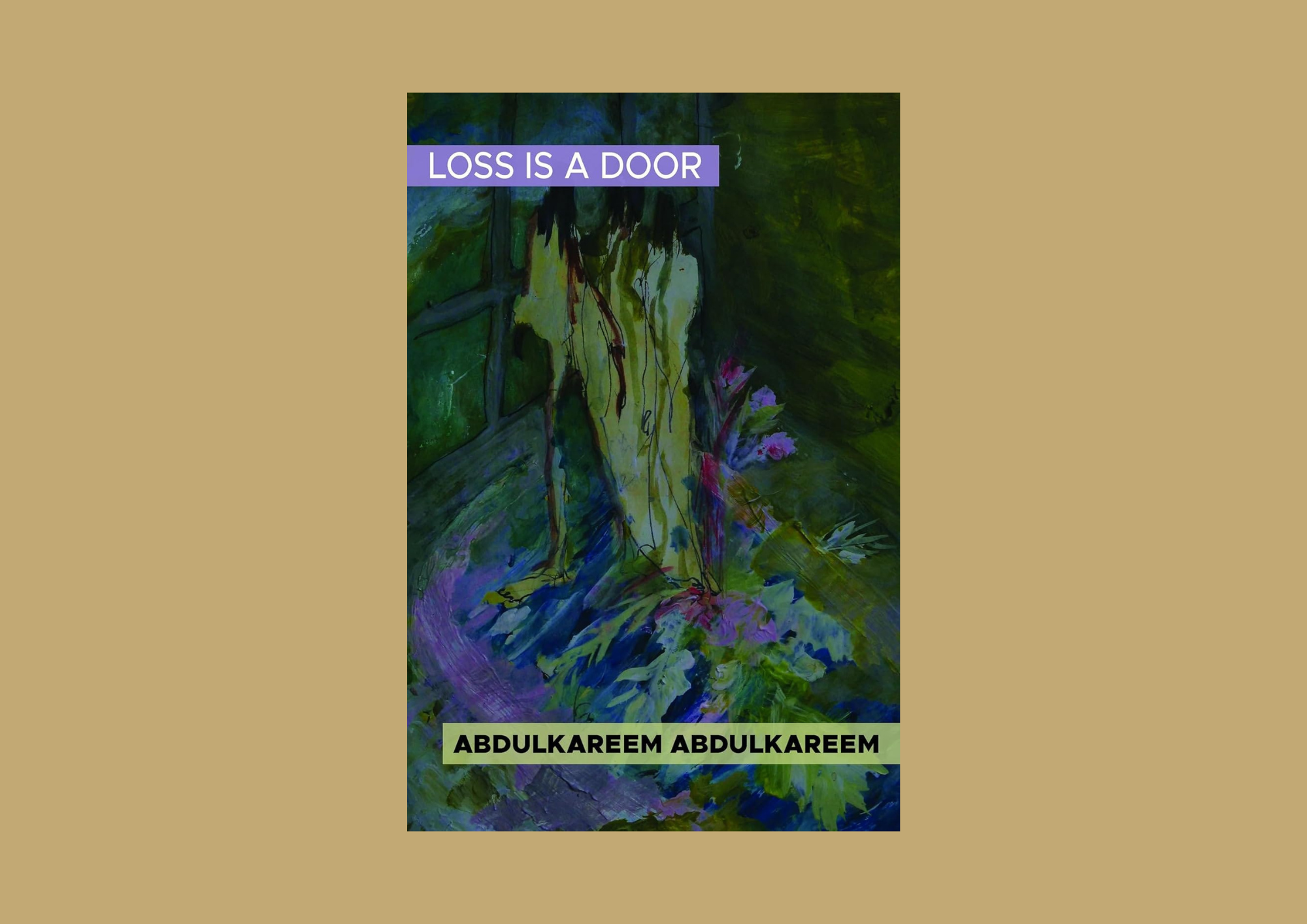
I read Loss is a Door in the way you listen to someone cry in the next room, aware of every pause, every resumption. There is a particular grammar to grief, one that Chimamanda Ngozi Adichie has described as a failure of language and a grasping for it at once, and Abdulkareem Abdulkareem seems to have arrived at that same grammar independently, through the body, through photograph, through the particular ache of a name you cannot stop saying. This chapbook, part of the 2025 Kumi Na Moja New-Generation African Poets Chapbook Box Set published by Akashic Books in collaboration with the African Poetry Book Fund, is not a collection that offers grief to you from a distance. It walks you directly into it. And then it closes the door.
The book is plural in its losses. Abdulkareem himself has said that it collects personal grief, familiar grief, and even his grievances on the loss of languages. Grief here is, as he puts it, “a damned thing; it’s like a wound from a claw that never leaves the lushness of the mind.” What is remarkable is that he has found forms adequate to this plurality: ekphrasis, elegy, lyric autobiography, and something that resists naming altogether. What it birthed is a chapbook that does not grieve one thing. It grieves the very condition of being alive inside loss, which is to say, it grieves everything.
The poem “Confabulation” opens a wound at the center of the book: There is no memory, only thorns. / Their sharp edges poking my desire / for a paternal reminiscence. The speaker has tried to build a father from photographs, from the tumult of recalling, and each time he tried, he found memory insufficient. What continues to disturb me through the reading here is the honesty of the admission: Once, memory granted me a line, but / everything would fit into my palm. The father is not dead so much as absent, and this I’d consider as another species of grief. It is harder in some ways because it offers no clean event to mourn. The poem moves toward a harrowing conclusion: Forgetfulness, like effigies in the dark. / Forgetfulness, like a body losing its self. And then: Because my memory begins at the end of everything. Is this a kind of despair? not exactly. It is something more rigorous, It is more of the speaker refusing to pretend that memory heals.
“August Third” makes paternal loss explicit, and it does so on a birthday, that two-edged blade of a day. The paternal is celestial as a comet, life-wrenching / as lava & faceless as my father’s name in my thoughts. The father here is faceless, some sort of feather with zero weight, and he is only present in music: Stevie Wonder playing between the spiky tongue of a cactus & confetti. What Abdulkareem captures here is the way grief ambushes the anniversary. A birthday becomes the site of an undoing. My mother’s song is a hand unfettering the night / & my mother’s music is a dead one. The line is expressing two things at a go: it is the mother’s song that liberates sleep, and yet that song is itself elegiac, the music of someone gone. On this day, I don’t know what my lips taste of / but there is a foundry melting the delight on my chest. This is grief as physical sensation, as Adichie knew it: tongue bitter, chest heavy, the body refusing to behave.
In “When Your Mother Is a Bird Which Accompanied Love Into Exile,” Abdulkareem writes a different grief: not of a father who was absent but of a mother who chose to be: Some roads lead to regret. & your mother is a portrait / of this expression, the terror of gnashing teeth. The poem’s second person technique creates a curious and protective distance, in which the speaker observes someone else’s wound while unmistakably bleeding from their own:
On cold nights, when there was no mother to undo
/ your shivers with warm blankets & heated water,
/ you undid a crescendo of litanies like a wounded angel
/ seeking the dawn of a motherly coexistence.
This is abandonment rendered in liturgical terms, which feels right, because here is a child praying for a mother the way one prays for an absent god. The poem’s final line appears like some verdict: Loss is a door / to many types of regret; your mother sits at the apex of the first. The chapbook’s title lives here, not as metaphor but as taxonomy. Loss has types. The mother occupies the highest rank.
And yet grief in this chapbook is not only loss of persons. It is loss of self, of origins, of the body’s legibility. “Enchanted Beach With Three Fluid Graces,” after Dalí’s 1938 painting, meditates on the dissolution of the self into landscape: I grew like rain from the rumbles of my parents’ / cloud, a dark dawn, admitting growth. The speaker is a boy seeking existential relevance, his visage like a landscape, pursuing identity the way the equestrian in Dalí’s canvas endlessly pursues the horizon, with the knowledge that arrival is not the point: Holding on to the edge of my thread, bowing to the ache / of an empty body, my fingers grip the edge of my cloth. / Nature becomes a skull. Dalí haunts this poem not as decoration but as ontology. In Dalí’s dreamscapes, objects lose their function while retaining their form, clocks melt but remain clocks. Abdulkareem’s speaker does the same: remains a self while the self becomes more illusion than truth.
The poem “I Am Tethered to Possibilities” feels like home for me, especially the opening lines of a Saturday morning’s ritual of eating ṃóín-ṃóín elewe and pap. Although I felt uneasy at the spelling of ṃóín-ṃóín as moi-moi, the poem is the chapbook’s most tender, and in some ways its most devastating. A grandmother appears:
she said: ̣e wọ ilé wá sùn — which means,
/ she beckoned us into the warmth
/ of our bed, which could mean,
/ we are the stars in her night sky.
The Yorùbá untranslates itself, opens a door into a world where love has its own grammar. Then she is gone: I unearth her from / a photograph, & there’s / laughter. And this is where I find the strangest truth. Abdulkareem writes: I still remember my dead beyond / grievances; the humorous memories, / another laugh splits from my lips / once again accompanied by a lonely tear. Adichie knew this too — “how much laughter is a part of grief,” she wrote, how it is braided into sorrow, how the laughter trails off and becomes tears. Abdulkareem arrives at the same knowledge through a grandmother’s photograph, through a brother’s joke about pap, through the ordinary Saturday of a mother wrapping beans in green leaves. The domestic is the site of grief’s most persistent ambush.
What Abdulkareem has built in Loss is a Door is not a monument to loss but a door, as the title promises. A door suggests transit, a threshold between states. To read this chapbook is to pass through something; to move from one understanding of grief to another. Not a healing. Not a resolution. But a passage. Kwame Dawes and Chris Abani, who edited this volume, have long known that the most powerful African poetry does not aestheticize suffering so much as insist on its full dimensionality: its rage, its tenderness, its comedy, its silence. Abdulkareem has delivered exactly that. He is a poet who writes with the precision of someone who has been living inside these poems for eons. In the interview I conducted with him for this series, he said something I have not stopped thinking about: “The pain pulls you back each time.” That sentence is the entire chapbook in miniature. It is also, if Adichie is to be believed, the entire truth of grief. The door is always there. You walk through. The door remains.

Káyọ̀dé Ayọ̀bámi
Káyọ̀dé Ayọ̀bámi is a Nigerian poet and an African literature enthusiast, interested in Academics and Yorùbá translation. His works have been published or forthcoming in icefloepress, Olongo, Àtẹ́lẹwọ́, PoetrySangoỌta, Isẹle, Ake Review, South Florida, porter house review and elsewhere. He was shortlisted for the Ake Climate Change Poetry Prize (2022).