Vanessa tucks a Nokia phone in her bra and waits outside on a wooden stool, watching the road from morning through evening, certain her son, Kwame, will return because a prophet promised a date. When she wakes from exhausted sleep, it is already midnight. She does not know that in Agadez, Kwame’s friend Jide clutches a broken Nokia wrapped with a rubber band, using it to lie to his own mother, telling her he needs accommodation money in Lagos when he is actually trapped in the desert, extracting funds from her poverty to pay the next smuggler. Both mothers, one waiting, one sending, are trapped by phones that transmit only the distance between what is believed and what is real.
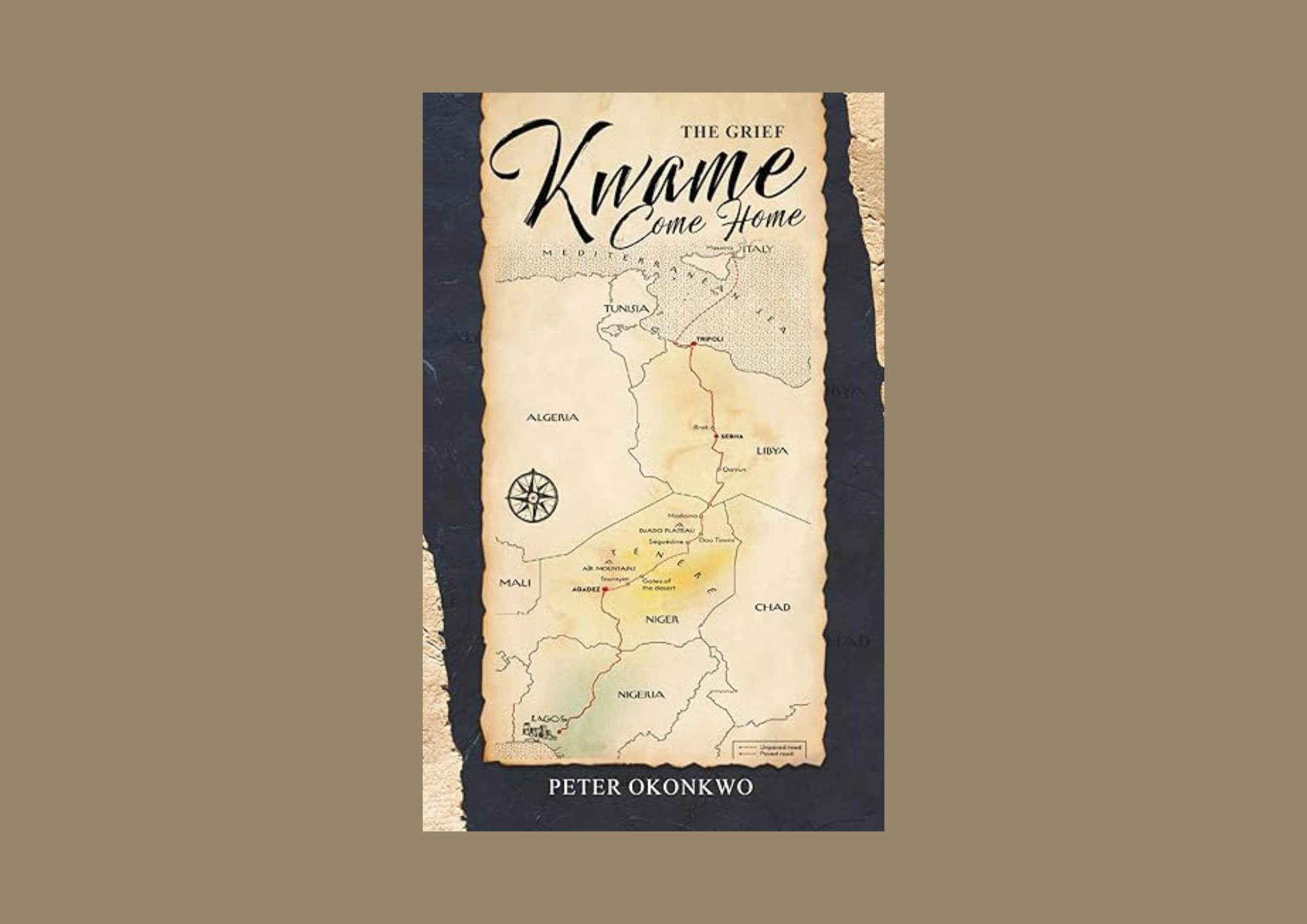
This gap is the architecture of Peter Okonkwo’s Kwame, Come Home. For half the collection, Vanessa invokes Yoruba deities, curses invisible antagonists, and performs midnight rituals at river junctions, believing her missing son has been spiritually attacked by envious relatives. Meanwhile, Kwame is crammed with forty-five other migrants in an airless room in Agadez, his hair matted with clay, drinking water sold at extortionate prices, watching children fall from speeding trucks in the Sahara. The family fights witchcraft while the son fights smugglers. That irony, that terrible structural reversal, transforms every curse and prayer in the first half into something more tragic than the author may have intended: evidence of how poverty forces families to mythologize what are fundamentally economic catastrophes.
This is not a subtle book. Okonkwo writes in a register of unrelenting intensity, what might be called testimonial maximalism, where Vanessa’s laments, Etean’s imprecations, and Kwame’s desert confessions all operate at the same high pitch, rarely modulating into quiet or restraint. For readers accustomed to contemporary poetry’s preference for understatement and fragmentation, this will feel excessive, even melodramatic. But Kwame, Come Home is not trying to be that kind of poetry. It is closer to liturgical performance, to the West African tradition of praise poetry and lamentation, to biblical imprecation psalms. It announces its genre in the opening poem: “Should I not rather die than suffer the scourge of a missing son?” This is not a question seeking nuance but a declaration of absolutism, and the entire collection refuses to back down from that emotional certainty.
Yet emotional certainty, sustained for too long without variation, produces diminishing returns. Vanessa’s voice and Etean’s voice are nearly indistinguishable, both employing the same prophetic formulas, the same curse structures, the same assurances of divine vindication. When Etean writes “Cursed be those who hate you without a cause. And those who have vowed your death shall be utterly destroyed,” he sounds identical to his mother’s imprecations dozens of pages earlier. A brother’s grief should feel different from a mother’s, should carry its own contradictions, perhaps even resentment or doubt, but the collection offers no tonal spectrum. Everyone laments at maximum volume. By the sixth or seventh curse poem, the language begins to feel formulaic rather than urgent, ritualistic in the wrong way, not incantatory but merely repetitive.
The other persistent weakness is the tendency to explain rather than dramatize. Lines like “Confusion, depression, and aching anxiety filled her fragile soul” or “The trouble with Vanessa sprouts beyond human description” name emotions instead of embodying them. Compare these to the poem’s genuinely powerful moments: “Now his absence; splits her spirit in two.” Here, the metaphor does the work and the split becomes visceral. But too often, Okonkwo retreats into abstraction, “immeasurable pain,” “perpetual disturbance,” “soulfully shattered,” and the poetry flattens into generic grief language that could describe anyone’s suffering anywhere.
Which makes the moments of specificity all the more striking. When Okonkwo commits to concrete detail, the writing ignites. The Nokia phone tucked in Vanessa’s bra, checked obsessively for calls that never come. The wooden stool where she waits outside all night, forgetting it is already midnight, still expecting the prophet’s promised return date. The December tradition of preparing Kwame’s favorite meal year after year, the pot cooling untouched. The blood pressure medication, Moduretic and Aldomet, groped for in the dark when her heart races erratically. These details accomplish more than twenty pages of curses combined, making Vanessa’s grief tangible, specific, and undeniable. This is where the book transcends proclamation and becomes witness.
The psychological turn in the middle section deepens the collection significantly. When Vanessa admits “Kwame also had a part to play in his own disappearance” and acknowledges he was “an obstinate lad and a competent liar from childhood,” the myth of pure victimhood cracks open, complicating the narrative in essential ways. Suddenly Kwame is not just a cursed innocent but a flawed human who made choices. Similarly, the revelation of marital abandonment, “Who shall help an emo mother whose husband has turned her into a sudden widow,” expands Vanessa’s suffering beyond a missing son into gendered oppression and economic abandonment. These moments suggest that the real antagonists are not village witches but poverty, patriarchal neglect, and social structures that crush women regardless of whether their sons disappear.
But the collection’s true power arrives in Part Two, when Kwame’s voice finally enters and the migration narrative begins. Here, everything shifts—the language tightens, the imagery sharpens, and the testimonial urgency that felt overwrought in the curse poems suddenly becomes justified because now we are in the actual horror, not the imagined one. “The Ancient Phone Call” gives us dramatic tension through restraint: Jide lying to his mother, stepping outside so she won’t hear, the quiet desperation of “I sold everything I have; my TV, laptop, phone, mattress, and all.” Then comes the devastating admission in “The Old Saturday Evening”: “I intended to call her when I had made enough money I was told flows like a river on Europe’s soil.” That single sentence reframes the entire first half: he meant to return triumphant but vanished into silence, and the tragic irony unfolds with precise, controlled devastation.
The Agadez poems represent the collection’s artistic peak. “In Agadez” achieves genuine lyric compression: “The desert did not lie. It burned our skin, swallowed our water, and wrote death on the sand with the bones of the forgotten.” This is economical, image-driven, and devastating. Here, the repetition finally works because it is ritual grief rather than redundant explanation: “If regret had wings, I would fly back across the Sahara, back to the soil that raised me.” The conditional becomes prayer, and the prayer becomes elegy.
What makes these desert poems succeed where the earlier imprecations often fail is their grounding in concrete, unglamorous detail. Forty-five people in one room. Hair locked with clay “like an artwork from an incompetent painter.” The broken Nokia was wrapped with a rubber band, its battery removed to preserve the last charge. Fifteen-hour waits in the sun. Water sold at prices that mock the thirsty. Sleeping outside in the Saharan cold that “pierced through our heart like a syringe on a fragile vein.” The stench of unwashed bodies, the fear of dying like Liya, who “fell sick and died,” the Senegalese joke that Kwame’s shaved head “looks like an ancient dead skull buried in red earth.”
These are not metaphors. These are conditions.
And they do more to convey suffering than every abstract declaration of “immeasurable misfortune” in the first dozen pages.
The broken Nokia phone becomes the collection’s most resonant symbol, creating a brutal symmetry across both halves. In Part One, Vanessa clutches her phone, waiting for calls. In Part Two, Jide uses a broken phone wrapped with a rubber band to lie to his own mother, telling her he needs accommodation money in Lagos when he’s actually trapped in Agadez, extracting money from her poverty to fund his and Kwame’s next smuggler payment. Both mothers are trapped by phones, by hope transmitted through failing technology, by love that cannot overcome the machinery of migration.
“We Saw Dried Bones on the Desert’s Sand” delivers the book’s emotional knockout. The child Leye falls from the speeding truck. His mother, Asaya, screams. The driver does not stop. “Her cries were paid no attention to, not even by the driver. We clearly do not matter.” This is tragedy without metaphysics, without spiritual explanation, without the comfort of believing someone is to blame. Just indifference. Just economics. Just the disposability of poor bodies in the global migration system. When Kwame asks, “What if I die like these people, how would my mother find me?” we finally understand what Vanessa was actually fighting in Part One: not curses or ancestors, but the very real possibility that her son would become “a bone without a story,” unidentified remains in sand, disappeared into the anonymous dead.
“The Desert Keeps Its Dead” is the collection’s most mature poem, and its best. Here, the language is tighter, the metaphors more disciplined: “The driver’s eyes were the color of other people’s indifference.” That line alone justifies the entire second half. So does this: “I did not want to be a bone without a story, a skull to be read by scavengers of wind and time.”
Here is the book’s thesis.
Kwame is not cursed by witchcraft but by poverty, by the lie that Europe offers salvation, by smugglers who view migrants as freight, by systems that render poor Africans expendable. The real antagonists are not Njideka or village relatives but economic structures that make young men like Kwame believe their only option is to risk death in the Sahara.
This reversal, from spiritual mystery to geopolitical reality, is the collection’s major literary contribution. It performs a kind of dramatic irony that indicts not the characters but the systems that shaped their understanding. Vanessa is not foolish for consulting oracles and performing river rituals—she is poor, lacking access to information, to institutions, to the transnational networks that might actually locate a missing migrant. So she does what poverty allows: she weaponizes language, prayer, curse, and hope, fighting the only battle she knows how to fight, against enemies she has been taught to fear. Meanwhile, the actual enemy, the smuggling networks, the economic desperation that makes young men sell everything for a lie, the European immigration policies that force migration through the deadliest routes, all of this remains invisible to her.
This is what the book gets right, and it is no small thing. Kwame, Come Home exposes the cruel gap between how poor families interpret disappearance and what actually causes it, showing how mythology becomes a survival strategy when material recourse fails. It documents, with unflinching detail, what irregular migration actually looks like: not adventure or even clear-eyed economic calculation, but desperation, lies, exploitation, bodies falling from trucks, water sold at murderous prices, children lost in sand.
The book’s flaws remain significant. The first half is too long, too repetitive, too committed to sustaining a single emotional note without variation. The voices need differentiation, the curses need editing, and the abstract language needs to trust image and metaphor more consistently. A sharper editorial hand could have tightened this collection by several pages without losing any of its essential power. But these are craft weaknesses, not failures of vision, and in testimonial literature, vision matters more than polish.
What Okonkwo has created is not a perfect book but an important one. It bears witness to a crisis that kills thousands annually but remains largely absent from African literature: the violence of irregular migration from West Africa through the Sahara to Libya and across the Mediterranean. It centers the grief of those left behind, the mothers who spend decades searching, who mythologize disappearance because the truth is too vast and systemic to comprehend. And it refuses easy consolation—the book does not end with reunion or closure but in the desert, with bones, with Kwame still trying to hold on, still trying not to become anonymous remains, still trying to be “a bone without a story.”
Kwame, Come Home succeeds most powerfully not when it curses or preaches, but when it witnesses, when it gives us the Nokia phone, the December meal, the clay-locked hair, the driver’s indifferent eyes, the child falling, the bones in sand. In those moments of brutal specificity, Okonkwo achieves what all testimonial literature attempts: he makes visible what systems of power prefer to keep hidden.
That is work worth doing, even if the doing is imperfect.