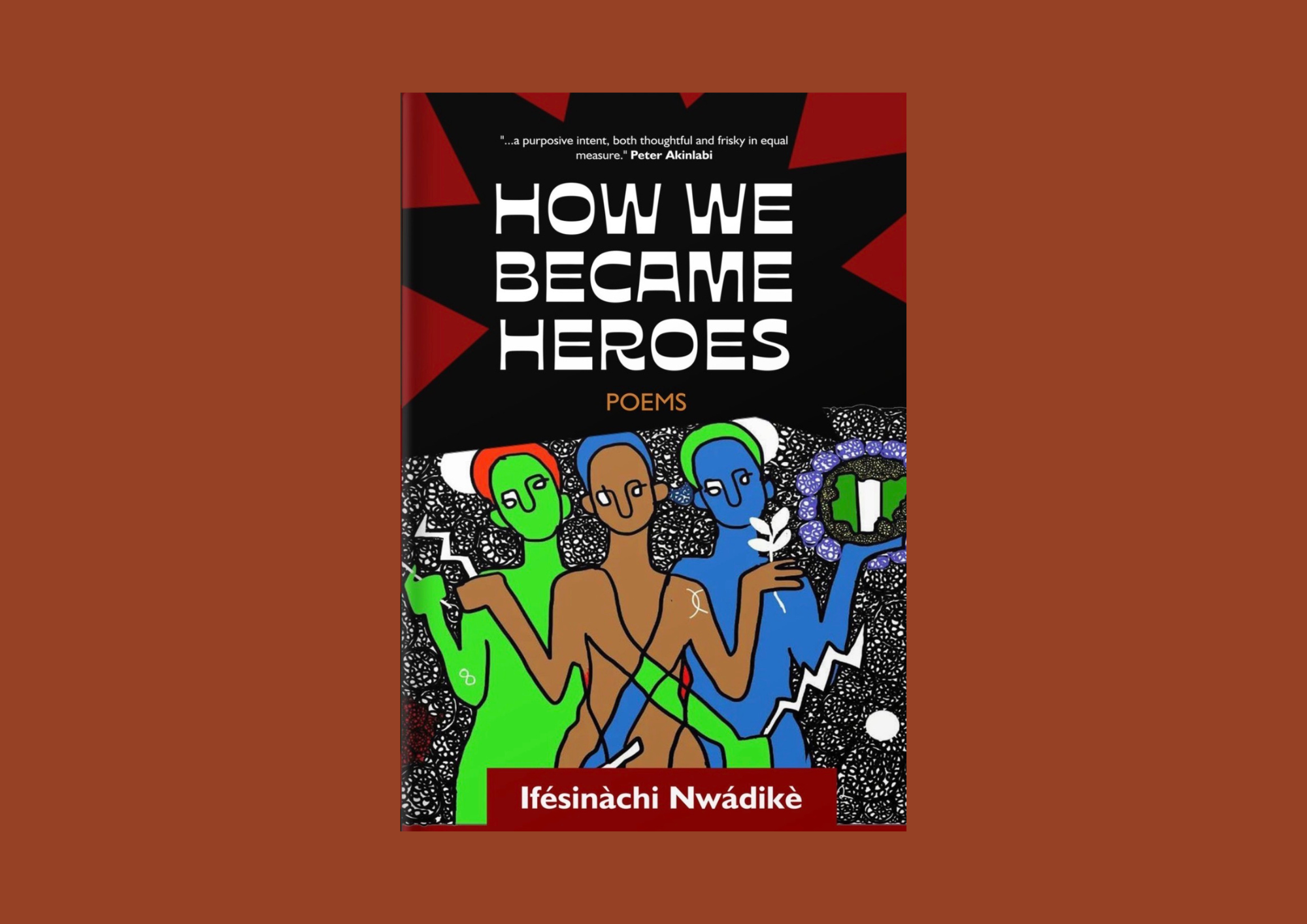
In December 2025, Noirledge Publishing released How We Became Heroes, the second collection of poems from Ifésinàchi Nwàdiké. The collection accentuates the strong voice of a counter-hegemonic, marked by the idiosyncratic scathing rage that seeks to dismantle unscrupulous systems. The poems initiate one into a world that froths with an unquenchable thirst for vengeance against oppressive orders. Ifésinàchi shows unrivalled mastery in erecting this rage through his remarkable use of clear and neat language, laced with beautiful metaphors and imagery.
In his first collection titled How Morning Remembers the Night, the poet-persona deprecates social-political atrocities burdening his nation. The lamentation comes off in a way that necessitates action. This action is what we eventually see in How We Became Heroes, where the poems sing like war chants. Ifésinàchi believes that we have gone past the era of simply lamenting the Nigerian misfortune, and that we are now in an era of ousting these oppressive elements. In my conversation with the author, he explains: “How Morning Remembers the Night is burdened with the excavation of national anguish through a rewiring of our collective memory. It was aimed at an awakening, to set the stage for the main business of reclamation that is prescribed in How We Became Heroes, noting that we can only become heroes if we reclaim and fix our country; a way of reconstructing the literary notion of an Aristotelian hero.”
The collection is divided into three parts. The first part is titled The Sound of Vengeance and opens with this excerpt from the 1894 poem, Red, by Serbian Poet, Kosta Abrasevic: ruby-red anger sets fists tightly clenching: tremble ye tyrants, our vengeance is nigh Ruby-red. It will be bloody and dire. The poems in this section — truly bloody and dire — intone the atrocities of the oppressors and the fury that follows. Here’s a line from the first poem in this section titled Intimations (pg. 3): Pontius Pilates of the clean hands / vengeance is upon you / if we miss your heads on earth / Okigbo awaits you at Heavensgate. Here, Ifésinàchi not only assures all Pontius Pilates of vengeance, but also pays homage to the great Christopher Okigbo who, in this collection, epitomises the force against injustice. For the sake of those who may not know Okigbo, he was the Nigerian poet that died on the battlefield while fighting on the Biafran side in the Nigeria Civil War. In Intermission Before The Apocalypse (pg. 14), we meet Okigbo again, as the one who swallowed thunder in the field of ghosts where a lone warrior — described as ancestor to the author — stands. Ifésinàchi appears to share kinship with Okigbo’s warrior spirit. He says: “Okigbo is many things to me. He is, as you rightly said, a symbol of revolution and justice. One of the few poets in the world to walk the talk. I also share with him, a sort of kinship. Racial interconnectedness aside, I share in his dilemma (to be fully traditionally rooted or to straddle between my local traditions and the invading colonial religion). Okigbo was, to me, a perfect symbol of the artist as a revolutionary, but I think twice about revolting these days. In the early years of my development as a poet, one of my lecturers, Dr. Psalms Chinaka, had written a blurb referring to me as “not just a literary activist, but a physical activist.” By this, he was bearing witness to my penchant for taking up fights for people. I began my activism by challenging common day to day unfair practices within my immediate environment. I have fought on the road many times in Owerri. The most memorable was fighting a group of policemen who were harassing a scrap dealer along Wetherel Road for money. They beat me up, yes, but I achieved my aim of making sure they don’t get a dime from the poor man. Growth has changed me a lot, especially after realising that Nigerians prefer their oppressors to their liberators. If Okigbo were to be given a chance to see the country he was fighting for today, he’d surely regret picking up a gun. But also, I adore Okigbo, his poetry, his very brief life. The things I learnt about him from Chinụa Achebe’s There Was A Country; from Femi Osofisan’s book on J.P Clark; and from the stories from his cousins and brothers when, in 2021, I was among the headline poets for the Return to Idoto Festival that was held in Okigbo’s family home in Ojoto.”
In The Apocalypse (pg. 18), the persona, named after the author, beckons on his brethren to make six bonfires, each for a decade of misrule: beside each bonfire; a slaughter slab / upon which we shall slit the throats of the jackals / before giving them up for immolation. The poem bears semblance to the eschatological narratives found in the biblical book of Revelations and stages a revolt, wherein four rebels, each astride horses of different significant colours, march against the oppressors, liberating all that had been held captive. Ifésinàchi also deploys the tool of symbolism using animals to refer to the Nigerian exploitative ruling class, a technique found in the works of Tanure Ojaide, George Orwell, amongst others. This revolt is also observed in another poem titled An Account of How We Became Heroes (pg. 12), written after Esiaba Irobi and Niyi Osundare. Together, these two poems strongly reflect the creeds of Marxism, pushing for the violent overthrowing of the ruling class.
The second section of the book titled Memo to The Poets, begins with a quote from South-Sudanese and Ugandan poet, Taban Lo Liyang: But a writer must say a word for humanity’s sake and not remain the eunuch scholar, fat with manhood beaten out. In I know Why Caged Birds Don’t Fly (pg. 24), Ifésinàchi writes about the kind of unfavourable conditioning where captivity becomes normalised, even preferred: Ebube, I listened to caged birds sing / Alas! It was a carol of fear, of defeat / Conceived, bred and fond of the cage / The sky becomes Bermuda. This poem is not just remarkable, but timely, urgent, and necessary, as it metaphorizes the habituation of Nigerians to oppression; a pitiable state in which they no longer think of themselves as powerful enough to attain freedom. Ifésinàchi further describes this abysmal state beautifully: the lion, unmindful of its lion-ness / despises its strength to roar / the bulldog, ignorant of its canines / dreads to bite, to bark / the python, unsure of the size of its throat / wimps at the thought of swallowing. To liberate people from not just their oppressors, but also from their ignorance, Ifésinàchi turns to the writers in the poem We Are Writers, Not Sandbags (pg. 23), where he writes: gifted in the art of weaving, we have no need for guns / if our voices are loud, it is for the masses’ freedom. Ifésinàchi uncompromisingly embraces the words of Taban Lo Liyang. “The artist is tasked with saying a word for humanity’s sake. The necessity of committed art has been long debated and, I believe, finalised. From Achebe to Ngugi; Akachi-Ezeigbo to Osundare, etc, treatise abound that privilege this topic so there is absolutely no point rehearsing them. For the sake of this conversation, however, it needs to be restated that I agree that a writer’s duty is to say a word for humanity’s sake, to ask uncomfortable questions that people would not normally ask, hoping that in exposing the rot, the masses can react,” he says.
In I know What Poetry Is (pg. 25), the author highlights the ethical responsibility of poetry as resistance and confrontation: poetry is the long hiss / drawn after daily ‘Breaking News’ / that is never good; poetry is throat-full phlegm / spat on the cottage of unscrupulous power / where a cunning minority sits by the fireside / roasting the senses of the foolish majority.
The imagery is intentionally unpleasant, framing poetry as something bodily and confrontational. However, Ifésinàchi explains that poetry is not always synonymous with rage. “There are so many other good things happening in the world that matches and catches the creative fancy and energy of writers but, in the Bwalalean sense, context matters (this is where we pretend to laugh). In a country like ours, rage is inescapable. It’s an arduous task fantasising about making love to your wife in a country full of heat, literally and metaphorically speaking,” he says.
Believe me, this response cracked me up. But beyond the humour in it, Ifésinàchi strikes a good point. The society from which an artist creates from often informs the issues he tackles. Charles Bressler, in his book, Literary Criticism: An Introduction to Theory and Practice, puts it aptly: ‘…society shapes our consciousness…’ The current happenings in Nigeria makes it difficult to escape rage. In a clime with malfunctioning systems, how can the artist, who truly has this country at heart, put away rage? Impossible, I say. We are all filled with it. However, Ifésinàchi doesn’t just want us to possess this rage. He wants us to act with it. He believes that we can harness the gift of language to pursue dissidence and emphasize justice, as Nawal El Saadawi urged us to.
Are we acting already? Are we doing enough to speak back at the corrupt elites, I asked. “No,” Ifésinàchi replies. “I do not want to go into details, biko.” He blames this on the desire for economic empowerment and a lack of principles. Speaking further, he says: “everybody is now theorising what truth is. So, truth now has many other meanings. It is no longer a word.” In other words, the truth that Nigeria is being run by corrupt elites, overseeing one of the worst moments in the country’s history, can no longer be held in an objective light. For some, the country is the safest it has been in recent times, despite daily reports of killings and bombings and kidnappings.
The third part of the collection is titled Conversations with Sochima and Other Imaginings and begins with a biblical reference from Psalm 127:3-5. In this section, Ifésinàchi holds intimate conversations with his son, Sochima. In Little Boy Selling Ice Cream (pg. 41), Ifésinàchi explores themes of inequality and the pitiable innocence of those on the margins. He uses rhetorical questions to invite the reader to reflect upon these themes: Little boy selling ice cream / do you see them? / They who zoom past / in tinted convoys / do you look at them / then smile, waving your shriveled hand / in naïve excitement? The author also pays attention to mothers, soldiers, and the victims of the 2020 End SARS protest. In A Soldier’s Song (pg. 54), we see the existential and psychological cost of war, presenting the soldier as both a participant and victim. Contextually, the poem speaks of the plight of military life in Nigeria as a game of chance and not heroism: To be a soldier is to be a gambler with your own very life. The stupidity / of accepting to fight for a fee, knowing you may not return to your / wealth / knowing you may die unsung…
In Homefronts, Warfronts, Deathfronts (pg. 53), the author delivers a heart-rending tribute to the victims of the heartless shootings at Lekki Toll Gate during the peak of the End SARS protest. It does well to frame every region of Nigeria as a continuous battlefield, thinning the lines between civilian and combat spaces. Lines like the bullets rippled like staccato thunders / finding home in millennial voices, creates a graphic imagery of the voices and wailings of youths as bullets were rammed into them. October 20, 2020: this date comes alive between the lines of this poem.
One skill of this author worthy of note is the ease with which he creates humour. Aside from the language of rage and satire, we find hilarity in lines like this: the accent of stone is beautiful music / pebbles thrown on pot bellies make tom-tom sounds / and upset intestines where generational meals are hoarded, from the poem, We Need To Start Throwing Stones (pg. 26). The author confessed to laughing out loud when he finished writing this line. “And I hope it elicits laughter from the reader. But, from that laughter should also arouse the urge to pick a stone, for it is through jests that most African cultures pass encoded meanings. So here, the poet-persona envisions a scenario where the masses gatecrash a political gathering with stones and pebbles ensconced in catapults. Now, let me return to question to you: all over the world, which group of politicians have the most pot-bellies? I know you already know the answer. So, if you gatecrash such gathering, is it not pot-bellies that will beset your eyes?” he says.
It appears that art, being a supreme spirit, has possessed Ifésinàchi to manifest through him, the voice of an unwavering iconoclastic poet. He comes from a line of activists; men who possess a strong consciousness towards society, who fight for justice and order. Little wonder the book is dedicated to his father, Ikechukwu, repulsed by the sight of injustice. Speaking further, he says: “We are all born into things, into events or ideologies. I like to think that what many readers refer to iconoclasm on my part is that innate urge to see that common humanity, the people at the lowest rung of the social ladder are treated properly. You can see from my dedication that my father’s egalitarian views are acknowledged as the animating force of the poems in the collection. Like I have clarified in the past, I come from, not just a lineage of teachers, but from a lineage of griots, men of songs, masquerade custodians and jesters, which explains my gift of ịma njakị́rị́. So, you can imagine how these types of preoccupations are in close affinity with social activism. I even learnt from my father, recently, that my Great-grandfather was also a Warrant Chief, but was known to have rebelled his white masters because he couldn’t bear to see how much they were trying to use him to enslave his people. Carl Jung’s theory of the collective unconscious easily comes to mind. He talks about the shared layer of the psyche containing universal symbols and inherited archetypes, so I like to think of myself as “a chip off the old block.” I did not stray from the way of my ancestors. I was born like this. The difference is that I have managed to subsume all their approaches to social consciousness into written poetry.”
How We Became Heroes is surely not a solitary work. It has drawn remarkable influences from a long list of writers who are known for challenging the status quo. About his influences, Ifésinàchi says: “I read a lot of Toni Morrison and El Saadawi. I recently published an essay on Nigerian poetry where I deployed Saadawi’s dissident theory. But I have never consciously sought to replicate them. However, I have caught myself on several occasions, especially in my formative years, trying to ape Esiaba Irobi. This was crucial in helping me carve my own niche and I can see how I have developed a voice I can strongly refer to as mine. Talking about the influences on my political voice, a tentative list would include Esiaba Irobi, Christopher Okigbo, Chinụa Achebe, Ngugi Wa Thiong’O, Wole Soyinka (especially his essays), Odia Ofeimun, Niyi Osundare, Hyginus Ekwuazi, Dambudzo Marechera, Ezenwa Ohaeto (especially The Voice of the Night Masquerade), Isidore Diala (who I think should write more poetry), Taban Lo Liyong, Meja Mwangi, Syl Cheney-Coker, Jared Angira, Festus Iyayi (for his novel, Violence), Remi Raji (especially for Gather My Blood Rivers of Song), Chris Onyema (who I also think should write more poetry), Nduka Otiono, Gilbert Ebinyo Ogbowei, and Uche Peter Umez.”Ifésinàchi Nwàdiké has written an important body of work that is timely and reveals the power of poetry as a strong tool for resistance. His strong political voice derives its nourishment from the fertile grounds of revolutionary poets like Christopher Okigbo and Esiaba Irobi, amidst many others. This is a work that uses lucid language to demolish injustice and, I dare to say, could cost this intrepid poet his head.

Chukwuemeka Famous
Chukwuemeka Famous is a Nigerian writer whose short story ‘Oyinbo’ was shortlisted for the Pack Light Writing Contest. He has also been a finalist for the Quramo Writer’s Prize in 2020, was longlisted for the Bold Call Writing Contest in 2022, and was nominated for the 2022 Young Writers and Creatives Award. His debut novel, We Will Live Again, was published by Griots Lounge Publishing in 2023. More of his writing has been published in the anthology Pack Light: Memories of Growing up in Africa, Ibua Journal, The Shallow Tales Review, WSA Magazine, and elsewhere.