


Tobi Aluko’s work first appeared in the literary scene in 2021 with the publication of his short story, “Euthymia”, in The Atherton Review. Of Yoruba origin, Tobi Aluko hails from Ekiti State in Southwestern Nigeria. Trained as a lawyer in the University of Bournemouth and the Nigerian Law School, Aluko has always had a knack for creativity, and it is as a writer that he applies himself best. In addition, with his fiction, Aluko’s poetry has always come to him in bloom and in moments or romantic observation.
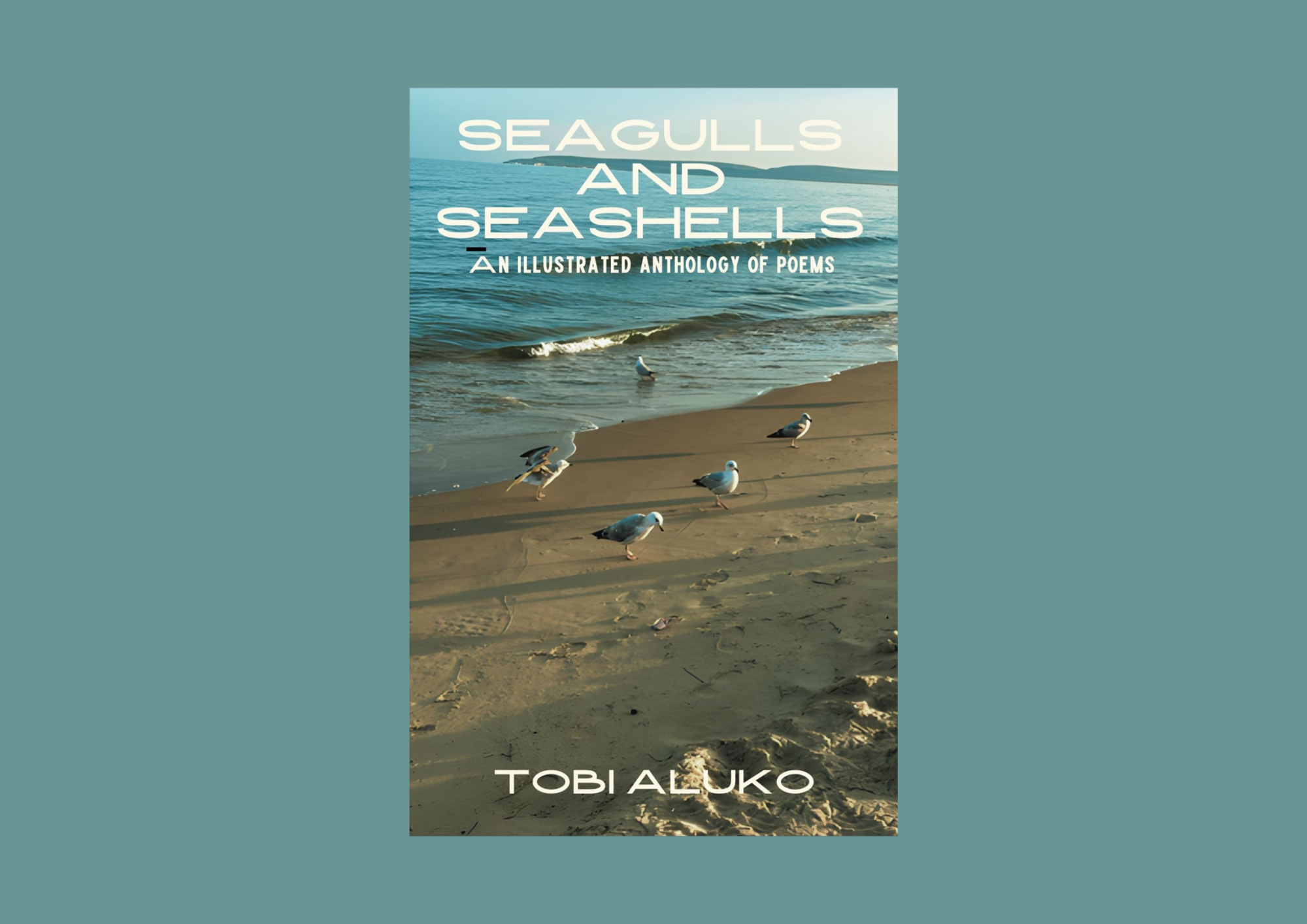
Oluwatobi Aluko’s debut body of poems is a chapbook titled, “Seagulls and Seashells”. A collection of 24 romantic and mildly introspective poems; it begins with a poem, “Roses for Qu” in which the protagonist watches over a flower at the risk of being consumed by sawflies. He thinks of plucking it for his love interest, because if he doesn’t, the flower is doomed, and if he does and she doesn’t come, it whittles as well. He is stuck at a kind of crossroads. But if she comes and he gives it to her, and it inspires in her some beautiful feeling even if the flower dies it would have been put to great use for matters of the heart.
This beginning poem pretty much sets the tone for the rest of the collection which charts the emotions of longing, imagination of love, and tells some stories through its rich imagery. It is easy to see that this poet is one who is starry-eyed. And one who aspires to evoke similar feelings in his readers. He is also a poet who tries to capture the poetry of moments even from his daily life association. And like every poet who takes their craft seriously, he spares a moment to be idealistic. “You will find me seated in the poetry club,” he writes, “knees crossed, chair squeaking,/ while a poet recites a boring poem./ I write poetry for you,/ your smile, and the reflection of spring’s sun on your face./ What is the poetry club?/ It is a place where starving artists commune to/ mourn the collective destruction of our craft…” In this poem he demonstrates the aforementioned quality, and even at his most idealist, the feeling of love manages to creep in.
The imagery in Tobi Aluko’s poetry is very accessible. In “Lavender Fields”, he writes, “I want to walk with you/ through lavender fields./ Purple, like the crown/ on a mother’s head./ Mother, like a minstrel/ who sings the truth to children./ Lover, who sits by my side/ and let me rest my head on her lap./ Peace, what we find/ walking through lavender fields./” The imagery of the poem is unfurls as though with the reassociation of metaphors the poet strives to open our eyes more and more to the beauty of a lavender field. This is one of such things that is expected of a poet, to make familiar things assume a beauty through deeper perception.
Like in every poetry collection, not all of the poems are of the same artistry. Many of the poems struggle to get out of their prosaic skin. This is not to say the poet should not write prose poems, but part of the qualities that would make this poet’s work more profound as he progresses in his poetic pursuit is in how he tightens his language. In poems like “Awe” and “Because You Are,” It is evident that there are still obvious leaps needed for this poet to elevate his work especially in the way he handles language. And sometimes the poems come off as very prosaic, but it is in their musicality and the pivotal moments from which the poems are sieved that they get their vitality.
Another striking poem is “Younger Millennial” which in its first and second lines take a generation back in time through collective memory. “Let’s host a party with songs at least ten years old./ Maybe we would remember the soundtrack of our teenage years,/ when we stole kisses at the back in between classes…” There is no romance without memory because it is memory that fuels good feelings. Good memories have the power to idealize the poet’s view of the world, and create art from a reminisce of the past.
The beauty of this collection is in how it is able to evoke depth in simplicity. One other poem which exemplifies this is the poem, “God is in the water” for how it takes the metaphor of water and turns it into something transcendental. In the imagery we experience reverence, we experience awe, we experience love. And this is what poetry does. And this is one of the effects the poet should aspire to magnify in his work. Although there might be an argument of how a poet should set out to improve his work. A poet often gets better the more they improve their observatory power, because poetry stems from making a superpower of the artist’s observatory abilities. And Tobi Aluko has succeeded in demonstrating his ability to do this in this collection, which is summarily, warts and all, a beautiful rendition of romance, memory, the motion of the poet’s life and familiar feelings like nostalgia.

Michael Chiedoziem Chukwudera
Michael Chiedoziem Chukwudera is a writer, community builder, and entrepreneur. His works have appeared in Jalada Africa, The Republic, OkayAfrica, Havik, and elsewhere. He is the director of Umuofia Arts and Books Festival, and the author of the novel Loss Is an Aftertaste of Memories (Mmuta Books, 2024).