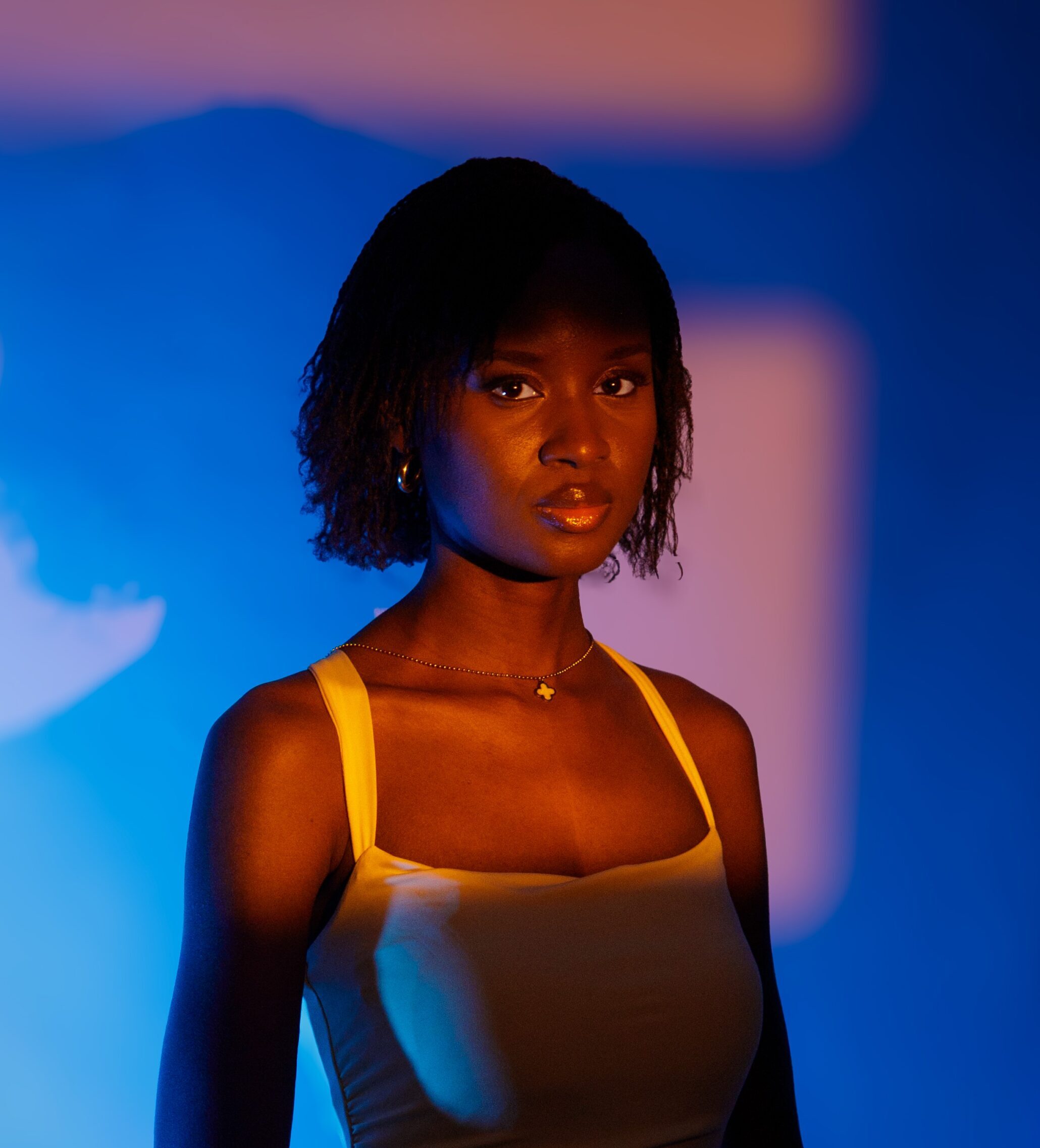
The Nigerian artist, Gladys John, popularly known by her artist name, Luchong, creates art works spanning multiple disciplines from visual art to sound development and storytelling. My first discovery of their visual arts was in a feature piece about her from LSTVWW, from where I discovered her website, and what drew me to her work was the lucidity of the art, which seems to call forth to the observer for a moment of observation.
Her work, as described on their website, “is primarily done with acrylic on canvas, with which she creates figurative paintings distinguished by their captivating gaze, subtle expressions, and richly textured surfaces.” She also introduces extra materials like jewelries, fabric, cultural embellishments and the like which enriches the art, and makes it a more interesting spectacle for engagement. Another interesting thing about her work as referred to in the feature piece is that she creates her art using paints, in the presence of sound.
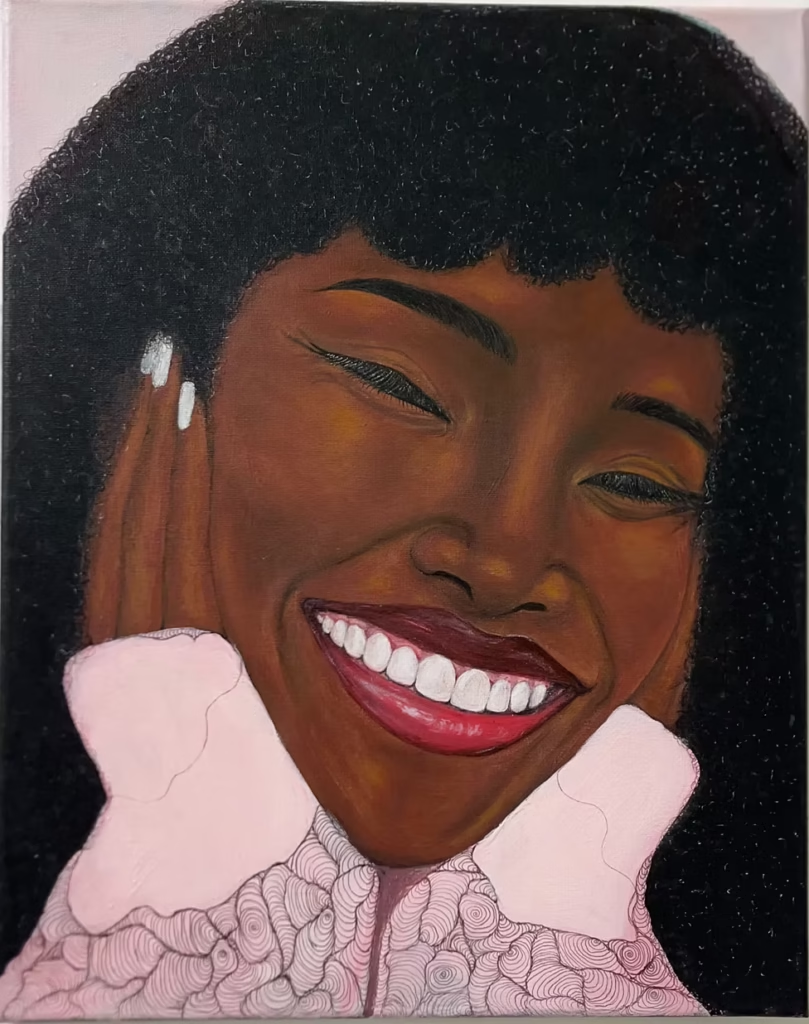
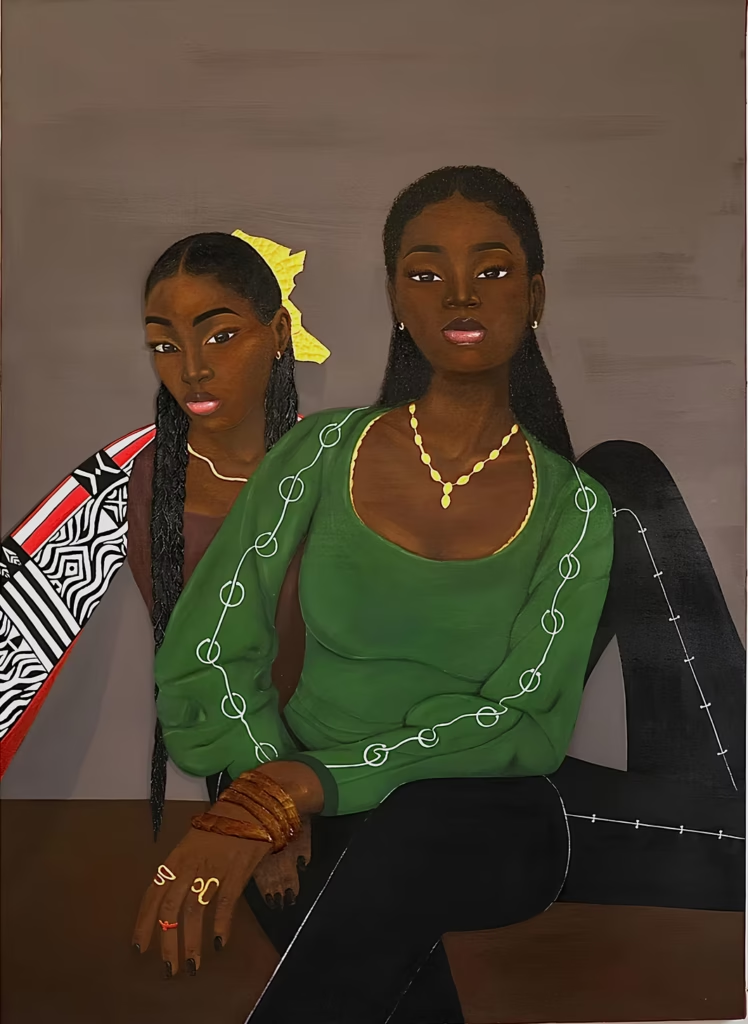
Her art deals primarily with the subject of expression and unaccidental emotions. Her subjects, some of which include a family dressed in their traditional regalia posing for the camera in a portrait titled, “A Book on Manipulation”; a girl deeply happy and clasping his face and smiling deeply in a portrait titled, “I am allowed to be happy you know”; a girl with her eyes closed–all broadcast a deep range of emotions. But what is common about them, is that these emotions, public, and private as they variously are, are not accidental. Luchong’s characters are emotionally expressive and the most common outlet for their emotions is their faces. In her female characters, their make-up—the lipgloss and the eye shadows—seem to play a part in highlighting the intensity of emotions displayed in the art.
In the slides where the subject of friendship and family are portrayed, there is a kind of solemnity in the expressions, and in the slides where the subjects are in solitude, their emotions are more pronounced. This made me think of the expressions of the familial, and that of the individual. Luchong’s art teaches us that we project parts of ourselves most suited to the occasions with our friends and family, and in the privacy of our solitude, we are our most authentic selves. The “I’m allowed to be happy,” and “Does My Smiling make you uncomfortable,” portraits remind me of radiant sun slanting into a room with blue walls. I was also struck by the depth of the “Ikigai” artwork with the girl whose eyes are closed. Her demonstration is almost transcendental. I am struck by how intense their emotions are in solitude. With nobody to perform for, we become our most authentic selves, even the part of us that may be too happy for those around us, or too sad. But the most important mode in which her characters express their emotions is in a mode of meditation.
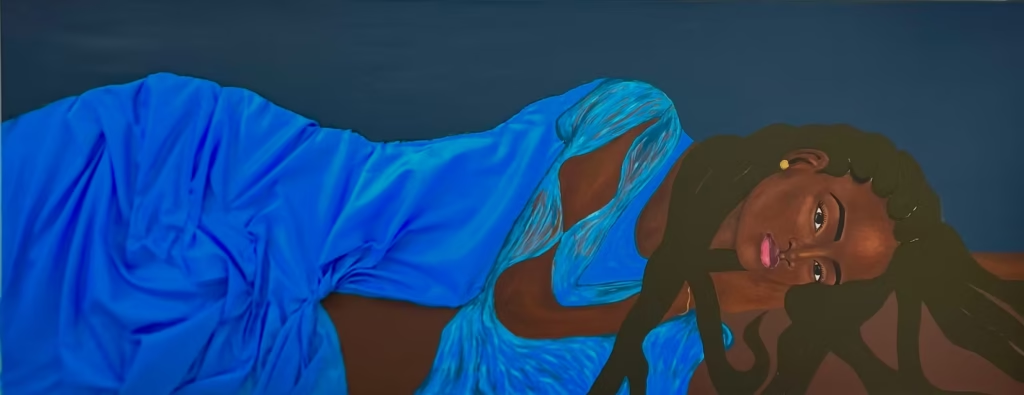
In the paintings we see that the eyes are an important window of emotions. Sometimes the eyes of the characters are open and in their gaze, there is a deep contemplation, and other times they are closed, heightening their inward musing. There are even a broader range of emotions when you consider other carousels like “Repair,” where the subject is in a blue dress, lying sideways on the ground, a faraway look in her eyes, showing that she is lost in deep thoughts. And in the portrait, titled, “Body dysmorphia,” there is uncertainty in the eyes of the subject who seems to be holding herself, a portrayal of someone guarded against her emotions. In these portraits, the emotions in the eyes of the subject are also in tandem with their body movements.
Luchong’s art holds an idealised image of selfhood, kinship and in some aspects, culture. The characters, whether they are at their happiest, or most equanimous, or in deep thoughts, or melancholy, are very present in the moment, as we see in their composition and tonal suggestions. Their bright colours and lush hairstyles, also suggests that the artist thinks highly of black life, which is shown in how she represents it.
Luchong is also very keen on the use of colour and light. It would seem that for her one of the most important things is to create eye-catching images. Beauty is a consistent occurrence in her pieces. And this is maybe here, the artist can come under criticism, because there are maybe, times, when the art seems to colourful, but lacking in rough edges.
To the deeply observant artist, Luchong’s contemplative paintings drive home the in-depth meaning of art, to create art, the artist has to subject their mind to a deeply attentive state to the muse, hence the deep state of pondering in which her subjects are often found is like a mirror to the artist, of their own process. I wonder, too, if this has something to do with Luchong herself. If it is the work of an artist to make us stop and think and to ponder a bit more intently at life, then it could be said that Luchong has done her fair bit in this regard with her expressive and contemplative art.
Some of Luchong the Artist’s works…
Michael Chiedoziem Chukwudera
Michael Chiedoziem Chukwudera is a writer, community builder, and entrepreneur. His works have appeared in Jalada Africa, The Republic, OkayAfrica, Havik, and elsewhere. He is the director of Umuofia Arts and Books Festival, and the author of the novel Loss Is an Aftertaste of Memories (Mmuta Books, 2024).