![You are currently viewing [Featured Post] Journey to Rongo](https://jaylit.com/wp-content/uploads/2026/10/Ntui.jpg)
I must have been praying that night because I remembered feeling particularly empty; a longing for something that had been a prayer in my heart: an acceptable email from The Rongo Artist Residency, 2026. I’d refreshed my Gmail app a million times since I submitted. Somewhere, I had told God that if he wanted me to keep writing, Rongo should be his clue to me. When I refreshed again that evening, and the mail dropped, I remember screaming, “Thank you, Jesus,” and my mom asking, “What happened?” Her tone had a somewhat unceremonious ring to it, as though she didn’t know that “Thank you, Jesus” meant it was definitely good news. Maybe she just knew I was going to leave her soon. Later that same tone followed her worries about who these Rongo people were and about the insecurity of traveling in Nigeria.
I really didn’t connect with her fears because I needed badly to get out! into the world and find a breathing space for my craft, which had been dying the last years. I had gone from just discovering my voice and almost immediately hit some poverty bottom that I stopped writing. Then, when I picked up the pen, I became afraid that I was losing my gift because I just couldn’t write anything, even though I could read. So, when I saw the opening for Rongo, I quickly put together old stories and applied. The acceptance felt like God was finally saying, “It is time to get out and write!”
The journey, however, was a baptism of sorts. After waiting all morning in the park at Uyo, I found myself holed up in a bus that had as much cargo as people. The drivers and loaders seem not to care about the difference. My legs felt so sore I had to stand bent inside the bus at intervals during the journey to stretch so my legs could have a little respite. The bus took me back to a visit to the Slave Museum in Calabar and the curator explaining the cramming of the slaves. The climax that hits me is when he starts describing the discomfort during times of turbulence on the sea, and as if memory were prophecy, the bus reached the part of the Benin-Agbor Road that had lost all its tar and granite, and whose potholes had become traps for vehicles. We were about to enter a Nigerian version of turbulence.
The queue of trucks and tankers was so long I imagined the queues on judgement day. And just like that, we were locked in that spot for hours. The only baby passenger among us, an infant girl, kept screaming her lungs out as though she was blaming her mum for giving birth to her. The bus was stuffed and hot, and she badly wanted air. The tire mum kept hopping in and out of the bus like a punishment. She was a young mother, maybe a first, and I could feel her weariness as though it was mine. It got me thinking oddly about why we still have children in this country, especially when we know the hell waiting for them here. It felt like something irresponsible, even immoral and unforgiving. Maybe someday, I would write a book titled, Children, Why do we have them in Nigeria?
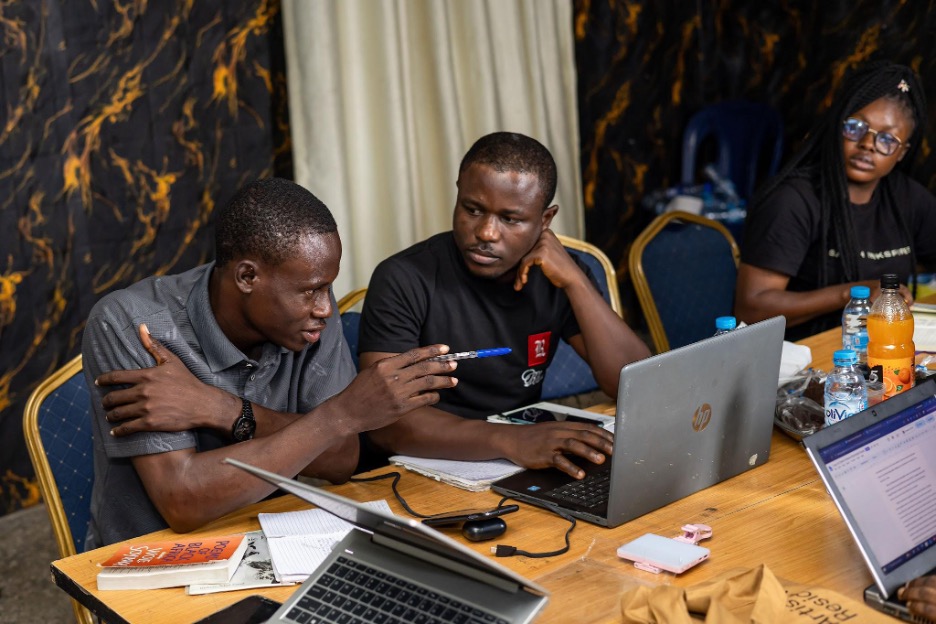
When I finally reached The Peter Fleming Art Gallery in the morning, I felt like pure shit. Thankfully, the hours and days that followed would make up for it; another baptism. I met a company that I knew I had been missing. Who do I start with?
Testimony. She was much smaller than on her Instagram page where I first saw her. She turned out much prettier in person than in her pictures. She was the program manager and seemed to relish the role even in small things like making sure meals got to everyone through her hands and cleaning after us whenever we clumsily left the wrappings and water bottles behind. Later, I met other faces of Rongo: Abby (her voice had followed me throughout my ordeal on the road), dark and tall with quite a quirky fashion sense, a definition of Benin beauty. Ruona. The residence director: Tall also. She reminded me of a close friend who stopped talking to me. I almost fell into sadness, but I shook it off. I came here to write, not to get entangled!
Sunmi. We had met online in July on Google Meet, where we held workshop sessions. Never think you can figure him out from the always stoic look on his face. He seemed very relaxed and unbothered, as though he was living a second life and couldn’t be excited by anything. His thoughts were collected, controlled, and spoken with an elderly aura.
Isaiah. Dark, tall, handsome and intelligent. He was most gracious with writing advice and would just go along as though he didn’t know that what he said was worth lots of coins. From him I learned what should stay in the story and what shouldn’t, and why: the singular lesson my craft needed, in my estimation. I owe him. He just doesn’t know.
Ridwan. The first Northerner I know personally that actually writes poems – I don’t know if I sound stupid now, but with the low rate of education down North, he feels to me like a breath of fresh air. And his poems are dope even when they are sad. I stole some lines away.
Blessing and Sarah. They only two women at the residence. For some weird reasons in my head, I didn’t quite see them as writers until I encountered their works later and absolutely fell in love with them. I think they were the kind of writers who were content with what they produced and didn’t really dip their heads into the sands of literary jargon, history, and tradition.
Then lastly, I met the city, Edo – seeped in history and culture that wasn’t just a relic from some time in the past but very much alive and vibrant in the present. Time and again, I travelled to those centuries when the carved masks, bronze heads, and elephant-skin shields were a kingdom’s pride. The city held something special for me. My mom was a young woman who came with her elder brother many years ago and would later meet my father, who was serving in the Air Force, an unlikely union that would produce two other siblings and me.
Hence, it was a kind of homecoming, a memory nearly as old as the city.

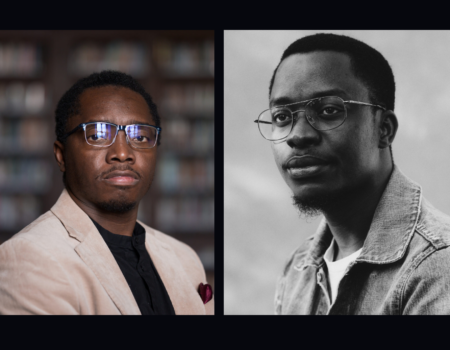
Ntui Mbey
Ntui Mbey is a writer and poet. A recent resident at the Rongo Artist Residency, he has also been longlisted and shortlisted for the GlassHouse Initiative Poetically Written Prose Prize 2021, Poets In Nigeria (PIN) Nigeria Students Poetry Prize 2021 (Top Entries), and the K and L Prize for Fiction 2021, respectively. He is also an online tutor, majoring in English language, Literature and Creative Writing. He can be found on everywhere on social media @ntuimbey.