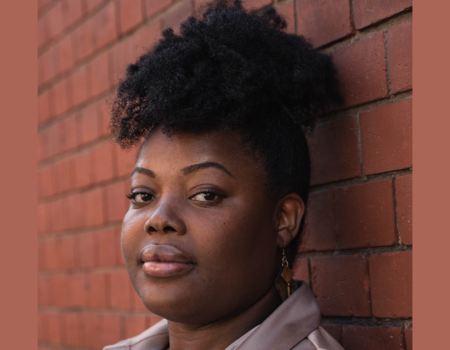
Utibe Hanson is a poet and literary theorist who earned both bachelor’s and master’s degrees in English from the University of Uyo and the University of Ibadan, respectively. He is the author of the study, Football as Literature: A Semiotic Reading, and the poetry collection, Unnoticed Presence of Things.
Three years after Utibe Hanson’s Unnoticed Presence of Things won the 2023 Association of Nigerian Authors (ANA) Poetry Prize, I sat with him to understand how a collection grounded in absence could be felt so deeply. In this conversation about craft, we examine how faith and biblical allusion are inseparable from the poet, and why most poems in his debut collection refuse to end with a full stop. A certain poetics — Nothingness — hovers around this dialogue. However, it would seem nothingness doesn’t mean emptiness, perhaps made more pronounced by the implication of the “miserly” use of the end punctuation. Hanson’s poems invite readers to create meanings, as he verges on what the poet and critic, Ndubuisi Martins Aniemeka, inspired by Mikhail Bakhtin and Derrida in reading Hanson’s collection, describes as presence’s unfinalisable and decentered. On the poetics of absence, faith and form, Hanson responds to how a poem holds nothingness with transparency and theory, relying on semiotics. With a close examination of the tension between visibility and invisibility, a Niger Delta poet follows where art leads.
~
Sarah Adeyemo
As an emerging writer, I have been active in the Nigerian literary scene since 2020, but I have never come across your works, not even when you won the 2023 ANA Poetry Prize. Recently, in a conversation with Ndubuisi Martins, I learned about you as a brilliant poet whose work I hadn’t previously encountered. I took my time to dig into your works, and your biblical allusions intrigued me as a reader. This prompted my first question: how do you navigate the intersection of religion and poetry?
Utibe Hanson
Well, thank you, firstly. However, it is needful to note that one is not antagonistic to the other; therefore, the navigation is easy. Additionally, poetry is an art form, and all art forms can bear any message; it is only the intersection that unifies them—that is to say, the medium becomes the message, and vice versa—or to put it in a more literary parlance: form becomes content, and content, form. Or, you think about it in terms of an onion bulb, layer after layer folding over no kernel. In the same way, I’m separately a Christian and a poet; hence, whatever trope serves the temper of my poetry at the time of conception and writing shapes the outcome of the art.
Sarah Adeyemo
Your debut, Unnoticed Presence of Things, won the 2023 ANA Poetry Prize. That was three years ago, but can you describe the experience of winning the prize?
Utibe Hanson
Well, I don’t write for laurels, but the dexterity of my art cannot escape laurels. So, winning the prize, I was happy, but not surprised. Generally, I have been actively studying, practicing, and teaching the art form for several years, since I started writing poetry in 2007. I have started and conducted communities that have produced some good and known poets. One of these communities, Poetic Nest, founded more than a decade ago, is still doing the great work of teaching art at its highest form.
Sarah Adeyemo
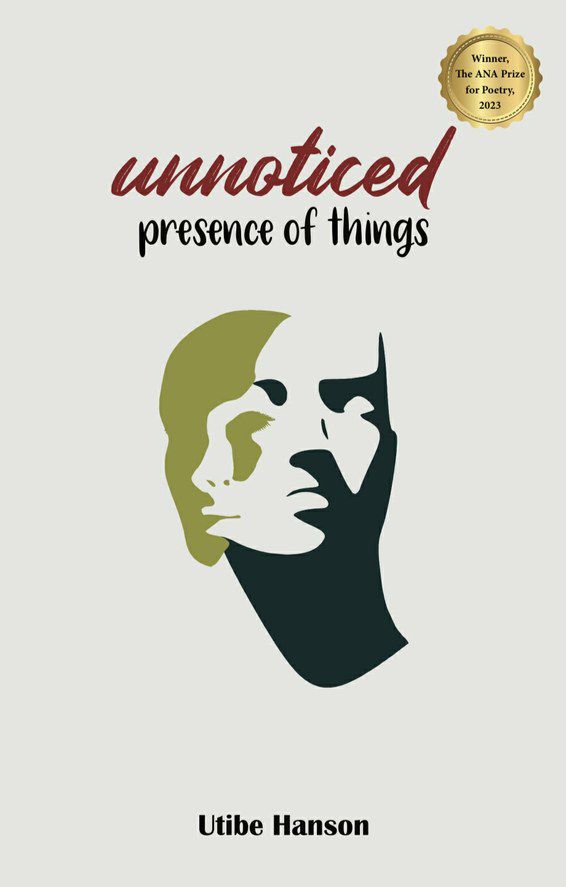
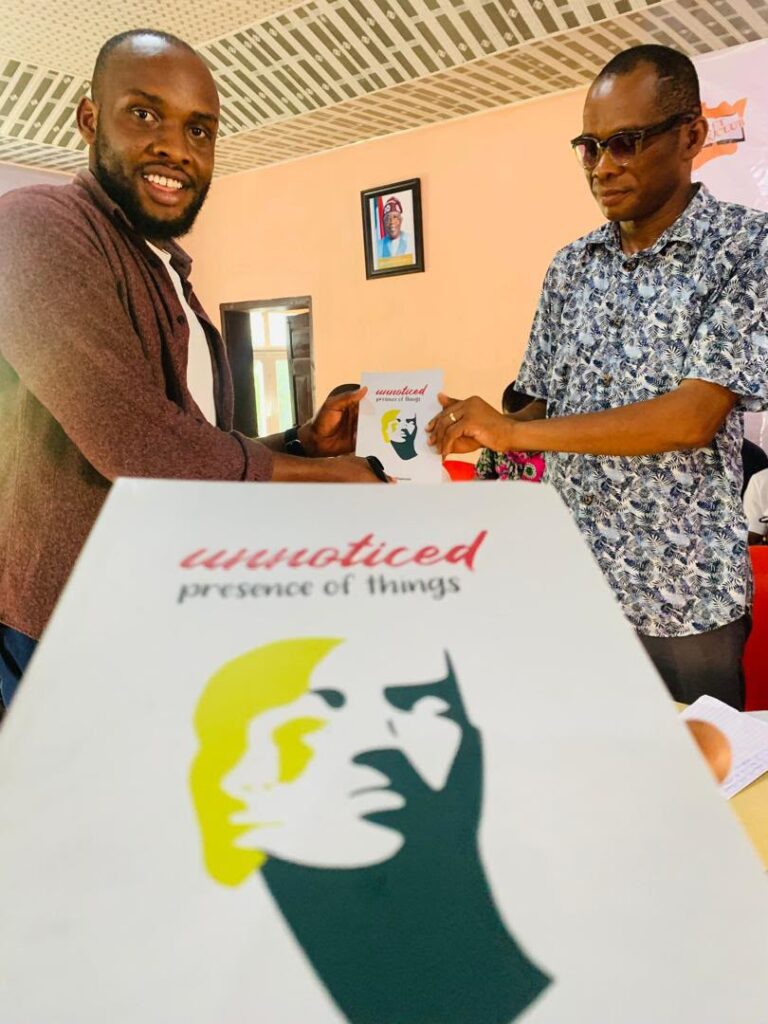
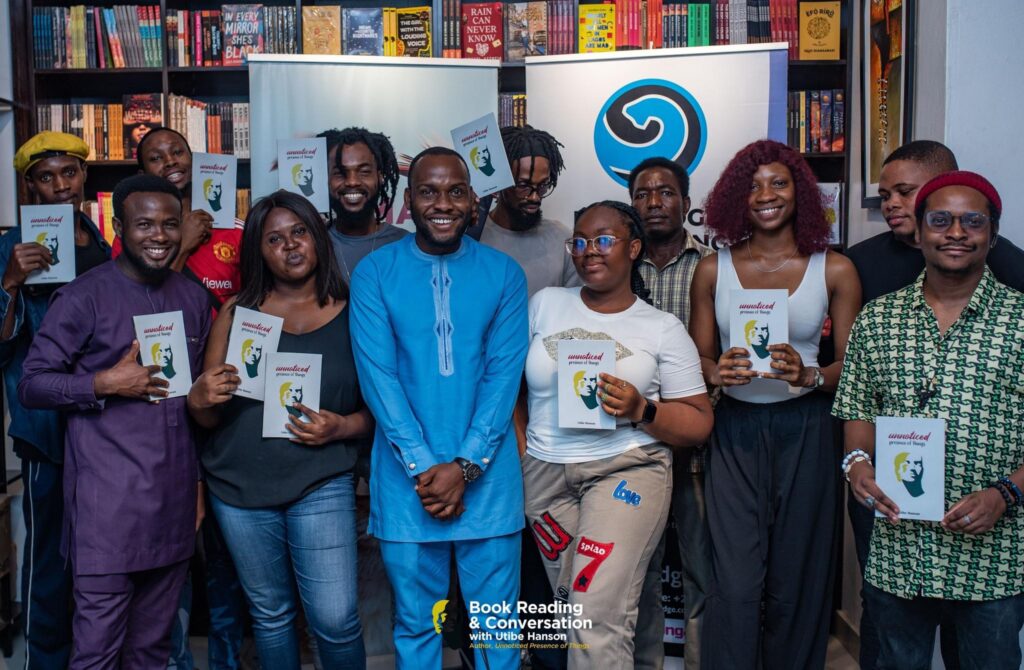
In your book cover, we see entangled faces or shades of one, which portrays a tension between visibility and invisibility. Were you involved in the paratextual process, and what do you aim to achieve with it at first sight?
Utibe Hanson
The cover conceptualisation was entirely my idea, and the designer, David Olusegun, was keen enough to represent it. Of course, his innovativeness contributed to the success of what we arrived at. In the preface, titled Proem in the book (9), I explained the thought behind the book’s title as a signification of relation—a noticed absence or an unnoticed presence, with nothingness as the anchor. So, I had no aim of what to achieve apart from satisfying the general preoccupation of the work’s title. The implicature is left for the reader or literary critic/analyst to reach for. Because I put it there that “The poems in this collection appear as a panoptic survey, unspecific and detached, an invitation to the reader to see and decide…” (9).
Sarah Adeyemo
Are you aware of the ambivalence of presence as a site for critical undercurrent in your paratextual choices and the textual signs summoned in your book, and why did you choose the title Unnoticed Presence of Things when this poetic presence is noticed?
Utibe Hanson
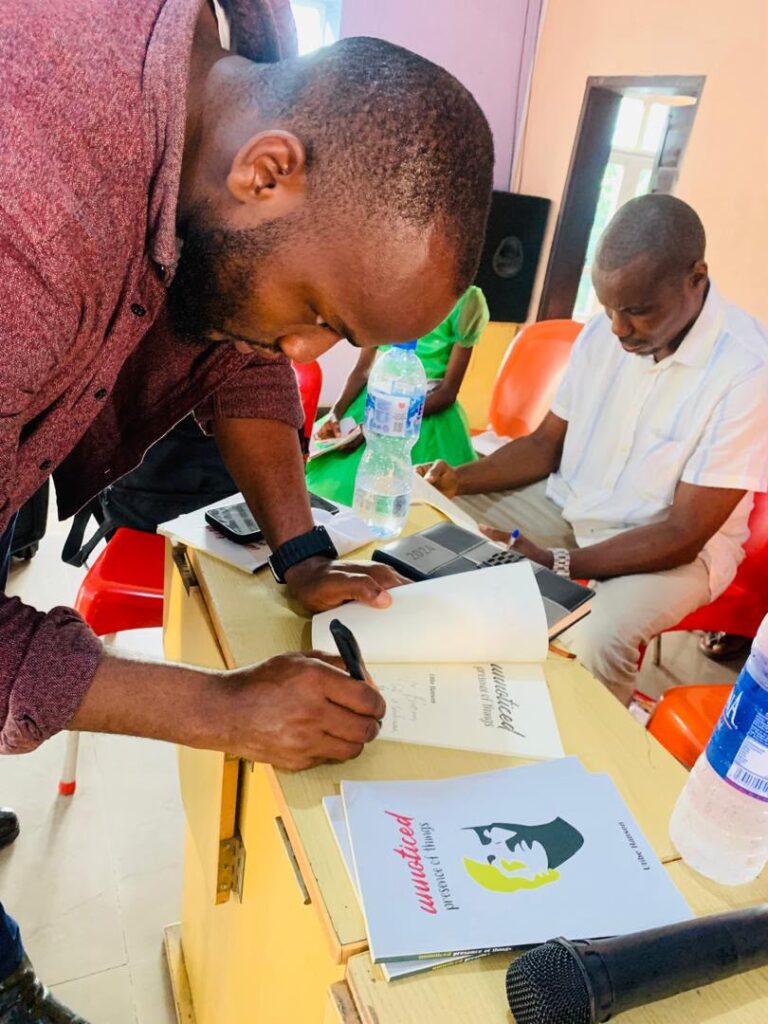
Again, I will refer to the Proem of the book and continue the quotation, because the ambivalence the book stirs contributes to its success. “…fragmented preoccupations grope most of the poems to find meaning within whatever contexts the reader brings to them.” (9). That is to say, this book was encoded for the reader, and whatever context they adopt to pursue the poems’ aesthetics is ultimately just the serving context. Therefore, the framing secures presence or presences in the absence or absences. As for the titling, the insight came from my studies in semiotics. To put it tersely, semiotics is the science of signs, and it was about the most appropriate medium to account for this sort of signification of relation.
Sarah Adeyemo
In a recent critique of your poetry collection, Ndubuisi Martins Aniemeka theorised the unspecified as poetics. How exactly would you describe the notion of presence unnoticed? To what extent does your style hint at politics of presence, what Aniemeka probes as materially, decentred or unfinalisable?
Utibe Hanson
Aniemeka is so palpably intelligent, and his critical interventions in the paper are largely insightful and revealing, interrogating the discourse of the politics of presence layer by layer. To contribute, again, I refer to the Proem, where I showed that I was either non-existent or that the invitation to the reader to co-create effectively removed me as a possible monarch of meaning regarding the collection. Still, to reach the nucleus, we must unpack my subject, which I mentioned is nothingness. “My subject is nothingness…” and nothingness consists in the signification of relation: “a noticed absence or an unnoticed presence…” (9).
Sarah Adeyemo
Aniemeka also observed that your writing gestures at the foreign style – the type associated with John Donne, John Milton, and others outside the usual African experience. Could you explain why, even as a Niger Delta poet, you have not engaged poetics in the ecological despoliation of the region as found in the poetry of Tanure Ojaide, Nnimmo Bassey, and others?
Utibe Hanson
Well, I follow where my art leads. But generally, I am still growing. Perhaps, in the future, the spirit with that preoccupation would possess me, and I would cry. To run at it without that possession would be letter without spirit, to allude to the Apostle Paul. But thankfully, there are already voices crying in the wilderness; hopefully, there is change before I need to cry too.
Sarah Adeyemo
In a poem titled “Across timelessness” (28), you wrote: “…let us begin/with asking for forgiveness/of our children/ because by tomorrow/ we would have failed/ our past by repeating it/across timelines” (28). How would you explain the concept of time with what is not worth repeating by the next generation?
Utibe Hanson
This is such a perfect time in the history of our nation to ask this question. And it mirrors George Santayana’s position. “Those who fail to learn from history are doomed to repeat it.” Everything we are suffering as a nation comes from either not learning from the past or suffering amnesia of convenience. And it remains that whatever we fail to punish, resist or refuse, we reinforce; and as the cords strengthen, it begins to look like a normal phenomenon, and with that it becomes near-impossible to think of a difference, let alone desire a change of status quo.
Sarah Adeyemo
In Unnoticed Presence of Things, there is a reflection on the concept of time in the poem “creation story” (13), the beginning where “God translated into letters”. Is there a reason why you chose to start the collection with that poem that takes us back to Genesis?
Utibe Hanson
Well, yes. The opening section of the book is titled Ascent, and the epigraph is a quote from Revelation 4:1, where John is invited to come further up into Heaven to receive revelations. In the same way, the poems in the section reach towards the higher reality—muse, poetry—embodied in whatever way. Additionally, its allusion to the ‘Genesis’ realities made it an incontestable choice as an opener.
Sarah Adeyemo
Contemplating “time reveals the crime of man” (16), to what extent will ignorance govern, because, until revelation, a lot would have gone out of hand?
Utibe Hanson
Truly speaking, that is not an easy question to answer. But let’s hope retributive justice comes sooner for all offenders.
Sarah Adeyemo
Having studied your works and marvelled at your brilliance, how do you respond to the constant invitation of biblical allusions or references?
Utibe Hanson
Like I said, whatever the temper of the poem calls for, I submit to. The best I can engender is a triggering subject; even that has to kick in my heart. But generally speaking, I begin there and follow whatever bend of music the poem takes to truth.
Sarah Adeyemo
If you are to carry out a stylistic analysis of your poems appearing in the middle of the page, what should we expect from you, or should we close our eyes to your style?
Utibe Hanson
No, not at all. Don’t close your eyes to it. For this collection, this is the graphological temper it called for, because it allowed the poems the freedom to live up to their preoccupation in text and texture.
Sarah Adeyemo
Most of the poems in your collection, Unnoticed Presence of Things, appeared in fragmented preoccupation, which invites readers to interpret in whatever context they deem fit. What then is the role of the original context of the poet? Don’t you give it a second thought that the embedded message in the poems might be lost due to misinterpretation at the reader’s end?
Utibe Hanson
Well, a good question here. But, as I mentioned, I am completely removed from presiding over the meanings of poems in this collection. Think about it in the light of Roland Barthes “Death of the Author”. With that, the figurations of the poems are enterprising enough to allow various possibilities.

Sarah Adeyemo
Oh, to allow various possibilities, in some open-ended way, perhaps. Most of your poems do not finish with a full stop. Personally, as I read them, I expected the next line. How did you achieve this, and how intentional are you with this style?
Utibe Hanson
Again, it is the temper of the collection, and the espousal of nothingness. A full stop makes a content definitive, in the way that it started somewhere and has ended somewhere, submitting it as a unitary entity with identifiable form and features. You can hardly reach that with nothingness. And for not possessing definitiveness outside the reader, it is hard for me to determine that the poem has ended. The only poems with full stops in the collection are the metrified ones, which are more a structural concession than a functional one.
Sarah Adeyemo
Structural concession, hmm, more like it. And then possibly it demonstrates why you titled a poem “House of Cockroaches”, but I have never seen one before. After reading this particular poem, I have been imagining what it would look like, but my imagination is betraying me, and memory cannot be a saviour because I have never seen one. Would you describe one and how it influences the title of the poem?
Utibe Hanson
Nice. But don’t overthink it. This is where the proem invites you to bring your context of meaning. But I can help a bit. The section of the book where the poem appears particularly speaks to the state of the nation. And, mainly, the awful characteristics of the cockroach are what is interrogated, and the metaphor is extended to represent the “army of perdition/in a stinking match/ by mandate” occupying the houses.
Sarah Adeyemo
Profound, that authorial intervention! Your poems “Heaven” and “Exit Wound” resonate with their brevity. How intentional are you with brevity?
Utibe Hanson:
Again, yes. I am intentional with my style and sequences. More so, my style is often marked by brevity, except when I’m writing a naturally long-form verse, like an epic. Even then, I tighten the metaphors to say so much in so few lines.
Sarah Adeyemo
What kind of sequel comes after Unnoticed Presence of Things? What should we expect from you?
Utibe Hanson
Well, I have something of a sequel to Unnoticed Presence of Things. But it’s still in the works. I can’t say when it will see the light of day. But I have a publication coming out soon with Noirledge again. It’s an epic titled Consternation. I’m sure news about it will flood the space soon.
Sarah Adeyemo
Thank you so much for revealing things that would have been hidden if not for the time spent with you. I look forward to reading your future works.
Utibe Hanson
Thank you very kindly, Sarah. It was a wonderful session.
Works Cited
Aniemeka, Ndubuisi Martins. “PresenceDecentred or Unfinalizable? Utibe Hanson’s Unnoticed Presence of Things.” Journal of Artistic Creation and Literary Research14, no. 1, 2026, pp. 1-24: https://reunido.uniovi.es/index.php/jaclr/index
Hanson, Utibe. Unnoticed Presence of Things. Ibadan: Noirledge, 2022.

Sarah Adeyemo
Sarah Adeyemo is a poet, writer, editor, and spoken word artiste from Nigeria. She is a fellow of the SprinNG Writing Fellowship. Sarah has work published or forthcoming work in ANMLY Lit, D’Iit Review, The Fiery Scribe Review, Con-Scio Magazine, Sevhage Review, Okiti Literary, Synchronized Chaos Magazine, Pepper Coast Magazine, The Weeds Review, Akpata Magazine, The Shallow Tales Review, The Muse Journal, The Weganda Review, Everscribe Magazine, Afrillhill Press, TV-63 Magazine, Poems for Persons Interest, Northern Writers Forum Journal, Eboquills, Rinna Lit. Anthologies, and elsewhere. Her works have been shortlisted for the 2025 Labari Prize for Poetry and longlisted for the 2025 Eriata Oribhabor Poetry Prize. She serves as the Managing Editor at Words-Empire Magazine, a Poetry Editor at Yarnz Magazine, PFPOI, and a News & Feature writer at the Journal of African Youth Literature (JAY Lit). She was a writing resident of the Rongo Artist Residency in 2026 and is currently a writing resident at the Ebedi International Writers Residency. She is a member of The Swan Collective. A dramatic poet who tweets @sarahinkspires.