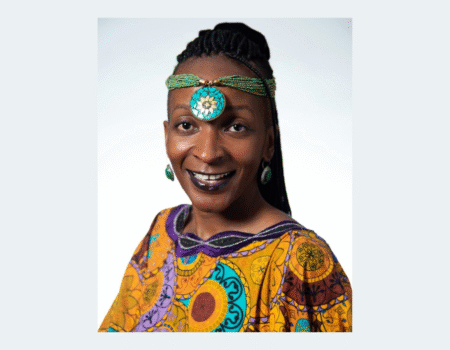
![You are currently viewing [Featured Post] Efe Paul Azino: The Principle of the Hiding Hand and a New Festival for Black and Africans in New York](https://jaylit.com/wp-content/uploads/2026/09/B964AFCE-2931-4978-9B73-33F38FBCC9A4-scaled.jpeg)
The Poet, Efe Paul Azino, by the time we finally sat down to speak over a Google Meet Meeting, had been running around the city of New York. It was 5 pm Nigerian time, and 11 am New York time, and three weeks until the New York Black and African Literary Festival, which he organizes annually. The subject of our conversation was to be the cause of his restlessness: a vocation we both share as artists passionate about community and founders; he also runs the Lagos International Poetry Festival, and I run the Umuofia Arts and Books Festival.
By the time Efe Paul Azino moved to New York in 2022, he found the city to be one with a lot of obvious cultural investments, both from private and public endeavours. Azino, at the time, had been the director of the Lagos International Poetry Festival (LIPFEST) for seven years, and he was looking at the city of New York with the eyes of an artist, weighted with hindsight and experience of community building. And in spite of the fact that in New York, there was a lot going on, Azino was quick to spot that there was no black-specific festival that brought writers of different black experiences together. It was interesting to Azino, and this insight activated in him a sense of urgency. “It was surprising,” he told me, “because New York is an immigrant city, it’s a Caribbean city, it’s an African city, it’s an African American city. You know, it’s a thoroughfare of some sort, you know, of black writers coming and going. So, it was a glaring gap that we wanted to fill.”
Azino knew what he wanted to do, so by 2023, he had assembled a team, and the New York Black and African Literary Festival was formed and registered. It was afterward that Azino and his team hit a brick wall; funding and support were not immediately forthcoming.
The challenge that had not hit Azino in New York was a familiar one; a challenge which he knew so well in Lagos, Nigeria, a city, which Azino still spends some of his time every year, and which is home to a budding community of Nigerian creatives. In Lagos in 2015, he established LIPFEST, which has since become an epicenter where African and Black poets from Africa, Europe, and the Americas converge annually. A poet and an economist, Azino spent the years of his early youth writing and performing poetry, and working with corporate brands interested in creative endeavours, like Heritage Bank, Sterling Bank, the US consulate, etc. With this, he built a network and reputation, which enabled him to build the Lagos International Poetry Festival.
The Nigerian literary scene, long underfunded and lacking government support, is notorious for being a hotbed where literary ideas and vocations come alive, then hibernate for lack of sustenance. Through Azino’s network of corporate establishments, he was able to keep LIPFEST running. Even with all the years, the festival has run, Azino says it is still underfunded. “We are talking about asking people who can’t fund public education, who cannot fund primary schools, secondary schools, and universities; people who won’t fund hospitals or the Primary Healthcare Centre close to them, people who prefer to cross the bad roads in front of their houses with big vehicles instead of fixing it, to give you money. They won’t understand what you are saying.” But while, with his connection as a community builder who has gotten known on account of his work, Azino has been able to make LIPFEST a reality, the festival has remained largely underfunded. “It is acutely underfunded,” Azino told me, “and structure is impossible without funding. In the last few years, we have had a revolving door of people that come and go, not because we can’t pay them, but because we can’t pay competitively. Of course, there are those who come and intern with us, who have grown with us over the years, but at the top, you will always need one or two or three people who are mature, who are strong hands, and to get that kind of support is money.”
Azino’s move to New York and founding the New York Black Literature Festival put him in an even tighter terrain. In 2023, in addition to struggling to host the Lagos International Poetry Festival, he was now in a quagmire, where he was asking himself if the literary vacuum he had seen in New York was as urgent as he had thought it was initially. They had written multiple letters for partnership, for venues, and none of them had yielded any positive results. And the years 2023 to 2025 saw Azino being stretched thin to the limits as he tried to manage two international festivals on both sides of the Atlantic.
“I think I have the misfortune of being so recklessly optimistic,” Azino told me. “I don’t see the full picture of the difficulty of the thing. I am blinded by the possibility of what the thing can be and why the thing must be. I’m already halfway in before I realize, and begin to ask myself, ‘What have I gotten myself into?’ And by then, it is too late. In Economics, we call it the Principle of the Invisible Hand. If you really knew what it would take to embark on an endeavour, you most likely would not embark on it. Optimistic people tend to underrate the difficulty and risks. They are always halfway in before they realise.”
The Principle of the Hiding Hand, as an economic concept, was popularised by American economist Albert O. Hirschman after studying a group of World Bank projects. The core component of the principle, as Azino stated, was that founders often begin events, blind to the challenges they pose. But even more important is that by the time they realise the challenges, it is too late to turn back, and so they are forced to both hold on, and invent clever solutions to their problems under duress. Azino, in the course of running LIPFEST, had gotten into this situation many times, and it was the same place he found himself in New York. In 2024, Azino and his team were finally able to set the swing moving for the New York Black Literary Festival. They had no funds or grants until the day the festival began, but managed to secure a venue, book flights for guests from around the world, and handle the complex logistics of running an Arts and Books Festival.
Speaking of the preparation for this year’s edition of the New York Black and African Literature Festival, Azino told me, “We got funding again from the Open Society because they liked it last year. So, we’re working to see, you know, how much more we can expand it, you know, into the U.S.”
The Nigerian literary scene is one tough terrain for writers to survive. This has led many writers to migrate out of the country. This phenomenon began with the third generation of Nigerian writers. “There’s no connection, you know, and as it is with most other fields, between what happens in academia and what happens in practice. You know, when it comes to literature, those are two very disconnected things in Nigeria, because otherwise there’s no reason why actual practicing writers should not be the ones, you know, for a large part running the literature departments and universities, and then they do literature. So, it’s not a country for writers, and so what we have seen with what we call the third generation of Nigerian writers, Helon Habila, Uche Nduka, Nduka Otiono, Afam Akeh, so many of them. You know, it was from that generation we started seeing a large, major exodus of Nigerian writers to the West.” And now a community builder like Azino is trying to expand the reach of African literature into the US market by creating a festival that is a meeting point for Black people from African, American, and Caribbean experiences, and so forth. This endeavour holds importance in the creation of a structure that helps connect the immigrant community. Much of the migration of African writers to the West has economic motivations and implications. Efe Paul Azino keeps abreast of this matter and how the festival was also part of the larger immigrant economic chain. “Those are practical matters, you know,” he told me. “People mature, they have family, they have children, they have to, you know, they have to deal with the economics of their lives. If coming here, you know, is how they can do that, it’s going to be a standing reality for a long time that the majority of our writers of quality and stature are going to be stationed in the West. You know, so the festival here, you know, I think also becomes timely in that sense.”

Michael Chiedoziem Chukwudera
Michael Chiedoziem Chukwudera is a writer, community builder, and entrepreneur. His works have appeared in Jalada Africa, The Republic, OkayAfrica, Havik, and elsewhere. He is the director of Umuofia Arts and Books Festival, and the author of the novel Loss Is an Aftertaste of Memories (Mmuta Books, 2024).