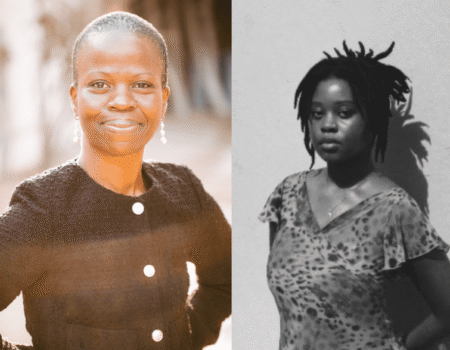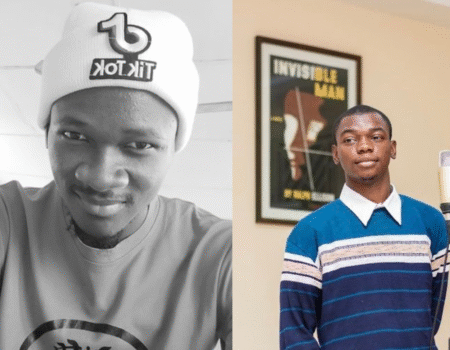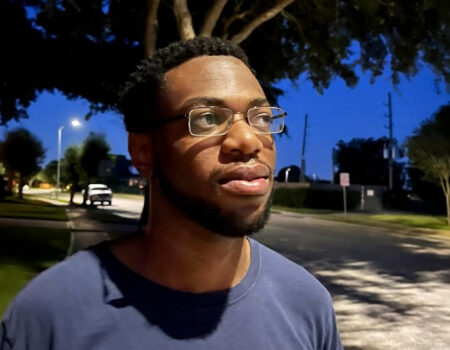
I first encountered Timi Sanni’s poems the way you encounter some moments waiting for you: without warning, and with the mild shock of recognition. There was a quality in the lines that I could not immediately name; not beauty exactly, though the beauty was there; not intelligence exactly, though the intelligence was considerable. Something quieter. Steady even, there was this refusal to flinch.
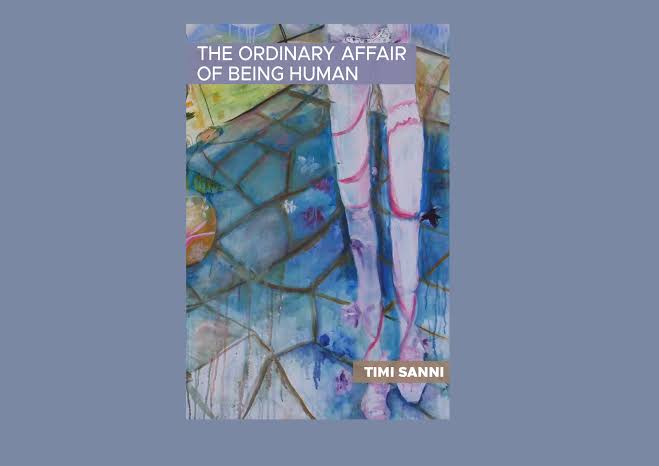
The Ordinary Affair of Being Human, his debut chapbook selected by Kwame Dawes and Chris Abani for the 2025 New-Generation African Poets Box Set, is the formal arrival of a voice I had been watching over the years, on Facebook, now formally through the eyes of a big platform. There is a proper assemblage now. The title is deceptively plain. Do not be deceived.
Sanni told me, when we spoke about the book, that it began with a Facebook post. A celebrity had lost her parents months before; one night she posted a goofy selfie. He saw it and felt, quite strangely, as though he had never realized it before: she was human. Like him. The observation sounds unremarkable until you follow it to where Sanni follows it; to the people who make gods of men, and the people who believe themselves gods and act accordingly, with the violence that belief licenses. The chapbook is an argument against that violence. It makes its case through the body.
The title poem opens without apology: Tell me about pride, and I will tell you / of the humility of the wingless. Heroes, the speaker says, become more ordinary the more you see them. That process of seeing is not gentle; it is the slow removal of a mythology that someone, somewhere, needs to survive. The more I saw my heroes, the more / ordinary they became.The line isn’t mournful, I will take it as simply reportage, you know, it reads like a doctor reads a chart. The arrow that breaks / a kiwi’s skin will break the falcon’s. The kiwi, grounded and unglamorous; the falcon, sovereign of air. The arrow does not discriminate, and Sanni does not pretend otherwise. This is not consolation; it is a leveling, and levelings carry their own particular violence and chaos, even when they are true. For me, what redeems this poem from mere disenchantment is its closing. The speaker asks us to wait for our miracle of wings, to sing and his body of mine will endure, and because the dance is beautiful, to let the music go on a little longer. This is not necessarily a triumph, but there is a sense of Permission. The body, stripped of its mythology, is still worth inhabiting; that is the argument, and it is made quietly, almost under the breath.
Zagajewski, writing about Two Books that meant something to him, observes that creativity contains at its core something that does not lend itself to description; and yet it is exactly this which transforms clay into sculpture, words into poetry, rustling sounds into music. Sanni’s transformations happen before you notice them. By the time you look up, the poem has already arrived somewhere else.
Whoever has come across my writing will testify to how obsess I am with my mother tongue (yoruba), and my excitement peaked at a poem titled “Bàtá”, which is perhaps the chapbook’s most layered achievement. the word for bee / is the same for honey, which is to say: a man / is what he makes with the machinery of his body. The linguistic collapse is the poem’s entire argument in miniature; maker and made, creature and product, indistinguishable. What you produce is what you are. The bàtá drum becomes the foot through which Sanni moves between the sacred and the colonial: a goat laid its life down for the miracle of this music; the Europeans came and took the drum, and there was no one to coax out its fine music; centuries later it returned and there they were, waiting to beat it back into its joy. Joy here is not innocent; it is recovered from loss, which is the only way joy survives history. Then the poem lands its most startling image: During a festival the town was raided, the huts burned, the crops reaped, but no one stopped dancing, because the music… the music. The ellipsis refuses closure. The sentence will not end because what it is pointing at cannot be ended; only interrupted, and even then, not for long. There is a theory of African resilience embedded in those trailing dots, but Sanni is too careful a poet to state it. He lets the silence carry it instead.
“If You Could Trick Death with a Name” is where the chapbook enters its most ancient conversation. The àbíkú in Yorùbá cosmology is a spirit child; one who dies and returns, dies and returns, cycling between the living and the dead with what seems like intentional cruelty toward the mother who keeps receiving and losing the same soul. Both Wole Soyinka and J.P. Clark wrote poems called “Abiku,” and the distance between those two poems tells you something essential about what the subject can bear. Soyinka’s àbíkú speaks for itself, in its own voice; it is seductive, almost proud of its restlessness, garbed with the imagery of a spirit exercising and fully aware of its power: In vain your bangles cast / Charmed circles at my feet. Clark’s àbíkú is seen from outside, from the mother’s exhausted vantage; the poem is worn by grief that has had to reconstitute itself too many times: Child, you pressed a sore / Against my womb and left / That empty space. Two poets, the same subject and irreconcilable distances. Sanni’s poem does not choose between these distances. It inhabits both simultaneously, whichi believe is a more difficult thing. The poem is told in the first person plural; we watch, we see, we witness. This collective voice is not a crowd; it is something older, a community holding its breath around a ritual it has performed before and must perform again:
We watch the mother stare,
/ unflinching, at the death of her newborn,
/ and whisper, in that din of spirits,
/ Àbíkú, look, there is no plea left
/ in these eyes you worsted with tears.
The address to the spirit is not necessarily a supplication, for me it appears as testimony. The mother does not beg; she presents evidence of her own depletion. And then the turn: old names given in love, are burned – Bámitálé, Dúrójayé – and a vile name is spat onto the child’s face instead. We see her spit a name so vile it stinks / and slap it on his face. The act, although brutal, still carries some love. Sanni does not flinch from that contradiction because the contradiction is the point. What looks like violence from the outside is, from inside the ritual, the hardest tenderness available. Death is to be deceived; ugliness is the only currency that works. Please don’t leave, my baby, The italics lift that line out of the witnessing voice and place it somewhere private, somewhere that belongs only to the mother.
Where Soyinka’s àbíkú poem is a portrait of spiritual agency and Clark’s is a portrait of maternal grief, Sanni’s is a portrait of the community that holds both; the witnesses who must watch, name, and hope without certainty. Chris Abani, during the editorial process, noticed the poem’s debt to Yorùbá incantation and drew a smiley face in the margin. That detail matters; it means the poem carried its root system intact across the distance between poet and editor.
Vulnerability can’t be hidden for long, especially as a poet. This I read in “Crisis”, which is the chapbook’s most exposed poem. The speaker tallies a childhood shaped by sickle cell disease; a father who stormed out at midnight, a mother who would not put the sick child down, a sister who held him to her chest as he dropped in and out of God’s light: The body, faithful in its work, / tallies these absences like clockwork. The body as bureaucrat; recording without sentiment what love withheld and what crisis, paradoxically, delivered. The only times I have been poured / a decent measure of love / have been with my body folded over / in crisis. There is no self-pity in this observation; there is only the cost of making it honestly. The speaker then performs a kind of temporal doubling: It is 2001 all over again. I appear / in this story as my father. To appear in one’s own childhood as the parent who failed is a disorienting act of empathy; it does not excuse the father, but it refuses to simply condemn him either. The poem ends on a line that has stayed with me since I first read it: I love myself a little / more, if only to bear the pain. I see no resolution here. I’d say it is a small, necessary increment; the minimum required to continue.
Sanni told me he believes that violence, however little, when examined, should push us back into the tenderness of each other. This is the chapbook’s organizing faith; not stated as doctrine but enacted, poem by poem, as a practice of witness. He does not resolve the tension between violence and tenderness. He holds them in suspension, the way a drum holds silence between its beats. Zagajewski writes that to build a bridge one must first, small detail, come upon a river. Sanni’s rivers are everywhere: illness; colonial theft; a midnight argument; a spirit child who will not stay. He does not moralize at their banks. He stands there and measures the current.
What I had sensed in Sanni’s poems before this book, that quality I could not immediately name, I can name it now. It is the refusal to let the ordinary stay small. On earth, there is nothing more / extraordinary than just being human. He means it entirely. And because he means it, so, finally, do I.
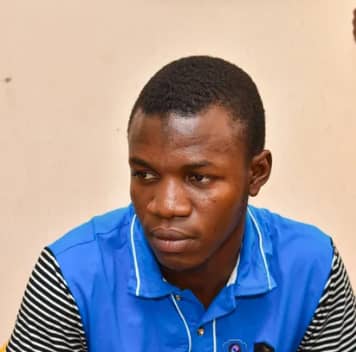
Káyọ̀dé Ayọ̀bámi
Káyọ̀dé Ayọ̀bámi is a Nigerian poet and an African literature enthusiast, interested in Academics and Yorùbá translation. His works have been published or forthcoming in icefloepress, Olongo, Àtẹ́lẹwọ́, PoetrySangoỌta, Isẹle, Ake Review, South Florida, porter house review and elsewhere. He was shortlisted for the Ake Climate Change Poetry Prize (2022).