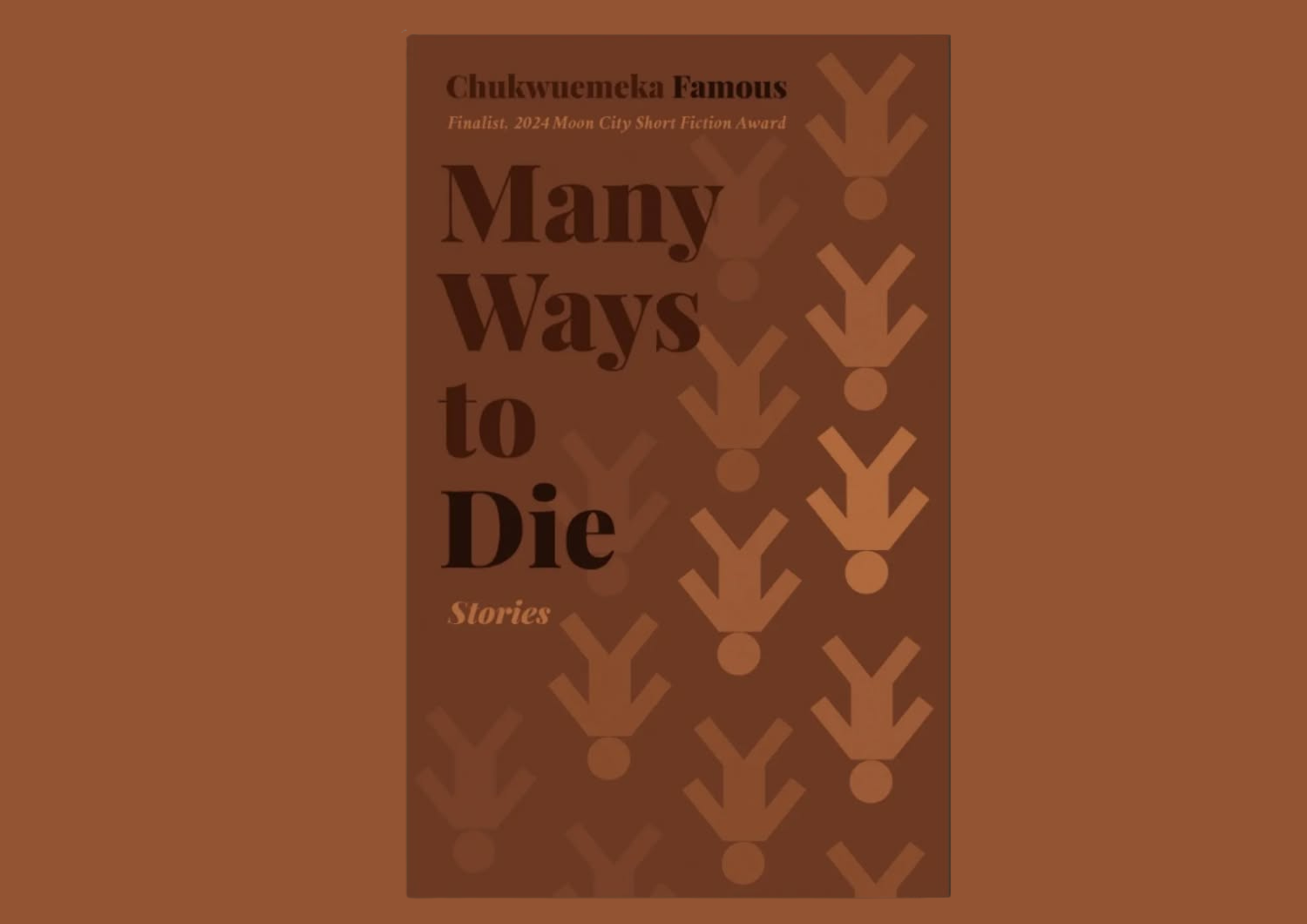
Too many dead bodies. That was my first impression of Many Ways to Die (The Roaring Lion Newcastle, 2026), a collection of short stories by Chukwuemeka Famous. When I finished reading it, I went back to take stock of the number of recorded deaths in the stories––both overt and implied. In all the eight stories, only one character deserved the death that came to him, others did not have to die the way they did. But is that not the way of the world? Unfair deaths of undeserving people? That is what Chukwuemeka Famous’s second book is all about. A book about ordinary people, aptly dedicated “to those slipping away.”
I am not unfamiliar with Famous’s writing. His debut novel, We Will Live Again, is acclaimed for its deft interrogation of the lives of an Igbo family caught in the throes of internal and external war. He continues that interrogation in Many Ways to Die––a story animated by poor street children, young dreamers, carpenters, traders, tailors, pastors, teachers, doctors, kidnappers, traffickers, and human parts dealers––normal, everyday people.
The first story, ‘Fly’, is about Ozichi, a teenage girl forced to drop out of school after the sudden, gruesome death of her mother who was her provider and with whom she shared a strong bond. Ozichi’s never-do-well father was not always like that. He was a thriving electronics dealer who lost everything to a devastating fire and lost his willpower in the process. He never recovered and took to drinking and smoking. In exchange for a loan to return to business, he sends Ozichi to live with one of his former business partners in another town. He does not know what this former business partner wants to do with Ozichi and he does not ask, but his tone gave him away as having consented to whatever it is. Against her will, she moves in with the man but discovers, to her chagrin, that she is neither going to be his maid nor his wife. Instead, she is to be trafficked into prostitution by the man’s mother. She resists. The man rapes her as punishment for resisting. The night before she’s taken away, she kills herself with a kitchen knife she always carried with her since her mother died.
While readers are conversant with stories like this, Famous’s individual talent salvages the trope by his imbuement of Ozichi with defiant, rebellious qualities that make her choose to live and die on her own terms? An outcome that is not always the case in the often happy-ever-after and utopian sense of justice stories within the African fictive canon. But did Ozichi really die on her own terms? Or did life’s wicked turns force her to take a drastic decision in the face of what she thinks is a violation of her right?
Famous has a wild sense of retributive justice. This is evident in stories like ‘When Flesh Summons’, ‘It Is Finished’, and ‘This Is Not A Way to Die’. In ‘When Flesh Summons’, a man is killed by two conniving brothers on trumped up charges. Unable to stomach the loss, the bereaved widow goes through a rite of passages that strips her spirit of its bodily flesh and sends her into the land of the dead to summon the ghost of her late husband for vengeance. The story begins and ends with the dead man’s arrival in the community to exact revenge. ‘It Is Finished’ will impress the reader by Erima’s refusal to play the victim card. Born by two silly folks, her lousy father wakes one morning to demand that she stops schooling: “I stood there, puzzled at how quickly my schooling had ended without a moment’s consideration” (142). Her mother was all too happy to agree with her father. His business had gone bad but instead of channeling his energy into finding other means to raise money for his brilliant daughter to, at the least, finish her WAEC since she was already in the exam class, he spends that energy drinking and eventually sexually assaulting her on one of the nights his wife went for vigil. The second night it was to happen, Erima lunges at him with a hammer, pummeling him to death. In ‘This Is Not A Way to Die’ grief and anger buoys Tony into carrying out a bizarre action. He loses his father barely one year after losing his mother. Their family doctor had recommended surgery for the father after being diagnosed with bowel perforation. The dying man refuses to consent to the surgery, owing to his pastor’s conviction that God will heal him. The man acquiesces to his pastor’s words but dies almost immediately. Believing that the pastor deceived his father into his untimely death, Tony pays him a visit before his father’s funeral and commits a murder he quickly regrets.
Famous has a fascination with life and death as could be seen in the titles of his two books. He acknowledges in the author’s note of MWTD that he was suicidal at a point in his life when he was feeling stuck. That explains why, in his stories, death is always a way out, his final resolution for everything. I imagine myself rewriting these stories, looking for other ways to save the characters whom Famous sends hastily to their untimely graves. But he says that that is what his country does to young dreams. And given that he is merely a writer retelling his nation’s lives, he is bound to be loyal to material reality, hence the collection is peopled by broken people whose dreams are tied to their very existence, the loss of which means death. Ozichi dies with her dreams by committing suicide. Tony destroys his thriving life out of unguarded anger. Erima commits murder and, seeing that nothing is left of her dreams and dignity, declares “it is finished” (154). Ije, in ‘Leaving’, loses her marriage after four miscarriages and returns to Nigeria from Switzerland to face the shame of a failure that is no fault of hers. A young couple, in ‘Magic Child’, lose their only daughter after years of barrenness.
As heartbreaking as these are, Famous further shatters what is left of the reader’s fragile heart by projecting characters who not only lost their dreams while battling social injustices, but some die in process too, in the most brutal way. In “Paradise” a brilliant tailor loses his life to organ harvesters in a bid to achieve his dream of being successful. He owes it to his late mother to succeed against all odds but when faced with the ugliness of wealth, he chooses a painful death, hoping it’d reunite him with his mother in “paradise” (76). The most heartbreaking story, in my judgement, has got to be ‘Water Takes All of Me’ which is a teenage boy’s painful recollections of his family members that were killed in a flood that ravaged their community. Told from the first-person of view, Tochi’s (the protagonist) recollections and grief is Famous’s contribution to the conversations around climate change especially as perennial flood threatens African communities. “Like that rat, my family did not escape the water, because nobody can escape from water” (121), Tochi says in a declaration that should compel a concerned reader to question his or her government’s policies towards proper urban planning. “Water Takes All of Me” speaks to the mindless, forceful dislocations of communities across African suburbs. Famous is asking, in this story, what becomes of these communities after government dislodges them from places they used to call home. More striking is Tochi’s likening of the flood that killed his family to that which took place in the bible. Famous brings in the Ark of Noah as a metaphor for the safety net that may be left for the elites in the near future when flood begins to intensely evict and uproot lives.
Chukwuemeka Famous is a brilliant writer and his medical profession plays an important role in his writing, in his use of medical terms and in the way he explains the medical conditions of his characters. I see how he doesn’t have to research too much in this area, given his background, and he commits it to an impressive outcome. I also see how his background in the medical sciences seeps into his skepticism of magic and the potency of voodooism. The character of Fidelis in ‘Magic Child’ is nothing but the writer’s avatar.
Many Way to Die wins on many fronts. It is a collection that touches on the lives of otherwise unseen humans struggling to make sense of the events around them. Famous lavishes the stories with nuggets of philosophy, logic and wisdom. For a reader like me, the pencil is my greatest ally, my companion with which I highlight thought-provoking sentences. It has been a while since I had to highlight so many pages at once. A remarkable achievement.
Ifésinàchi Nwàdiké
Ifésinàchi Nwàdiké is the author of the poetry collection, How Morning Remembers the Night (Winepress 2020), which won the First Runner-up to the Association of Nigerian Authors Poetry Prize, 2020, and was Longlisted for the inaugural Pan-African Writers Association Poetry Prize, 2022. In 2021, his essay "The Ludicrousness of Ungodly Things" (Kalahari 2021) was listed in Afrocritik's Top 20 Remarkable Essays of 2021 by African writers. In 2023, his essay was Longlisted for the Sehvage/E.E. Sule Prize for Literary Criticism. In 2025, his poems were Longlisted for the Renard Press Interwoven Poetry Competition, and the Joe Ushie Poetry Prize, respectively. His writings have appeared in Olongo Africa, IHRAM Press, Maroko, Nokoko, Brittle Paper, Ake Review, Kalahari, BookArtVille, Lunaris, Black Boy Review, LUDD GANG, and elsewhere. An inaugural fellow of the Black Orpheus Exploration Residency (2025), his sophomore collection of poems, How We Became Heroes, was published in 2025 by Noirledge Publishing.