When I was born, all the cocks in our compound crowed, and my grandmother said it was a good sign. It meant I was going to be a great person, and that is why the gods sent me down from the heavens with such noise. It was an unusual thing to happen with the birth of a girl. My father, younger and much less superstitious, did not know what to make of the menagerie. He worried more for the manic fowls. “The gods! This must be a terrible disease,” he conjectured. Mother also tells me my birth had been without fuss. One strong contraction. One push and out I came, coated with blood and slime. My life was meant to be simple, like my birth, like everything at Idututin. My people were content with the magic of moonlight tales and the chirping of crickets, the joy of frying garri and fermenting foo-foo, the smiles accompanying dawn and dusk, the mundanity of all our lives in huts cooled by the night’s air. Though my village sat on top of a hill and was the first to kiss the sun’s shine before it spread out to the other villages, I wanted more of the sun for myself. I wanted, like my name, to be a miracle.
Before I was born, the earth was not stubborn. Cassava yielded tubers if you planted them and yam didn’t shrivel in the soil. My father, a sturdy block of a man raised us with the proceeds from his farm and when he had surplus, gave it away to those who were in need. The farm is where he first saw my mother and the next day after finding her residence, approached my grandmother and promised to deliver two tubers of yam for each day of the week till she accepted a union. A month later, they were married. Their love story was so iconic it became a proverb. “The fastest path to a woman’s heart is two tubers of yam. One for herself. One for her mother.” By the oil bean tree, they tied their souls together forever. A union of two selves into one. A year later, I was born.
They named me Ekaette because I was a spitting image of my father’s mother who passed away. They called her Ow’ikanna because she fought my father’s uncles to a standstill. Her greedy brother-in-laws thought they could usurp my grandfather’s properties. As the story goes, after his death they gathered for a meeting in his house.
“She has no son yet,” one uncle said.
“She is pregnant,” another said, “but it could be out of wedlock now that our brother has passed away.”
“It is true, Widows are very horny,” another added.
Ow’ikanna tossed the caps off their gray-haired skulls and sent them parking with a cutlass. The world was not ready for a woman like that so before my father was old enough to climb a palm tree, the brother-in-laws — two of them, elders in the king’s court — banished Ow’ikanna to the evil forest. No one has seen her ever since. Once, after I pulled one of my many tantrums at home and Mama was mad at me, Father guffawed instead. “You have the spirit of my mother in you, ‘Kaette mmi. Don’t let anyone break it. Not even your mother.”
As a child, I carried the world within my palms. I could climb a tree as soon as I began to walk. At five, I could wrestle boys and hold my own against them, and before I fell into the cruel hands of puberty, I was hunting bush meat for supper. All the men in Idututin desired male children as their first child. Father must have been the only one who didn’t. He was so embittered by the loss of my grandmother that he longed to raise a girl as strong and as unforgettable as her. He shared stories of our kingdom with me under the glow of moonlight. Taught me how to sing the warrior songs of Idututin. “The star above, that one with the hair as long as yours, is Ekabasi. She lives in the Obolo and protects all of Idututin. And I know you will one day, my child.” Father spoke in parables and fables at times. I lived in his stories, the niche between them and my mother’s laughter, in a small world of warmth, comfort and moonlight tales. Like many good things, that kind of life was over as soon as it began.
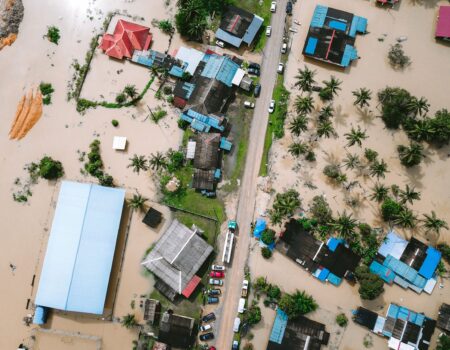
I was six years old when death first visited my village. The Village priest said Idututin was cursed and the gods had to be appeased. A few years later, everyone knew it was because of what was called the Oil spill. In the city, they wrote about it in what I now know as Newspapers. Black oil from the earth seeped into the waters and sucked life out of it. The river poisoned its own treasures, dead fish washed ashore, their bellies burst open, innards facing the sunshine. According to the Village priest, it was no cause for alarm. “A simple sacrifice will do,” he said.
The King declared a ceremony for the gods. Seven virgin heads were to be offered to the Goddess Ekabasi, and so it was. No one was to complain, not even the families of the “chosen ones” whose heads were mounted on a spike and left to rot for twenty-one days in the sun. My mother’s friend’s daughter, Inem, who had the sun in her eyes, the voice of a silent evening and a spirit bright enough to light up the entire village was one of them. They lived at the outskirts of Idututin where corn grew everywhere, like weed. Whenever she and her mum visited, they brought bags and bags of corn and pear, and she would braid my hair and tell me the gods had blessed my head. “Such full, rich hair, Ekaette. You’re such a goddess.” Inem would say, and then start to sing, her voice hypnotising the evening. The last time we met, she didn’t braid my hair. She only watched me from afar with an unmistakable sadness in her eyes. She didn’t sing. She didn’t call my name, Ekaette. She simply stared at me, as if she knew that would be the last time and turned away. That must have been the day she was taken to the village priest, her head placed over the royal guillotine and severed. I wonder if the Goddess heard her voice. Only a heartless being would hear her and not show mercy. The next day, we heard Inem’s mother, whose name was Idara, who we came to know as Mother of Inem after the birth of her daughter, after the death of her husband, drowned herself in a river. My mother didn’t eat or talk for another week and when she slept, teardrops trickled from her eyes. My father tried to pacify her. I didn’t fully understand, little me, still grappling with my world and its treacherous ways. Since then, I’ve never had braids.
Nothing happened. Seven virgins and nothing. The village screamed for the Goddess’ mercy. But the sun never kissed our hills first again. It was as if Ekabasi had turned away from us and left us to face our doomed fate. The earth grew stubborn, the Obolo River blackened. When my father would go to the farm to harvest yam or cassava, he would reap shrivelled tubers. Diseases spread like wildfire, the priest did more sacrificing and the earth grew drunk with blood. The supposed cleansing didn’t stop the plague, and it wasn’t long after this that it found its way to my household.
“The land is poisoned. Nothing I put in the earth grows anymore.” Father said to Mother one evening, his face creased with worry. I eavesdropped as both of them talked in low tones just outside the hut. My father hardly complained about anything, so I knew all was not well.
“Ekabasi knows our troubles, the great Mother will come to our aid, don’t worry my husband,” my mother had replied. In these times, I admired her faith. “Your daughter and I will make you maize porridge.” I didn’t like cooking, would normally complain about it and run off on some errand, then return two hours later to face my mother’s wrath. But on seeing the terror in my father’s eyes, I joined Mother to cook his favourite dish with all of my love. As we sat outside with a crescent of the moon filling our plates, our laughter suffusing the evening, he told me tales of Sito and Debende, two young women who restored their family’s honour; that night he reminded me of my responsibilities as the first daughter. Mother had slept off long before then.
Father died shortly after Asatmmong, my brother was born. The land had poisoned him too like it did to the yam, the cassava and the fish. I could not imagine my father, who once killed a python with his bare hands, a man who, when he spoke, made the very earth tremble, give in to the weight of the world. He died in my arms in tears thick as blood. I knew things would never be the same. My mother grew old suddenly before my eyes, as if Father was the fountain of her youth. She was still a woman in her prime, but her skin wrinkled overnight, her veins twisted, and her egg face now sagged like an old woman’s breasts. Father named my brother, Mboutidem, when he was born because he had faith that all would be well, that even if he wasn’t around to see things go back to normal, they would one day. On his deathbed, while shedding tears, the only time I saw my father in tears, he took my baby brother in his arms and spoke his name in one final breath. Mother, after watching our only hope slip away, changed his name to Asatmmong, because he came at a time when the oil in Obolo River killed everything.
I had come of age, swiftly. When a girl starts to see her monthly visitor where I come from, they say she is ready to know a man. My maternal grandmother, Ama, was more than ecstatic. “It would be the end of all our troubles,” she said. There was a big man who lived in a big city far away, he was a relative of the King and worked in a big company. Everything about him was big, even his name. They called him Babantan, and he had married three wives already. I, Ekaette Okon Effiong of Idututin, would be his fourth. I got to know of this while listening to a conversation between Grandmother and my mother while cooking in the kitchen, something I had to learn properly as a to-be wife.
“Mama, no o. She’s only a child,” Mother said to Ama.
“Oh. Not so much anymore, she’s now a woman, don’t you see. She bleeds, nko ntro?”
“Mama, but…”
“But what ehn, my daughter? You can barely take care of your children, and you know it’s next to impossible for you to remarry. Take a look at your son, he’s as thin as a broomstick and has never had a proper meal since he was born! Iya mmi! My God.” Ama says this wailing in tears, tying and retying her wrapper, pointing to the withered stalk that is my brother. Asatmmong points back to her, giggling. I think of how unburdened children are, oblivious of the world’s difficulties, and for a moment it is not pity I feel for him, but envy. I wish I could be a child again, a wildling free of responsibilities. Grandmother leaves the house after this.
Mother called me from the kitchen two days later to let me know a date had been set. She had given her consent for the marriage.
“Ekaette mmi, the goddess has turned her back on us. The river grows darker, and the sun no longer shines on Idututin. The earth too has grown stubborn.” She bursts into tears in a manner so explosive I begin to cry too.
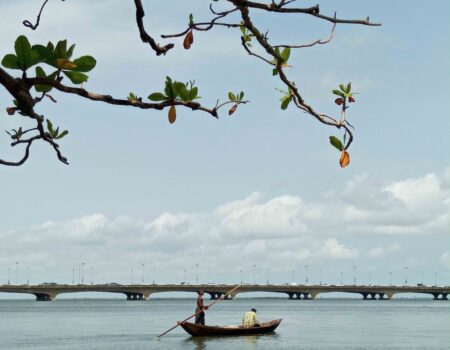
“Don’t do it for me,” she says in between a sigh and a shiver. “Do it for your brother. I can’t bear to watch him die. I’ll never forgive myself.” She says this on her knees, her eyes swollen with tears. It is not a common thing to see Mother beg. At this point, I think about Father, if only he was here to stop the hijacking of his daughter’s life. He always said, “don’t let them break your spirit,” but he also spoke of responsibilities. I recall the story of Sito and Debende and other tales by the moonlight of a daughter’s valour. I was the only saviour of my family now, and my brother’s lifeline. With my life rushing by like the wind, I needed to pause a minute to process everything. Where better to do this than the Obolo River where the wind halts to caress ebb and tide, where dreams unbridled set sail? For a moment, with my feet licking the shores, I think of Idara and the comfort of just giving up. The sea feels like home, my tangled hair billowing in the breeze. An aliveness cradles my heart. A whispering echoes. This is home. This is home. I think of the weaving of braids and the voices with them, at first calming, and then unbearable. I think of Mother, brother, Idututin vanishing behind me as something unnameable pulls me under.

Inimfon Inyang-Kpanantia
Inimfon Inyang-Kpanantia (he/him) is a Nigerian writer of Ibibio origin, winner of the WNDRRNG prose contest, and finalist for the K and L Short Story Prize for Africa and the Awele Creative Trust Award. He was longlisted for the Commonwealth Short Story Prize for Africa (2022) and is an alumnus of the Mo Issa Writing Workshop (2025) and Everlit Creative Writing Workshop (2026). His work has been published in Isele Magazine, Flame Tree Press, TSTR, Kalahari Review, Yours Poetically Mag, NND, BPPC and elsewhere. When he is not writing, you’ll find him confabulating with his three alter-egos. You can reach him on X: @inyang_k, and Instagram: @inyangik.