Life is a vast expanse of land on which the human existence is planted, manured by generous quantities of feelings and experiences. These experiences and feelings are unquantifiable, yet somehow connect all humans such that there exists the possibility of one person finding themselves in another. One of the fundamental aspects of poetry is its ability to explore the networking of even the tiniest of these experiences, and through them, ascertain the true nature of the human existence. A poem must engage intimately with these human experiences such that, as William Wordsworth puts it, it becomes the spontaneous overflow of powerful feelings, taking its origin from emotions recollected in tranquillity.
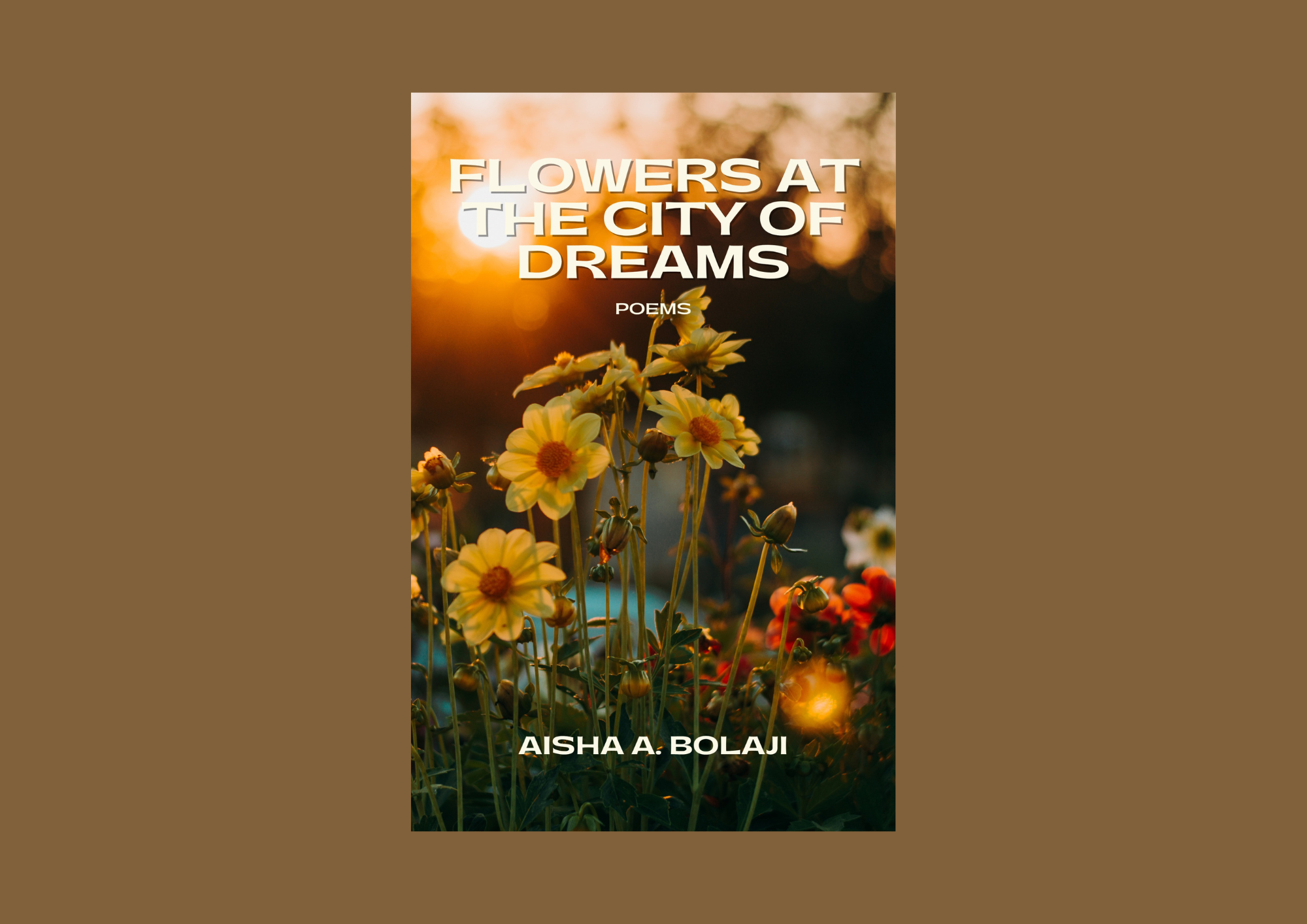
This is what Aisha Bolaji achieves with her collection of poems, Flowers at the City of Dreams (Witsprouts Zintle, 2025). She approaches the subjects of love, nostalgia, memory, dreams, pain, loss, grief, and many other feelings and experiences; with a palpable tenderness. The poems move through various emotional and philosophical layers, as observed in the works of Ocean Vuong, Warsan Shire, and Romeo Oriogun, particularly in their shared fascination with tenderness, pain, displacement, and grief, among other subjects. But Aisha’s technique is distinctly philosophically restless and deeply invested in transforming otherwise ordinary human experiences and emotions into vast landscapes, on which, as I mentioned earlier, the human existence is planted.
In Stranger Things (pg. 2), the poet uses light to symbolize intimacy, warmth, and emotional certainty, which eventually fades away through the transition from public light: All the blue lights down the road / have gone off…, to personal light; and the pale glow / of our skin, now like the white lights / of the same street, gone. This transition collapses the divide between the poet-persona’s emotional state and the environment — things she had previously been familiar with. There is also a philosophical tone to it: a memory is only a memory if it’s good / Every other mind-string is a regret. The metaphor ‘mind-string’ is admirably inventive and does well to frame memory as something pluckable — like stringed musical instruments — and capable of producing emotional reverberations. All through the collection, the mother-persona struggles with various forms of loss, from physical to emotional losses. We encounter one of these in the above-quoted poem: my mother is really still trying to / call my father back home / my father is still trying to remove / his thoughts from our lives. As simple as this excerpt is, it tells strongly of the devastating experience of a mother attempting to restore what she has lost and the father’s keenness on sustaining her loss by erasing himself. Whether intentional or not, the unusual comma placements (…is really, still trying to; my father, is still…) slightly interrupt the rhythm in a way that reflects emotional instability.
Aisha also does well in describing mortality and existence through thoughtful imagery and metaphors. In Silence of Dead Things (pg. 4), she writes: the body is a field of flowers, nourishing / light as the sun slowly dips its glow / into the silence of things. The opening metaphor presents the body as an organic entity, symbolising beauty and mortality, blossoming for a while and eventually descending into silence, the kind that signifies death. The poem also creates sharp paradoxes often encountered in existence: I am an honest lie… and later, I am half honey, half lemon… These contradictions reflect the complexities of the human existence, suggesting both a self-awareness within deception and the bittersweet nature of existence. In this poem, Aisha also touches on a subject which I have lately taken an interest in: the connection between the living and the dead. She writes: — the way life is / A black box at the intersection of busy roads, / Filled with the noise of living, / And the silence of dead things. What she does here is to brilliantly juxtapose chaos (…noise of the living) and stillness (…silence of dead things).
The author also interrogates why pain and suffering exist in a world that, from an angle of faith, is supposed to be governed by love, or precisely, God’s love. In A Million Reasons Why (pg. 8), she stylistically interrogates the paradoxical relationship between pain and love by merging words like ‘soft,’ ‘kissing,’ and ‘love,’ with ‘knife,’ ‘spear,’ and ‘sins:’ — another thousand / for how it swivels the inside / of your heart like a soft knife / kissing a wounded skin. The imagery here is tactile and even unsettling in the way it presents pain as an almost affectionate feeling. Also, Aisha tilts towards a religious angle in which she portrays faith as vulnerable to pain: there’s a million ways to push / a blunt spear into a faith / almost covered by the dust / of sins. The ‘dust of sins’ suggests spiritual erosion, while the ‘blunt spear’ suggests prolonged suffering rather than quick destruction.
In Towards Home, Towards Home (pg. 10), there is an intimate mediation on belonging and hope. The poem, with its prayer-like narrative, leans more toward optimism, even as it retains, in small measure, the awareness of fragility evident in many poems across the collection. A line from the poem reads: may whatever kindness I place into the world / find its way back to me… The poet-persona does not seek wealth but kindness. Also, the poem frames life as temporary, populated by individuals who move in separate directions: and though life is a fickle affair / between strangers carrying different dreams… Yet, despite the fragmentation of the human existence, the poem reflects a yearning for a collective return: they turn their heads towards home — towards home. Home, here, transcends physical location and suggests a space where all of humanity find their rest.
Through feministic lenses, Aisha emphasizes on the autonomy of the female body. In A Woman Has Many Names I (pg. 13), the poet asserts strongly on the identity of women coming from within themselves rather than from external notions. The poem insists on the female self as an internal reality that already exists, independent of societal constructs or external validation. In an uncompromising language, it begins with a critical opening: it is awful that men believe / they have anything to say about a woman’s body… It goes further to lament how opinions have transformed into social authority: their opinions of us have hardened / into communal facts — prescriptions / for who we should be. The author also skilfully portrays femininity through vivid imagery, as seen here: I am all honey and tenderness / all flowers and rosy lips / with legs strong enough to break a dance floor. What we observe here is a striking juxtaposition in which femininity is placed alongside physical strength, challenging the prevailing perception that the two cannot coexist.
In a calm conversational tone, Aisha writes about love in Love is a Miracle (pg. 24), in a way that connects personal perception of love to a mother’s lived experiences: I will not say this with many regrets: / I know love like the back of my neck —; / my mother, a woman who knew / all the places maps never named / in her hometown, would tell me / about the day she met my father — / how love, like destiny, happens / because it must.
In Nostalgia (pg. 27), Aisha composes an ode to nostalgic love. Her repeated use of ‘to’ as a structural anchor works well, as it gives the poem an incantatory rhythm. The poem is littered with beautiful imagery: to love like roots stretching / through the pulse of the earth’s veins; to handwritten love notes — / how, in the calligraphy of beautiful things, / my heart is italicised / in the comfort of your swift lettering.
In I Worry Too Much About the Wrong Things (pg. 37), Aisha reflects on the national anxiety and the emotional burden that comes with it. The poem does well to sustain the sense of fatigue through the repeated use of ‘tired,’ effectively creating a rhythm of emotional burnout. It captures both personal and national distress: I’m tired of burning and holding unto / the loose ends of a country on fire.
The collection achieves a high mark with the poem, The Theory of Physics (pg. 61). Here, Aisha proves to be an ambitious poet. The poem relies heavily on physics-based metaphors in describing the emotional weight of love and suffering: the law of physics is set / on the principle that no matter / how light an object is, when / held for a long period of time / the hand gets tired. Flowers at the City of Dreams stands as a very clear and coherent work of art that touches intimately on numerous aspects of the human existence, carrying with it a consistent philosophical and intellectual weight. It trusts so much in metaphors, and for the most part, this trust is rewarded. The language is intimate and malleable, being twisted into several forms through layers of imagery. The author writes with a striking sensitivity to rhythm and imagery, subtly collapsing the boundary between human and metaphysical spaces. The collection succeeds because it confronts emotions through diverse lenses, thereby positioning Aisha Bolaji as an important voice in contemporary poetry.

Chukwuemeka Famous
Chukwuemeka Famous is a Nigerian writer whose short story ‘Oyinbo’ was shortlisted for the Pack Light Writing Contest. He has also been a finalist for the Quramo Writer’s Prize in 2020, was longlisted for the Bold Call Writing Contest in 2022, and was nominated for the 2022 Young Writers and Creatives Award. His debut novel, We Will Live Again, was published by Griots Lounge Publishing in 2023. More of his writing has been published in the anthology Pack Light: Memories of Growing up in Africa, Ibua Journal, The Shallow Tales Review, WSA Magazine, and elsewhere.