![You are currently viewing [Featured Post] Griots and Bards: Conversation Will Build Healthy Society](https://jaylit.com/wp-content/uploads/2026/01/GAB-e1768258615777.png)
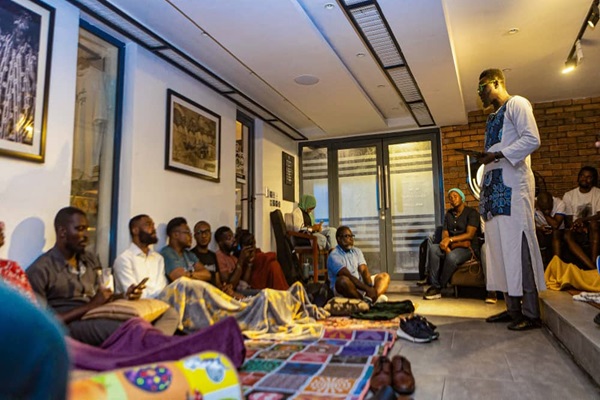
In one little corner of Ikoyi, a community of creatives and professionals, Griots and Bards (GAB) is building a narrative of emerging healthy society. The attendance is a personification of industry meet-ups. A crop of white-collar workers milling into Rap Joint Lagos on Norman William Street, Ikoyi, at 5pm on a Thursday. Really? In the same work-bedraggled Lagos? The body is making a case. There must be something integral to the substance of their being that brings them to the village square. Believe me, Lagosians are not so jobless.
Imagine a gathering of busy, big men and women for conversation reasons. This should debunk our erstwhile assumption that the demography of working Nigerians only unwinds at owambes. It is either that or any strand of hedonist indulgence that purges the mind of work configuration. But here are your journalists, doctors, accountants, musicians, engineers, IT experts, fad maestros, managers, architects and so on unboxing the mind for a fireside chat. Certainly not because they want to evade the next item on their desk.
GAB is a crib for discussing contemporary social issues on a polemic ground. There is no pervading topic that eludes the grasp of the lived and shared experiences of the house. Stories have always lived with us, but we have always been masterminds of impressionable approaches to telling them. Conceivable still is the straitjacket of immediate circles. It thus becomes imperative here to allude to James Baldwin’s submission that our deepest social distresses have their replica in antiquity. But GABites are no novelists. Rather, the setting of the house re-imagines the traditional village square where an elder straightens the child’s crooked perception of their immediate environment under a moonlit sky. Here, everyone is the elder; everyone is the child. Again, there is no folklore but our existing topics of unsettled intra and interpersonal bottled-up conflicts.
GAB is a therapeutic moment to reflect and discuss. The heavy atmosphere of meditation that descends on the house is usually unforgettable. Talk of reflection. Someone in the corner of the room is a repository of a scenario you have carried about, wondering whether sensibility will absolve you someday. And yes, it miraculously does on one Thursday evening! Unprecedentedly. Perspectives give way to opinions, opinions to facts and facts to reality. All that while you are gradually getting to understand that for every of your own remote experience, a larger drama has preceded it. And you begin to make the necessary emotional recalibration – reconciliation, sobriety, contrition and perhaps forgiveness. You make a mental note to loosen your grip on resentment, if need be, because you see that you are in a world whose evolution, by default, may offend your disposition.
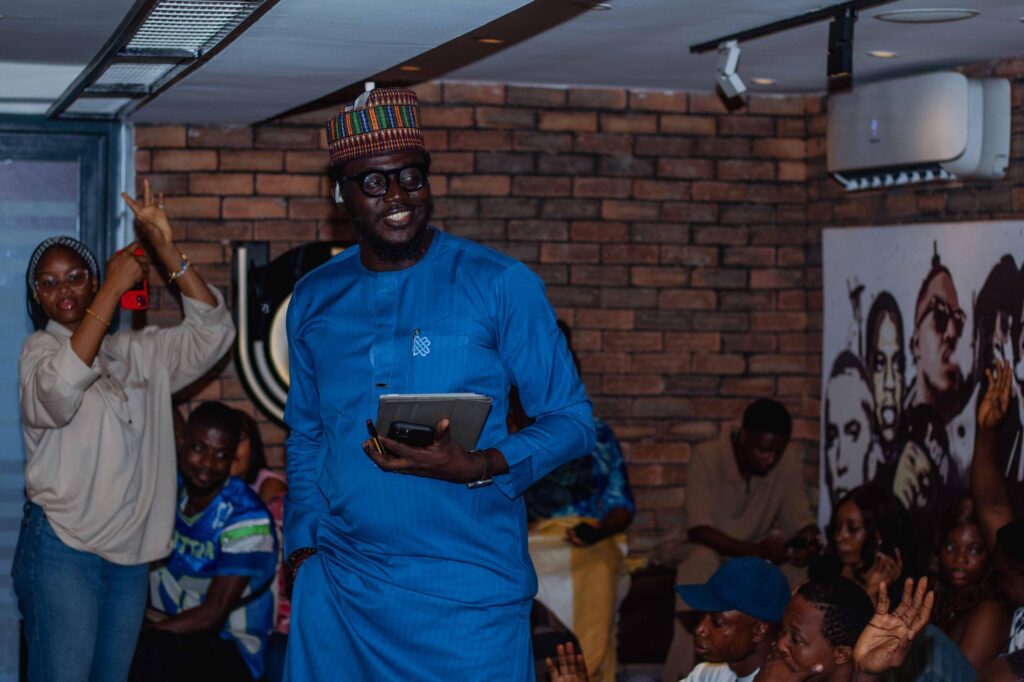
Ah, Adebola Afolabi (RezthaPoet Afolabi) deserves the salute of a general. I like to fondly believe that when he started GAB a few years back – most likely with just a handful of like-minded individuals –, he saw the challenges ahead of official jamajama. He knew that industrialisation and its demand for ‘9–5’ labour was surreptitiously expelling the culture of bildungsromanic conversations. Also, that the pleasures of assimilating the structures of the tortoise’s philosophical escapades was being undermined by the composite need to hustle harder. Yet conversation is central to invigorating interpersonal relationships and finding companionship in distressful times. So, he clutched that vision of a village square therapy space with a view to providing the necessary respite for the ‘mechanised’ mind. We cannot all be poets, playwrights and novelists but we are conditioned into states whose adaptation has a rounded implication on how we conduct our everyday life. Hence the need to feel the GAB atmosphere advisably at least once in two months.
As I prepare to bring this impression to a close, let me add that GAB also enlivens the room with electrifying artistic performances: poetry and music. The artistes have the genius to continue the momentum set in motion albeit by gracefully seating the heated passion. Look, let us give this GAB its accolade for bringing mind and soul this level of luxury. GAB has achieved what is impossible to achieve in a regular modern society gathering: using performance and conversation to champion a healthy demography of working Nigerians. Yes, I have made a survey of such events and found that besides the choice of the individual to be critical, this harmony is impossible to achieve even by our most feted art festivals.
Summarily, GAB is the lighthouse of interpersonal social healthiness in our industrialised world today. It brings an entirely fresh perspective on the notion of relaxation. And more interestingly, it bridges the generational gap of true community. It achieves the comprehensive signification of folk tradition of work-life order without the glitches our time. Think of GAB as a heritage of communal sound-mindedness.

Kehinde Folorunsho
Kehinde Folorunsho is a literary critic and a scholar of literature. His interest in literature spans poetry, visual arts and translation studies. He made it to the shortlist of the Atẹlẹwọ Prize for his Yoruba translation of Chimamanda's Ngozi Adichie's "We Should All Be Feminists"; shortlisted for the Gbemisola Adeoti Poetry Prize, 2025. As a book reviewer, he has been published in local newspapers. He is the recipient of the 2025 Ken Saro-Wiwa Prize for Book Review.